
An unusual DIY pot or kokedama
Content
Description and general characteristics
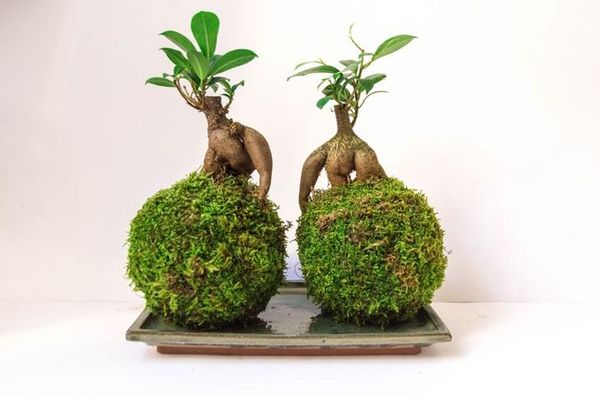
While kokedama is known to have originated in Japan, it was China that popularized it as an art form. It was in China that the practice was given its name, which translates as "moss ball." The name perfectly captures the essence of this garden decoration: kokedama is a peat ball entwined with roots and decorated with moss.
Kokedama is often compared to the ancient technique of bonsai, as in both cases, a houseplant is cultivated by hand using a specific set of practical methods. However, bonsai requires a special container. Furthermore, bonsai requires a woody base that is cultivated over a long period of time.
Bonsai is a more expensive practice, while kokedama does not require special containers and is easier and less time-consuming to make. Moreover, any plants can be used as a base (for example, lavender, liana, orchid).
Video: How to Make Cockadema Yourself
This video will show you how to make a cocadema yourself.
Self-made
Of course, China, as a country with rich traditions and numerous cultural and aesthetic schools, also has schools specializing in kokedama making. These schools complement their practices with spiritual tenets and teachings. However, we won't delve into such details, but offer you a simple and straightforward master class on how to make this plant-based decoration yourself.
Preparation and tools
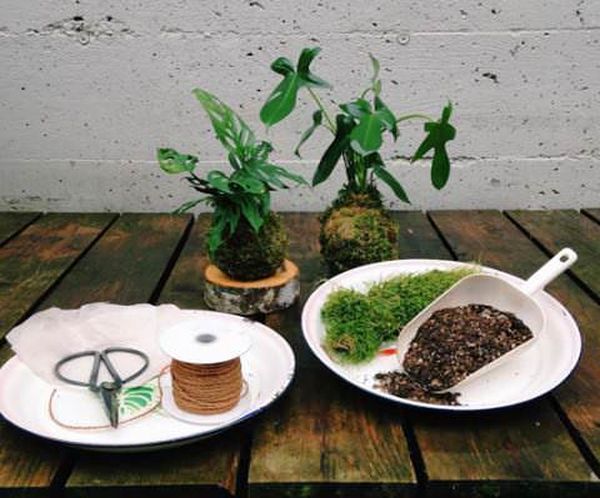
To make a kokedama with your own hands, first of all, you need to acquire all the necessary materials:
- Two-component peat. Keto peat is used in traditional plant growing. However, it's difficult to find in our country, but it's easily replaced with two-component peat. The mixture consists of two elements: high-moor peat and black cosmetic clay. The first component can be purchased at a flower shop, and the second at a pharmacy or beauty supply store.
- Akadama. A special bonsai soil consisting of granules. It's best not to substitute it with anything else; instead, purchase it from specialized bonsai stores;
- Sphagnum moss. Most often found in humid conditions, it can be purchased at a store or collected yourself;
- my green one, which will be useful for decorating the root ball;
- Plant material to use as a base. Choose the material depending on what you plan to use for the root ball—a kokedama for an orchid or fern would make a beautiful home decoration;
- Additional materials: cotton thread, scissors, containers for mixing ingredients, gloves, thin fishing line.
Manufacturing process
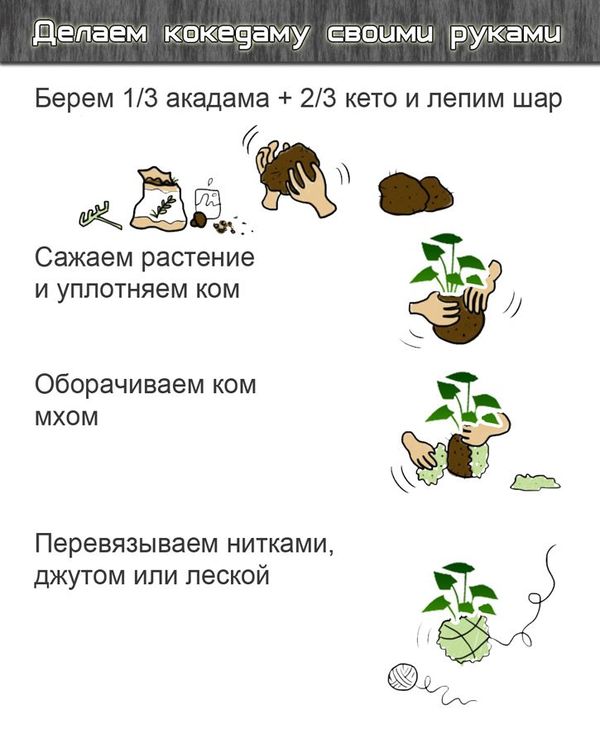
Before beginning the actual manufacturing process, you should prepare the individual elements—green moss and akadama. For the former, wash it, clean it, and store it in a dark place for a while.
Akadama is placed in clean boiled water for 24 hours and given time to soak up the moisture, and then the water is drained.
In addition, not only akadama, but also sphagnum are soaked.
Next, you need to prepare the soil. To do this, take 2 parts peat, 2 parts clay, and 3 parts Akadama, and mix everything together until it forms a solid paste.
The roots of the plant to be grown are washed and covered with sphagnum, which is secured with threads.
Then, we form a ball of soil around the resulting lump, forming it like a "snowball," and then wrap it in sphagnum moss. This is then tied with rope, and a third layer is made of green moss. The whole thing is then wrapped with fishing line.
Soak the kokedama in water for 15–20 minutes. The kokedama is ready!
Nuances of further care
Caring for the resulting plant is simple: weekly soaking in water for 15–20 minutes, frequent misting, pruning every 14 days, and fertilizing by spray. Since kokedama is often used as an indoor hanging decoration, be careful when watering to avoid spills on household items.