
Secrets to Proper Apple Tree Care at Your Dacha
Content
Top dressing
Of course, caring for an apple tree should begin with choosing the right fertilizers for each season, as your tree goes through several stages of development each year—from budding to winter dormancy. If the soil in which the apple tree grows is fertile and rich in nutrients, less fertilizer is required. However, if the soil is poor in nutrients, the amount of fertilizer should be significantly increased to ensure the tree doesn't lack essential elements.
Spring
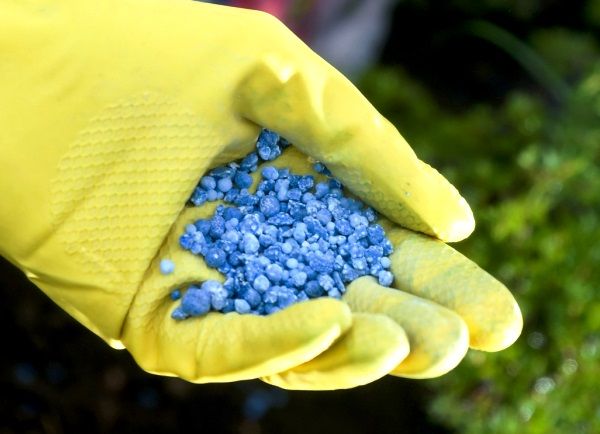
With the arrival of spring, apple trees prepare for bloom, so care should be aimed at stimulating growth and providing the tree with energy. The first fertilizers are applied when the leaves emerge. If the soil around the trunk is well-moistened, fertilizer can be spread near the trunk, where it will be absorbed by the moisture and saturate the tree. Some claim that crown treatments are helpful during spring apple tree care, but this must be done very carefully, diluting the fertilizer generously with water to avoid burning the leaves.
Fertilize apple trees a second time when the first flowers appear, as the tree needs to replenish its energy. For every 10 liters of water, you can add superphosphate (100 g), chicken manure (up to 2 l), and urea (up to 300 g).
After flowering, you should feed your trees with sodium humate or green fertilizer, which is easy to make yourself (place the grass in a large container, fill it with water, cover with polyethylene with holes made in it and leave it for 25 days).
Summer
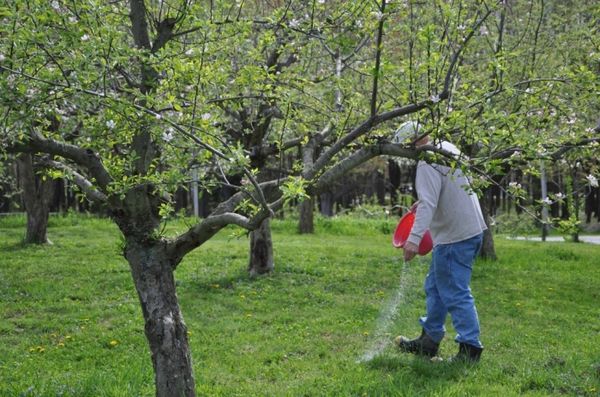
During the summer, care for your apple trees by fertilizing them with mixtures containing nutrients such as phosphorus and potassium. Fertilizer should be applied frequently, approximately every two weeks.
In June, it's recommended to apply urea, but not to the root system, but to the crown by spraying. Naturally, if the summer in your region is rainy, it's better to apply the fertilizer to the root zone to ensure your efforts aren't wasted.
In the second month of summer, feed your trees with supplements containing phosphorus and potassium. It's also recommended to spray the plants. Don't forget about nitrogen fertilizers, either.
Autumn
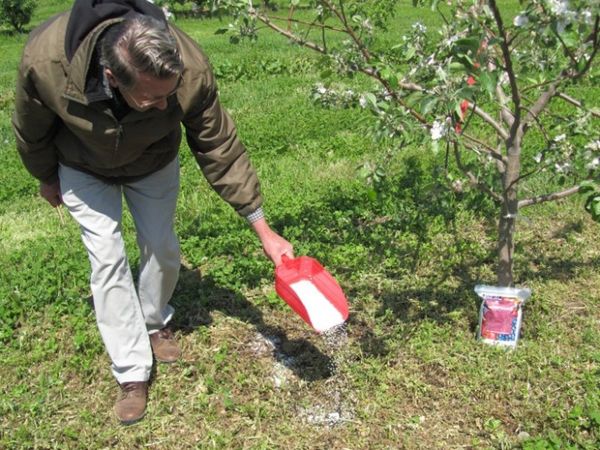
At this time of year, you should focus on fertilizers that will nourish the plant's root system and help it prepare for winter. You can buy a ready-made potassium-phosphorus supplement, or you can make your own. You'll need 1 tablespoon of potassium, 2 tablespoons of double superphosphate (granulated), and 10 liters of water.
Watering
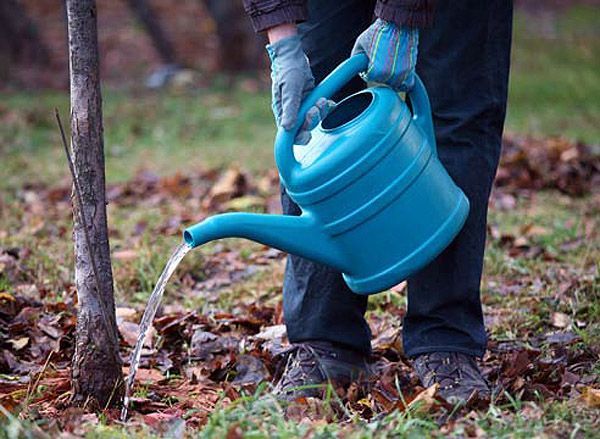
Apple tree care includes timely watering, but it's important to remember that excess moisture is just as harmful as too little. If your site is located in a region with normal climate conditions, watering three times a day will be sufficient: during flowering (June), during fruit ripening (first half of July), and before frost (October).
If you live in regions where droughts occur frequently, you can increase the frequency of watering.
Water for irrigation should never be cold; its optimal temperature is 18–25°C. Furthermore, as the apple tree grows, its water requirements increase. Young trees will need just 5 buckets of water, while older trees will require 7–10 buckets. A few days after watering, it's recommended to loosen the soil to ensure oxygen reaches the plant's roots.
Trimming
Timely pruning ensures the quantity of the harvest and normal growth of trees, which is carried out to ensure that new shoots do not lack sunlight.
Thus, in mid-spring, crown shaping is performed, and in summer, all excess shoots that could prevent the main "fruit-bearing" branches from receiving sufficient light are removed. In autumn, this procedure is performed to rid the plant of dead branches and remove non-fruit-bearing branches.
Crown formation
There are several methods for shaping the crown. The most popular shapes for small plants are the tiered, loosely arranged form (the plant retains its natural appearance) and the spindle-shaped form (a single large shoot with central shoots branching off). These are the easiest to create and help maximize the yield from a single tree.
To boost the plant's immunity and accelerate its growth, a cup-shaped form is chosen, but for apple trees planted at the edge of the garden, a vertical palmette is suitable, with the help of which the trees are transformed into a natural fence.
Rejuvenation
This procedure is aimed at opening up the tree's center as much as possible. The central trunk needs to be shortened (by a third), and then the denser areas need to be thinned out.
Pest control
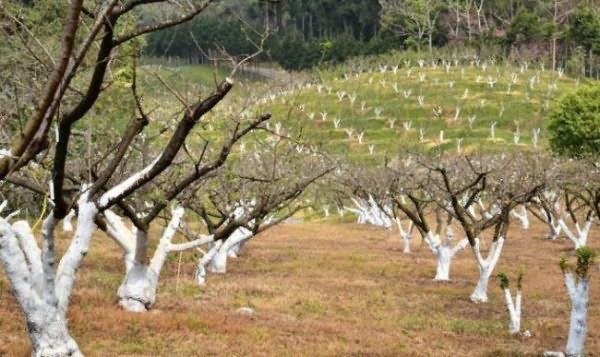
Apple orchard maintenance involves protecting against insects, which is achieved by installing sticky traps. To prevent various diseases, chemical treatments (such as Decis and Fufanon) are used before bud swelling, and bacterial treatments (such as Lepidocid and Akarin) are used after flowering.
Preparing for winter
Apple tree care in the spring and summer is aimed at stimulating growth and increasing yield, but with the arrival of autumn, it's important to ensure the trees survive the winter. So, what should you do?
- carry out autumn pruning;
- remove all unwanted elements (moss, lichen) from the trunk;
- whitewash the trunk;
- remove fallen leaves;
- Dig up the soil around the tree trunk and fertilize it.
Video: "Proper Care of Fruit Trees"
This video will teach you how to care for fruit trees in your garden.