
Features of spring cleft grafting of apple trees
Content
Pros and cons of cleft grafting of apple trees
Sooner or later, every gardener faces the question of grafting a garden tree. Why is grafting necessary? There are many reasons: poor fruit production, insufficient flavor, a small garden (this is especially true for farmers who graft different varieties onto a single tree), rejuvenating a fruit tree, etc.
Apple tree grafting can be done year-round. However, spring or summer is considered the most successful season. Why do farmers often recommend spring grafting?
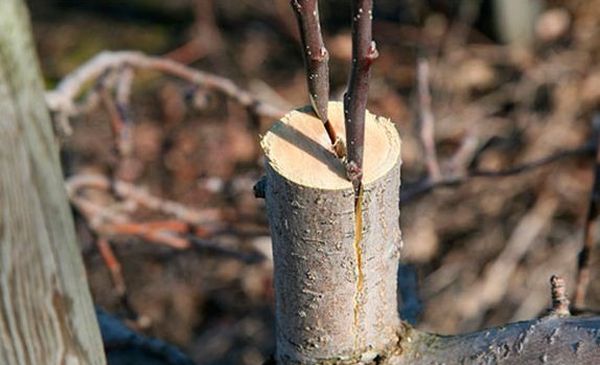
This period is characterized by active sap flow, which promotes faster establishment of the new branch on the "old" tree. If an attempt in early spring is unsuccessful, the tree can be grafted again in May. Some gardeners advise waiting until the second stage of sap flow, which occurs in mid-July, and only then attempting again.
Remember to follow the key rule: grafting apple trees in spring or summer is only permitted when the average daily air temperature has not exceeded 15 degrees Celsius. Cleft grafting is very popular among both experienced and novice gardeners. Why has this method gained such widespread popularity? Let's look at some examples of its positive and negative aspects.
The advantages of cleft grafting of apple trees include:
- good efficiency, that is, according to research data, the percentage of survival of the grafted shoot is very high;
- ease of implementation;
- low time costs;
- It is successfully used when other methods and techniques cannot be implemented (for example, when the rootstock is damaged or when the tree bark is eroded);
- the possibility of using both fruit-bearing apple varieties and overgrown wild apples as rootstock.
The disadvantage of this method is:
- There is a high probability of a small growth forming at the grafting site (this occurs when the scion and rootstock are not very compatible), but after a certain period of time it will resolve.
Step-by-step instructions for grafting
How to graft an apple tree in spring? To successfully complete the procedure, you need to familiarize yourself with the process. What to graft onto, what timeframes to follow, and what tools are needed—we'll cover these and other questions in this step-by-step description of spring cleft grafting of an apple tree.
Necessary tools:
- rootstock without any signs of diseases typical for fruit trees and insect pests;
- scion (a pre-selected and prepared cutting of the desired apple variety);
- garden knife;
- budding or grafting knife;
- garden saw;
- elastic electrical tape or thick polyethylene film;
- garden varnish used for protective treatment (as an alternative, oil paint based on drying oil with the addition of copper sulfate particles can be used).
Step-by-step instructions for grafting a fruit tree will help you avoid mistakes during the process:
- Preparing the rootstock involves cleaning it from dirt and other defects, removing the rough layer of bark, and cleaning the area for splitting.
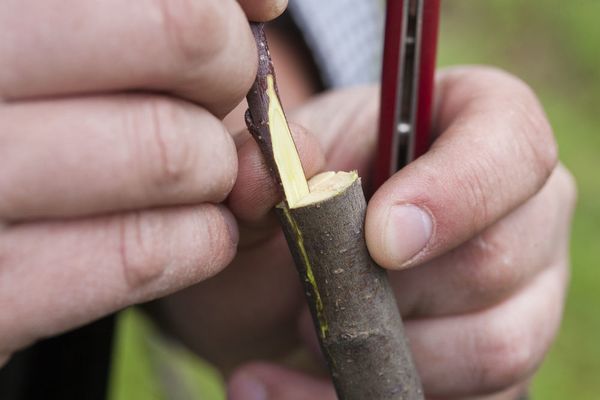
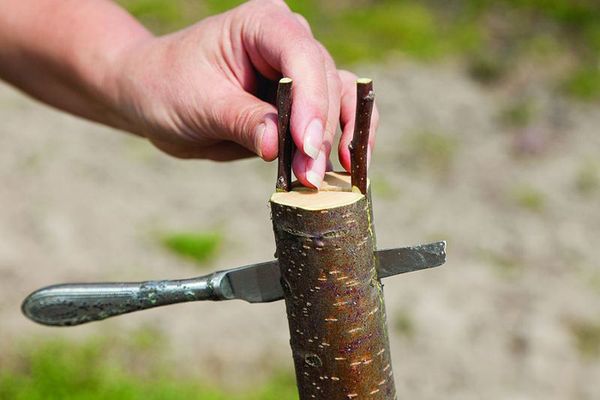
- Splitting the rootstock. For small branches, you'll need a sharp garden knife to make a 2- to 4-cm-long cut. If the branch is wide in diameter or a stump, a knife, garden saw, or a small hatchet will be useful. To prevent the split from closing, insert a wooden wedge into it. The cut should be approximately 7 cm deep.
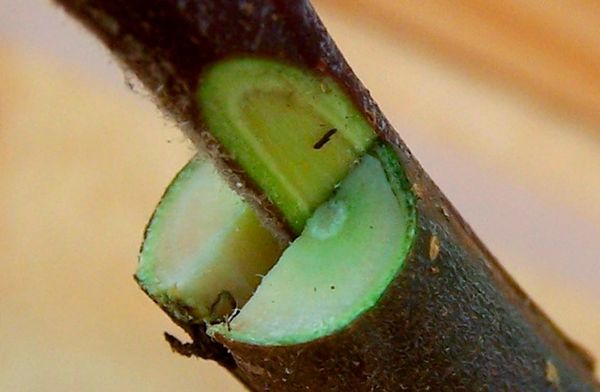
- Preparing the scion. The scion must have at least three buds. Avoid touching the cut with dirty hands to avoid infection.
- Joining the scion and rootstock. By joining the cambial layers, insert the prepared scion into the split of the rootstock.
- The final stage, or protective layer, is the final step. The surgical site is tightly covered with plastic film or elastic tape, and then generously coated with garden pitch. These procedures provide reliable protection against various infections and harmful insects.
To cleft graft an apple tree, you don't need any special skills or abilities; just follow the recommendations of more experienced gardeners.
Video: "Spring Grafting of Apple Trees"
This video will show you how to properly cleft graft an apple tree.