
When and how to properly prune columnar apple trees
Content
Why prune columnar apple trees?
There are no strict guidelines for the care and pruning of this type of apple tree, so it's up to the gardener to decide whether to prune columnar apple trees at all. The genetic makeup of these trees is such that, upon reaching a height of 2.5–3 meters, they stop growing, and their crown becomes pyramidal, similar in shape to cypress or poplar. If this is acceptable, you don't have to interfere with the tree's natural growth process, limiting yourself to periodic removal of excess young shoots.
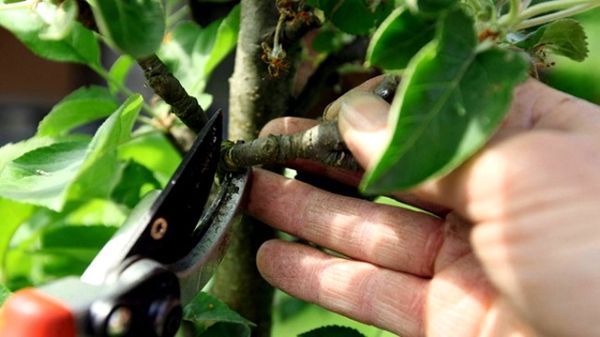
However, experienced gardeners strongly recommend forming a columnar crown, as this procedure has a number of advantages:
• by removing excess unproductive shoots, the nutrition of fruit-bearing branches improves, thereby increasing the yield;
• replacing old branches with new ones allows you to rejuvenate the tree and prolong its fruiting;
• you can form the crown of the desired shape, giving the tree a more compact and attractive appearance;
• regular thinning of branches prevents them from getting tangled;
• thanks to the abundance of sunlight, the fruits ripen faster and become sweeter.
Moreover, there are many known cases where, without formative pruning, a columnar apple tree turned into a dwarf tree with a normal branched crown.
When to prune
Caring for columnar apple trees includes 3-4 scheduled prunings throughout the year, since the trees grow quite intensively. Spring and fall pruning are, of course, the most important, but experts say winter pruning is preferable. Also, shaping a columnar apple tree is impossible without regularly removing the young green shoots that grow from the central trunk throughout the summer.
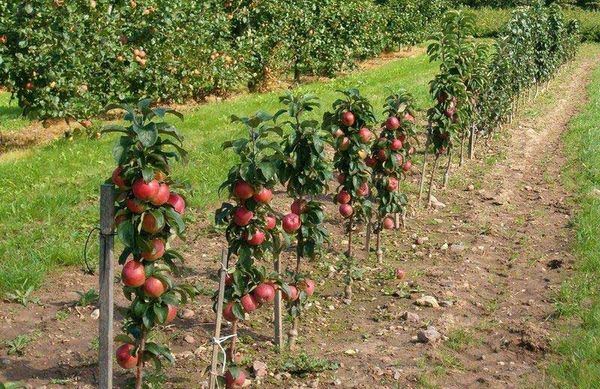
This procedure can hardly be called pruning, as the shoots are easily removed without pruning shears, simply by pinching them off. The correct method for pruning a columnar apple tree also depends on the tree's age. For young apple trees, this procedure is especially important, so shaping should begin in the first year of planting. The pruning pattern looks something like this:
• one-year-old shoots should be shortened by 2 buds, but so that at least 2–3 buds remain on each shoot – young shoots will appear on them next year;
• in the second year, you need to identify and shorten horizontal shoots whose height exceeds 30 cm - vertical branches extending from the trunk remain for future fruiting;
• in the third year the procedure is repeated, but in addition the fruiting shoots are removed;
• in the fourth year, all last year’s branches are thinned out and excess ones are cut out, leading to thickening of the crown.
Thus, apple trees only become fully formed in their fifth or sixth year. In subsequent years, scheduled pruning is carried out, each with its own specific characteristics.
Features of spring pruning
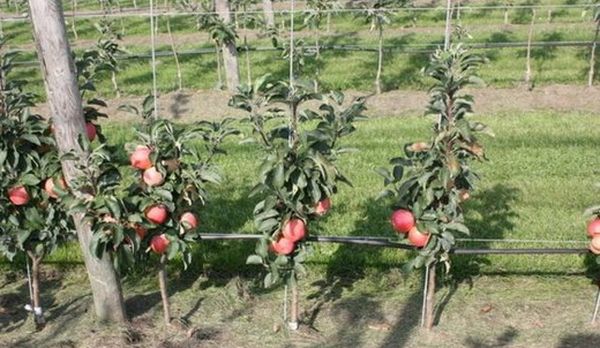
This should be done in mid- to late March, before the sap begins to flow. Spring pruning is primarily about shaping the crown, so it's a key step in preparing for the vegetative process. Young branches are shortened to two buds, and fruiting branches are pruned by about half, to four to five buds. All diseased shoots that were frozen over the winter should also be removed, and the frozen tips of healthy branches should be trimmed and shaped.
Features of autumn pruning
Autumn pruning is carried out only when the leaves have completely fallen and the movement of sap has stopped.
This is the most comprehensive pruning of the year, during which all dead, damaged, and diseased branches, as well as those that crowd the crown, are removed. Furthermore, by autumn, green shoots begin to grow on the trunk again, and these must be removed. Since all branches are removed, damaged areas will form on the tree, which should be sealed with garden pitch.
Features of winter pruning
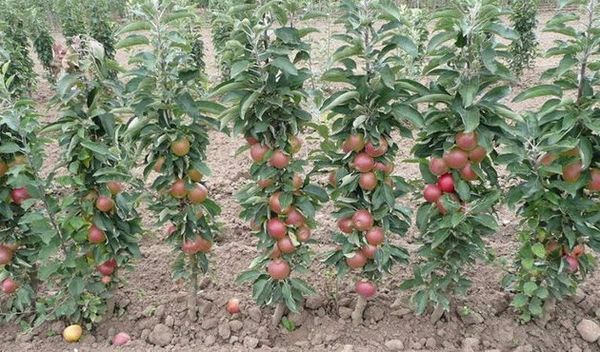
Oddly enough, for some gardeners, winter pruning of columnar apple trees is the most important. Now that the leaves are gone, they can see what was missed in the fall. Moreover, winter pruning has one major advantage: it guarantees the tree is 100% dormant.
For southern regions, this is the only opportunity to perform a full pruning, as the sap flow begins very early there. If fall pruning was completed thoroughly, then all broken, frozen, and dead branches can be removed in winter. It is advisable to carry out the procedure at temperatures up to -5°C. It is important to note that pruning is not recommended at -15°C and below, as the tree's bark becomes very brittle and easily damaged.
Rules for the formation of columnar varieties
To successfully prune a columnar apple tree, you must follow these rules:
• the central shoot is the core of the tree, it cannot be shortened until the apple tree reaches a height of 3 m - if young branches appear next to it, they are shortened to two buds;
• the apical bud is very vulnerable and often freezes in winter – the gardener’s task is to identify one of the strongest shoots and preserve it until next year;
• the correct pruning procedure involves making a cut at an angle of 45° – a more oblique cut will split the wood;
• the cut should be made at a level of 1.5–2 cm above the bud – a greater distance leads to the death of part of the shoot, and a cut made immediately above the bud prevents it from developing;
• only one-year-old shoots are cut to two buds, the rest are shortened to a length of 30 cm.
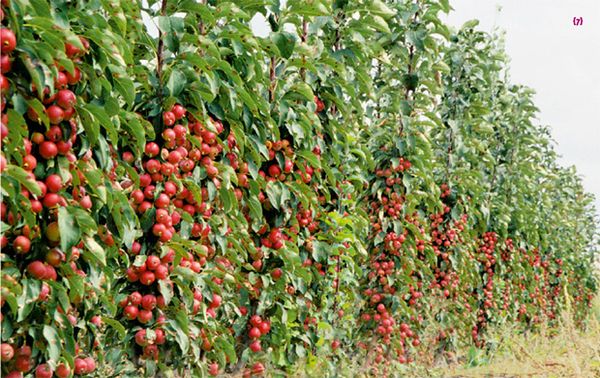
As a result, if regular pruning of columnar apple trees is carried out in the spring, and new growth is removed during the rest of the year, then already in the 4th year one can count on a full harvest and long-term fruiting for the next 10-15 years.
Video: "Pruning a Columnar Apple Tree"
This video will show you how to properly perform winter pruning of a columnar apple tree.