
Is it possible to graft a pear onto an apple tree and how to do it correctly?
Content
Will it be possible to vaccinate?
The very question "Can a pear be grafted onto an apple tree?" often sparks debate. In fact, both trees are pome fruits and rosaceous, meaning they are genetically related. Furthermore, they have approximately the same wood structure, which is important for the survival and longevity of the scion. The feasibility of this type of grafting has already been confirmed by numerous successful experiments. However, beginners are advised to first practice on wild trees.
But grafting an apple tree onto a pear tree is much more difficult, and a novice gardener will most likely fail at such an attempt – the pear tree is considered a very “selfish” crop.
Selecting a scion
The scion must be taken from an already fruiting, young and healthy tree. The cutting is best taken from the south side of the crown. It should be about the thickness of a pencil (5–8 mm) and have 4 to 7 developed buds. The growth portion should be clearly visible. The optimal length of the cutting is about 40 cm.
It's recommended to take cuttings immediately before grafting, but they can also be harvested in the fall, after the leaves have fallen and before the cold weather sets in. In this case, they should be stored in a refrigerator or cellar in slightly damp soil or cloth at a temperature of 0 to 2°C until spring. Harvesting later is undesirable, as the cuttings have a lower chance of taking root and may damage the pear tree itself.
Selecting a rootstock
To successfully graft a pear onto an apple tree, you should choose a young, actively growing rootstock that is resistant to physiological and infectious diseases, frost, and other adverse conditions. You can also graft a pear onto a wild apple tree—these are usually hardier than cultivated trees.
The rootstock can be a fairly mature, healthy tree. It should be free of moss and burrs, and the branches and trunk should be clean and strong.
It is important that both varieties had the same ripening periods.
Step-by-step instructions
The scion and rootstock have been selected – now let’s look at how to properly graft a pear tree.
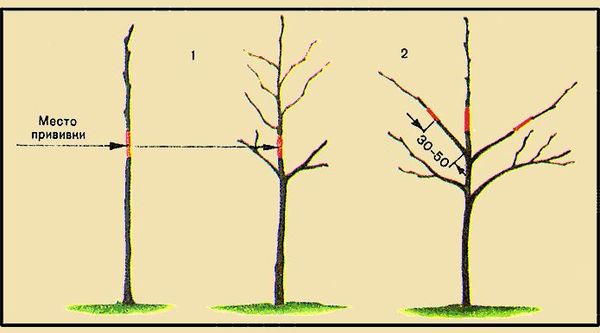
First, choose the right time. The best results can be achieved by grafting a pear onto an apple tree in the spring. For temperate climates, the best time is late April to early May, when the sap is actively flowing. Spring grafting should be done when there is no threat of frost, but before flowering begins.
Is it possible to graft in summer or fall? Theoretically, yes, but due to the difference in crops, fusion is slower, and there's a risk that the scion won't have time to strengthen before winter.
There are several ways to graft a pear onto an apple tree. We'll look at the most popular ones step by step.
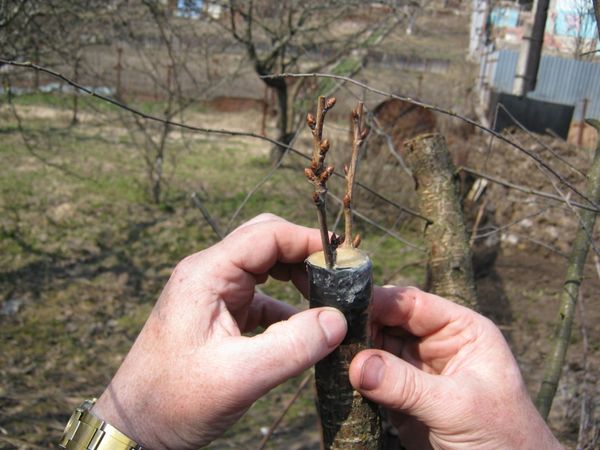
A proven method for grafting a pear tree is copulation. Selecting scions of the same thickness, they are cut with a disinfected knife at a 30-degree angle and placed cut-to-cut. Matching down to the millimeter is crucial. The cut is secured with film, tape, or electrical tape. This method is relatively quick; the only drawback is that it's not always easy to find perfectly matching scions and precisely match the cut angles on the branches.
There is an improved copulation method where the cut on both branches is not made even, but zigzag - this is more difficult, but significantly improves the fit.
You can graft an apple tree in a similar manner using grafting shears. Select scions of matching diameter. Cut them with shears and place the scion shoot against the cut of the rootstock, then secure the joint. The shears' blades have indentations (U- or V-shaped), ensuring a secure fit and ensuring identical cuts down to the millimeter. The disadvantages of this method are that shears can crush the tissue, making the scion shoots take longer to graft and are less effective. Their blades are also difficult to disinfect.
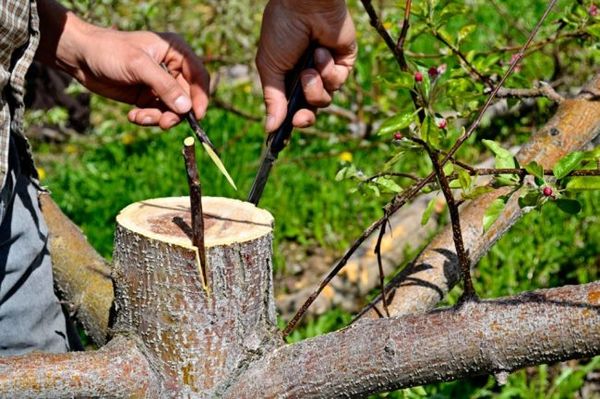
Another convenient method for grafting pears in spring is the "behind the bark" method. A branch about 4 cm thick is cut off from the rootstock and trimmed with a knife. A 3-4 cm vertical cut is made in the bark near the edge and carefully bent back. A long, diagonal cut is made on the scion graft and inserted into the cut in the bark. The cut should adhere as tightly to the tree as possible. Finally, the scion is secured with tape, and the exposed cut on the rootstock is treated with garden pitch. This method allows two scions to be grafted simultaneously onto a single large branch.
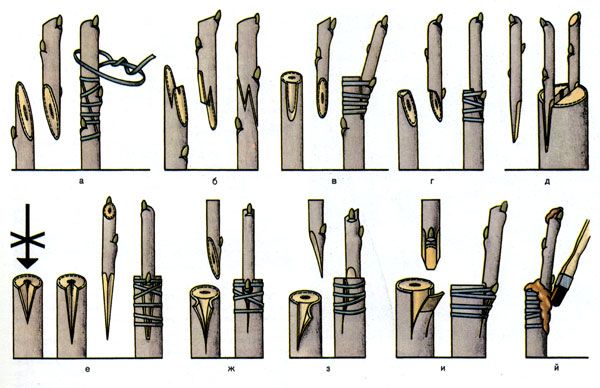
A similar method for grafting a pear to an apple tree is using a cleft graft. In this case, make a 5-7 cm deep cut at the cut site. You can use a knife, or, if the branch is large, a hatchet. Make two cuts on the scion to create a sharp wedge and insert it into the cleft so that the cambium layers touch tightly. As with the "under the bark" method, in this case, two scions can be grafted simultaneously. After securing the scion, coat the exposed areas with varnish.
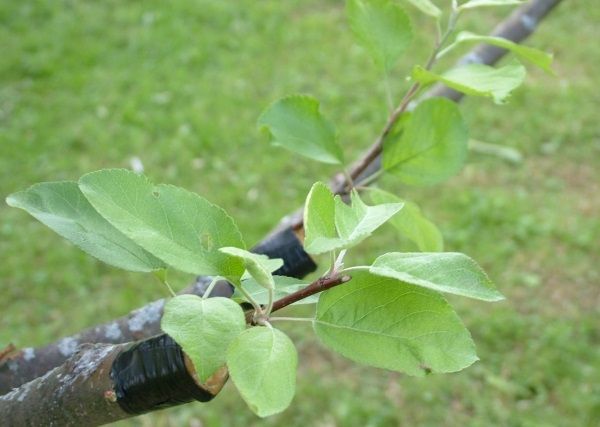
If the scion takes root, it will begin to produce new leaves in 2–3 weeks.
Gardener's Tips
Before grafting a pear onto an apple tree, remember to disinfect your tools. Avoid touching the cuts with your hands while working. A fresh tree cut is as susceptible to infection as an open wound on a person or animal.
The grafting procedure must be carried out very quickly, ideally in less than a minute, otherwise the sap will begin to dry out, making it difficult to take root. To speed up the process, two people can work together.
If the scion survives but is developing poorly, you can graft another shoot onto the same tree, this time from the scion itself. This shoot, which developed on the rootstock's sap, will be more compatible.
If these types of grafting experiments are successful, you can try grafting an apple tree onto a pear tree in the future.
Video: "Grafting a Pear to an Apple Tree"
This video will show you how to graft a pear tree onto an apple tree yourself.