
Features of caring for the ornamental red-leaved apple tree
Content
Description
Ornamental apple trees are often wild, ubiquitous varieties of their cultivated relatives, while some were created by breeders through hybridization of different varieties. All prefer light, well-drained, breathable, fertile soils, an open, sunny location, and wide spacing between trees. However, only the first few years after planting require special attention; virtually all ornamental apple varieties adapt easily to these conditions, grow quickly, and beautify the garden even in shady areas.
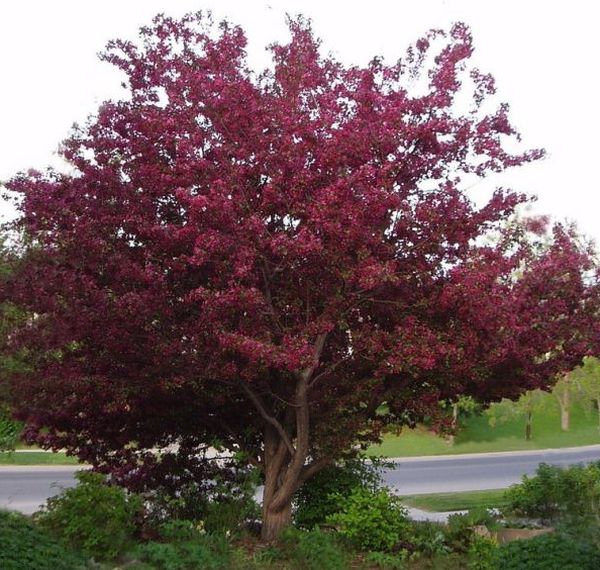
Of course, they are planted primarily for their stunning ornamental value, but they are, after all, fruit trees, meaning they must bear fruit. The apples of many varieties are edible; they are not eaten fresh, but are used to make aromatic jams, compotes, and wines. Extreme caution should be exercised with the Royalty apple tree; it is a rare apple tree with inedible fruit; eating it can cause serious poisoning. However, the well-known Paradise apple, Kitayka apple, and other varieties are used in desserts.
Appearance
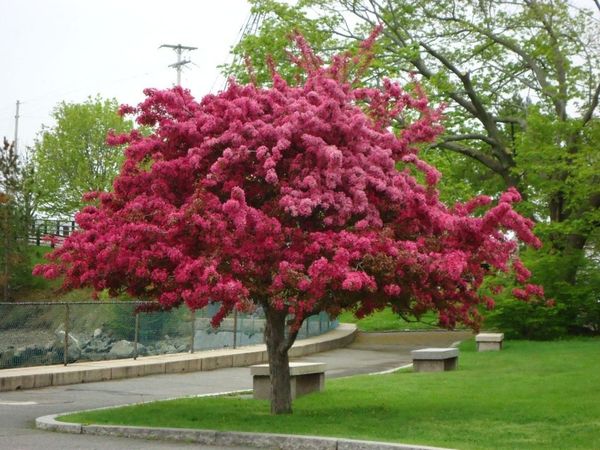
Some apple trees grow in the form of a tree, while others, if not specially trained, grow into a large, spreading bush. The Red Weeping Apple tree can grow up to 12 meters in favorable conditions; under the weight of foliage, and then flowers and fruit, its thin, flexible branches obediently droop, forming a kind of arbor.
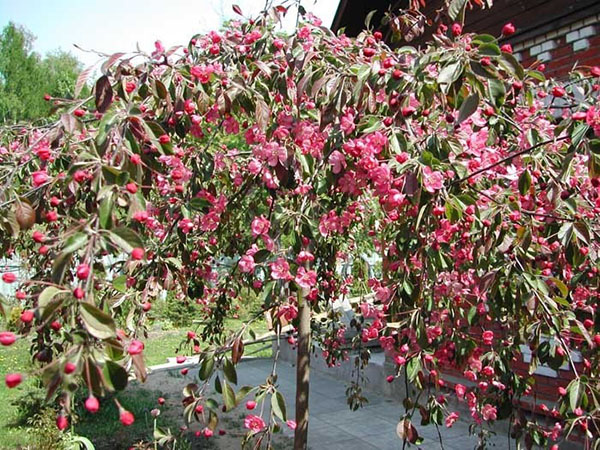
The Krasnolistnaya ornamental apple tree forms a wide shrub, reaching 3 meters in height and 4 meters in height, striking in its vibrant colors. Its leaves are bright red from the moment they emerge, then blossom into a rich, snow-white bloom, and as the burgundy apples ripen, the foliage gradually turns emerald. Some varieties remain bright red from spring to fall, accentuating their unusual coloring with snow-white petals during flowering.
The Royal Beauty apple tree grows up to 3 meters tall, its delicate, drooping branches forming a broad crown with a two-meter radius. The leaves surprise with their vibrant purple in spring, then, throughout the summer, fine green veins appear, gradually filling the entire leaf with green by autumn. The emerald green is sure to catch the eye when all other plants are turning red and yellow.
Landing
When choosing a planting site, you need to leave a distance of about 5–6 meters for other trees.
Planting of seedlings is carried out in early spring or autumn, approximately in mid-September.
The hole needs to be large – up to 1 meter deep and 90 cm wide. A drainage layer of small pebbles and sand is placed at the bottom, then soil mixed with several buckets of humus, wood ash, nitroammophoska, and superphosphate is added.
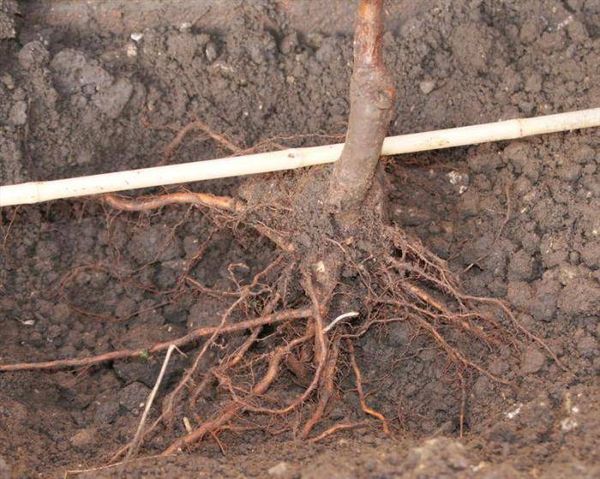
Pour a bucket of water into the hole, then lower the seedling into the hole, spread the roots, and cover with soil, compacting it gently. The tree is tied to a stake and watered generously in several stages. After planting and watering, the root collar should be 10 cm above ground level. Mulch the area around the trunk with pine needles or sawdust once the water has completely absorbed.
Care
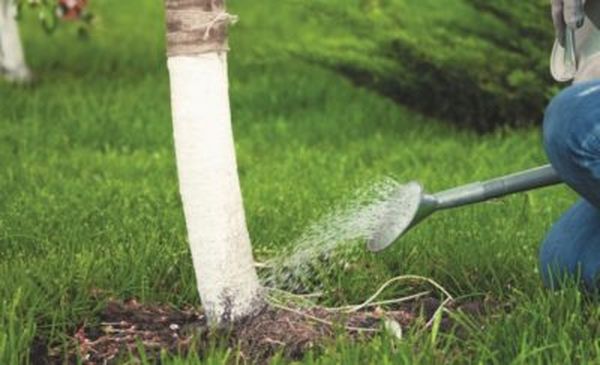
Ornamental apple trees require less care than fruit trees, but they still require watering, fertilizing, and weeding. The area around the trunk will need to be loosened and the crown pruned to shape it. Throughout the year, it's important to keep not only the area around the trunk but also the entire perimeter of the crown clean. Apply a mineral complex fertilizer once a year, and mulch the area with humus, compost, and sawdust the rest of the time.
Watering is very important for young trees; the soil around their roots should not dry out. For mature apple trees, this is less critical; watering is only necessary during prolonged droughts. Ornamental apple trees are not trained as skeletal trees, but pruning is necessary to clean out the crown and maintain its shape.
Reproduction
It's easiest to buy seedlings, but ornamental varieties can be propagated by cuttings or even seeds. Cuttings are best rooted directly in the garden using rooting stimulants. Plants grown from seeds are grown indoors. The seeds are collected when the apples have shriveled, removed, and, after drying, placed on the top shelf of the refrigerator for a month for stratification.
Around mid-December, they are sown in seedling trays, using fertile, light soil. After two true leaves appear, the plants are transplanted into individual pots and provided with additional lighting to ensure the seedlings grow well without stretching in search of sunlight. Like any seedling, they are grown, hardened off, acclimated to fresh air, and then transplanted to their permanent location. For the first year, or perhaps two, the young plants will need to be protected from frost.
Diseases and pests
Ornamental apple varieties generally survive winter well, so they grow throughout Russia, including Siberia and the Urals. They are extremely rarely attacked by pests, causing virtually no harm to the plants. These trees typically have excellent resistance to fungal diseases; even scab does not harm them.
The only thing that can cause significant damage is fire blight. Extreme caution is required, destroying damaged parts of trees or even the entire tree at the first sign of infection, and always using disinfected tools. It's important to take cuttings or seeds only from a healthy garden.
Video: "Overview of Ornamental Apple Tree Varieties"
This video will introduce you to the variety of ornamental apple trees and give you care tips.