
Advantages and rules for installing a greenhouse according to the cardinal directions
Content
What should the soil be like?
The soil suitable for a greenhouse must be fertile yet loose and drain well. Clay soil is unsuitable as it leads to water stagnation.
The groundwater level should not be closer than 1.2 meters. Please note: crops that prefer dry conditions may require deeper soil. If there are no suitable sites on the site, drainage ditches should be dug before installing the greenhouse.
Many experts recommend locating greenhouses on sandy soil. If your site doesn't have sandy soil, dig a pit of appropriate size where you plan to place the structure, fill the bottom with gravel, and then with sand. The top layer should consist of prepared soil.
The soil for the greenhouse should be disinfected with boiling water or a solution of potassium permanganate, and organic fertilizers should be added to increase the content of beneficial microorganisms.
If you're planning to set up a small temporary greenhouse and don't want to prepare special soil for it, consider crop rotation requirements—some crops are bad or good predecessors for each other.
Video: "How to align a greenhouse with the cardinal directions"
This video will show you how to properly install a greenhouse according to the cardinal directions.
How to choose a place
The location of the greenhouse on the site must meet a number of requirements:
- Flat terrain. It's highly undesirable to install a greenhouse even on slight slopes, as this increases the load on the structure. Minor uneven terrain can be corrected with a foundation.
- No drafts or north winds. Cold air currents constantly blowing through the greenhouse will slow down the development of crops and reduce their yield. A polycarbonate covering can provide some draft resistance, but even then, a large amount of the heat accumulated inside will be wasted on the walls. To avoid this, the greenhouse should be located approximately 3 meters away from large trees, houses, or other structures.
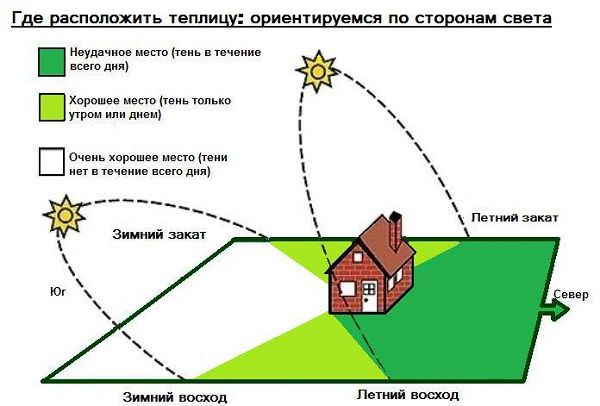
- Lack of shade. Make sure nearby buildings, fences, or trees don't cast a shadow on the area where you plan to install the greenhouse. Also, because of the close proximity of trees, the roof will need to be regularly cleared of fallen leaves in the fall.
- Snow protection. If you want to attach a greenhouse to a house or other structure, it should not be located under a slope; loose snow can damage the roof or the structure itself.
Installation according to the cardinal directions
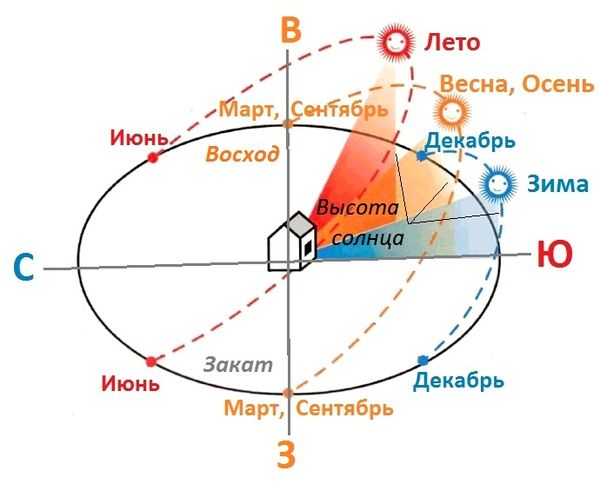
There are two types of greenhouse spatial orientation: latitudinal and meridional. Latitudinal orientation means that the ridges face east and west, and the slopes face north and south. In meridional orientation, the ridges face south and north, and the slopes face west and east.
The fundamental difference is that with a latitudinal placement, the morning and evening sun illuminates the rows along their entire length, and the plants receive maximum light. A meridional placement of the greenhouse allows only the outer rows to be illuminated at these times, leaving the rest in shade.
Both types are suitable for spring greenhouses (those used only during the regular gardening season): the long daylight hours compensate for the lack of light for some plants in the morning and evening. If your site is located at 40–65° north latitude, a meridional orientation is recommended for spring greenhouses.
It's recommended to install winter or year-round greenhouses in a latitudinal direction—this will allow plants to receive more light during the cold season. This is especially important if the site is located at 35–60° north latitude.
When choosing the greenhouse's orientation relative to the cardinal points, the requirements of the crops being grown are also taken into account: if they require shading, a meridional placement will be optimal, and conversely, some heat- and light-loving plants will benefit from a greenhouse positioned latitudinally, even in summer.
Advantages and disadvantages
Positioning a greenhouse according to the cardinal directions offers obvious advantages: plants receive the optimal amount of light and heat, resulting in a higher yield. On the other hand, even the correct method comes with certain disadvantages:
- If the greenhouse is located in a latitudinal direction, it may become too hot in the summer, so you will have to pay special attention not only to frequent ventilation, but also to installing curtains;
- If, after some time, you decide to use a meridian-oriented structure in winter, you will have to spend more resources on additional lighting and heating, which may simply turn out to be unprofitable.
Finally, there are cases where correctly aligning the greenhouse with the cardinal directions is impossible due to other factors: terrain, unsuitable proximity to other structures or trees, etc. If there is no other solution and proper orientation must be neglected during installation, this should be compensated for later by additional lighting or shading.
However, it's best to keep such a structure small and mobile: using a portion of fertile soil for a concrete foundation and constructing a substantial structure would be impractical if it turns out later that the compensation doesn't produce the desired effect or is too tedious or costly.