
Features of greenhouses with a roof vent and installation rules
Content
Why do you need a window?
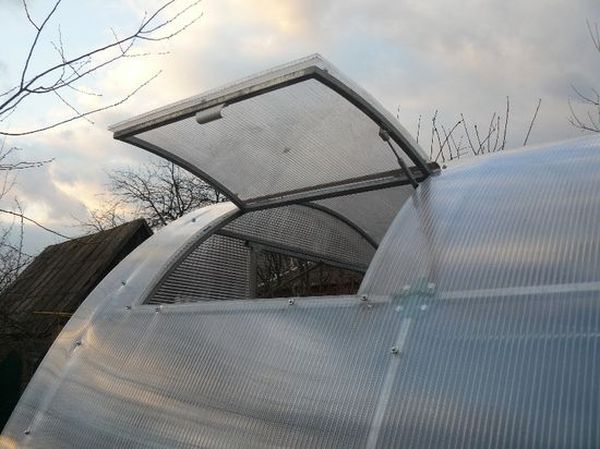
A greenhouse vent is a necessary design element. It can be located either in the walls or on the roof. Moreover, a top-mounted opening is considered the safest for plants.
Opening the vents in the greenhouse performs the following functions:
- Provides effective cooling for the entire structure, which becomes especially hot on hot summer days. According to the laws of physics, heated air accumulates under the roof. Therefore, when the roof vent is opened, the warm air is quickly replaced by cool air masses;
- Preventing drafts, which are detrimental to most greenhouse crops. In this case, active air exchange occurs at a significant distance from the crops—under the roof. Therefore, the plants are not exposed to cold air;
- Facilitating pollination. Bees and other pollinating insects can access the greenhouse from above much more easily than through open windows in the walls.
As we can see, windows play a significant role in a polycarbonate greenhouse. By properly positioning them, you can easily create optimal growing conditions for your plants.
Video: Installing an Additional Window in a Greenhouse
This video will show you how to install a window in a greenhouse yourself.
Main types
A vent or window is an opening device for greenhouses that can come in a variety of designs. It's worth noting that these devices can consist of a varying number of elements (from one to six panels). Most commonly, DIYers make single- or double-panel ventilation devices.
In addition, the greenhouse can be equipped with two types of vents:
- Devices that require external force to open (they're traditionally opened by hand). In this case, a standard mechanical opener is used. To prevent the device from opening accidentally, a standard hook or plug can be used. A very simple mechanism is used to create such a device;
- Self-opening greenhouse vents. A special mechanism with an external power source is used here. A special hydraulic device (an opening cylinder, a greenhouse vent opener, and other components) is required. To make the mechanism open automatically, it must be powered.
It is worth noting that there are several ways to attach such vents:
- using rotary joints;
- on hinges that can be placed on the top side of the transom.
Whatever design option is chosen, it's important to consider not only the location of the ventilation system but also all the necessary materials (such as a window cylinder) for its assembly while drawing up the greenhouse plans. The quality of the harvested crop depends on the quality of the greenhouse ventilation vents.
Installation Features
To begin making simple or self-opening vents in a greenhouse with your own hands, you need to purchase the necessary tools and materials.
To work you will need:
- screwdriver;
- cutting knife;
- hacksaw for metal working;
- Self-tapping screws with wide heads. O-rings are also required;
- file. It is used to process the edge of a profile;
- standard profile fasteners;
- mounting perforated tape;
- transparent sealant/tape.
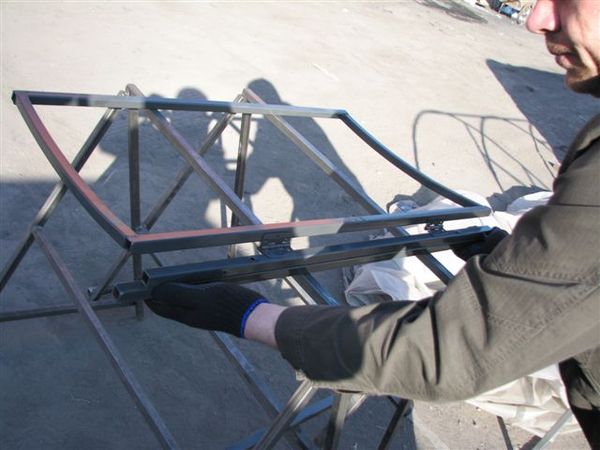
You'll need polycarbonate sheets and U-profiles to assemble the frame. You'll also need a mechanism to open the greenhouse window.
It should be noted that the opening elements should be placed in the place where the roof has an intersection of two transverse and two longitudinal load-bearing structural elements.
The work on installing the vents is carried out as follows:
- We cut out a sheet of polycarbonate in the place where the ventilation device will be created.
- We take the profile and cut pieces of the required dimensions from it (using the drawing as a guide). For rigidity, we can add a couple of transverse or diagonal ribs. When creating the frame, you can have your own vision for how it should be constructed. The main thing is that it remains strong.
- We assemble a frame from the resulting profile fragments and try it on in place of the cut polycarbonate. If the structure doesn't fit properly, file down the edges.
- To ensure the device lasts longer, it's best to coat the frame with an anti-corrosion primer and paint. Avoid direct contact between the metal and the polycarbonate.
- Once the frame has been successfully installed into the greenhouse roof, the polycarbonate sheets should be secured to it. Glass should not be used here, as it is fragile and can be damaged by strong gusts of wind.
- Next, seal all open channels in the polycarbonate sheets with sealant or tape. Pay particular attention to the lower part of the opening to prevent rainwater from penetrating.
If necessary, the edges of the window can be sealed with a special rubber band. This will ensure an excellent seal and completely prevent cold air from penetrating the structure when the ventilation unit is closed.
However, this element doesn't have good wear resistance, so the rubber will need to be replaced frequently.
This is how simple, manually operated greenhouse vents are made. If self-opening devices are desired, additional mechanisms must be installed in the frame and connected to a power source. If desired, such devices can be equipped with timers. This allows the greenhouse to be ventilated at a set time without human intervention. This automated care of greenhouse vegetables will significantly simplify the process of obtaining a bountiful and, most importantly, tasty and healthy harvest.
When constructing such a structure yourself, remember that the window in the greenhouse must occupy its own place, which is determined based on the dimensions of the greenhouse.