
Assembling the frame and cladding of a metal greenhouse yourself
Content
Pros and cons of metal greenhouses
Many agronomists believe that a DIY greenhouse made from metal profiles offers the best value for money. These days, it's easy to order a design or even a pre-fabricated structure made from PVC pipes, which can then be used to grow various fruit and vegetable crops. A DIY greenhouse doesn't require significant capital investment and meets all your requirements and wishes.
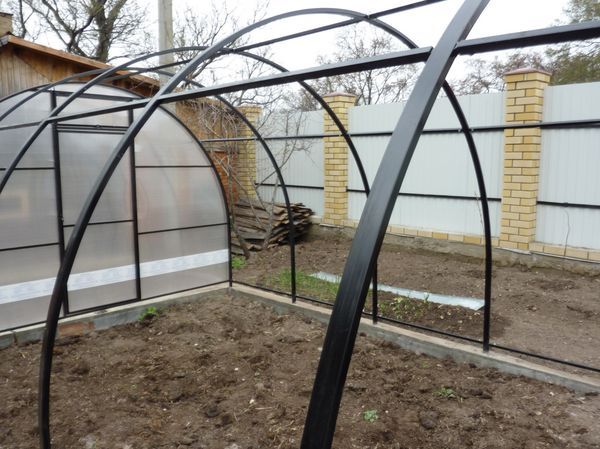
The main advantages of metal greenhouses include:
- Metal arches for greenhouses are several times cheaper than similar structures made from other materials;
- a large selection of diagrams and drawings for the manufacture of metal frames for greenhouses of various shapes, types and sizes;
- Unlike wooden and steel profiles, PVC structures are characterized by high corrosion resistance;
- Due to the flexibility of the material, a greenhouse made of metal profiles is easy to assemble and easy to maintain;
- The lightness of the metal-plastic frame allows you to move the greenhouse to a new location, which is especially important in case of soil depletion;
- Due to the low thermal conductivity, the costs associated with heating the greenhouse structure are significantly reduced.
Despite its many advantages, a metal greenhouse also has its drawbacks, notably its lightweight and unstable structure. Strong winds and adverse weather conditions can cause the metal frame to tip over or break. To prevent such situations, careful attention to the proper fastening of the pipes and arches is essential.
Form selection and design
Due to a large number of positive characteristics, the popularity of metal greenhouses is growing every year. Today, on specialized resources where experienced and novice agronomists communicate, discussions often arise about the shape or design of a do-it-yourself metal greenhouse.
There are many varieties of such structures, however, as experts note, there are seven basic forms:
- Single-pitched and double-pitched structures used for growing plants that require a lot of light.
- Mini-greenhouses installed on small garden plots.
- Arched greenhouses for growing root crops and low-growing crops.
- Pyramid structures that are suitable for low-growing vegetable crops and seedlings.
- Polygonal greenhouses for growing climbing plants.
- Dome-shaped frames, which are difficult to install.
- Dutch greenhouses with sloping side walls, used for light-loving crops.
Almost any of the above-described structures can be either permanent or dismountable. Prefabricated greenhouses are less stable, but are in high demand due to their portability.
Video: "DIY Arched Greenhouse"
This video will show you how to build an arched greenhouse using rebar.
Materials and tools
Let's look at the materials and tools you'll need to build and assemble a metal greenhouse. Building a greenhouse won't be difficult if you follow a pre-designed plan for the future structure.
Necessary tools: tape measure, level, twine, wooden pegs, hacksaws for metal and wood, a set of knives, a construction hammer, nails, self-tapping screws, anchor bolts, a screwdriver, a screwdriver, a welding machine for working with metal-plastic, a shovel, etc.
All necessary materials are prepared depending on the type and shape of the planned greenhouse. You will need: rebar lattice, metal arches, square and round metal-plastic pipes, wooden planks and beams, film, glass, polycarbonate, and more.
Installation of the foundation
A permanent greenhouse must be built on a foundation. First, you need to decide on a location for the greenhouse. The next preparatory stage involves excavation work: removing the topsoil and leveling the surface.
Using wooden pegs, string, a tape measure, and a level, mark out the area and dig trenches 30–40 cm wide around the perimeter. Once the trenches are dug, a layer of gravel and sand is added, and wooden formwork is placed on top. A grid of rebar is installed around the perimeter of the trench, and anchor bolts or metal inserts are placed in the corners to secure the frame.
Having mixed cement, sand, crushed stone and water, you can begin pouring the foundation.
Assembling the frame
Building a pipe frame for a metal greenhouse is considered a labor-intensive and complex process, requiring specific knowledge and skills. To save time, it's best to purchase a pre-fabricated metal greenhouse frame, which can then be covered with glass, film, or polycarbonate.
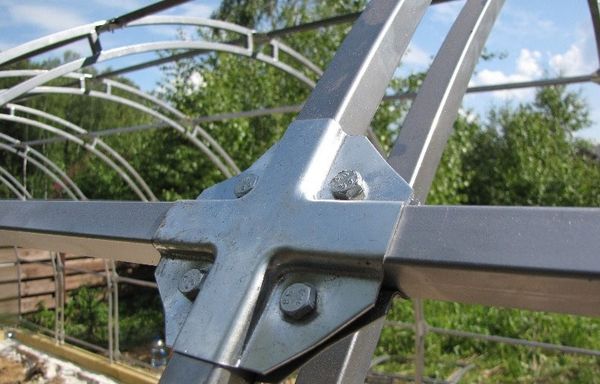
To attach the frame to the supports, you'll need a welding machine. To prevent metal corrosion, be sure to treat the profile with a high-quality primer and enamel. This procedure is only unnecessary if the profile is galvanized.
Depending on the varietal characteristics of the crops to be grown in the greenhouse, the recommended spacing between vertical supports ranges from 50 to 85 cm. The greenhouse should be equipped with ventilation vents, which are installed during the frame construction stage.
Greenhouse cladding
The final stage of greenhouse assembly is covering the assembled metal structure. Glass, polyethylene film, or cellular polycarbonate are the most common coverings used for greenhouses.
The cheapest and easiest option to build is a plastic greenhouse. However, despite the low cost of polyethylene film compared to other materials, this option is characterized by low wear resistance and unreliability. In adverse weather conditions, the film covering tears.
Glass coverings are considered more expensive and require specific knowledge and skills. If you plan to use the greenhouse in winter, double glazing is a better choice.
The optimal option is a cellular polycarbonate covering. To attach the polycarbonate film to the greenhouse's metal frame, you'll need thermal washers with wide heads.