
How to choose materials and assemble a greenhouse from film
Content
Advantages and disadvantages
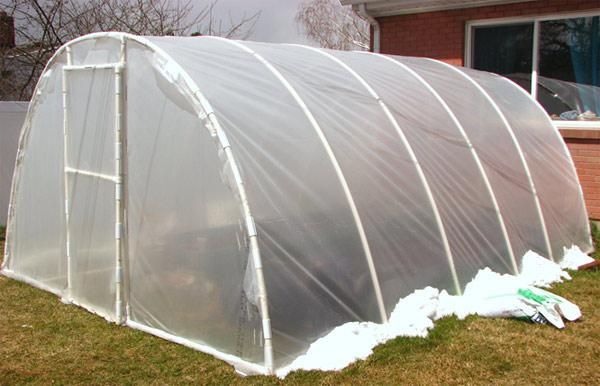
Greenhouses made with film have the following advantages:
- easy assembly process of both the frame and its sheathing;
- affordable cost of film;
- the structure allows sunlight and air to pass through well, which makes it possible to easily create an optimal microclimate for plants inside;
- light weight of covering material;
- The film is highly reliable and wear-resistant.
However, this type of greenhouse has one significant drawback: the material used can be easily cut.
Video: "Greenhouse Film and Its Installation"
This video will show you how to choose greenhouse film and attach it to the frame.
What does the design look like?
A film greenhouse has a structure that can resemble either an arch or a shed. The structure's appearance depends on the type of frame used.
Today, a greenhouse for film can be made from the following types of frames:
- PVC. It is used extremely rarely, although it is resistant to rust and chemicals;
- Aluminum. The main disadvantage is the high cost. Advantages include resistance to moisture, high temperatures, and rust;
- Metal. The downside of this frame is instability when heavily snowed in;
- Wooden. To use a wooden frame, all its elements must be pre-treated with special protective agents.
Hungarian-style film greenhouses are constructed from a wooden or metal frame. A distinctive feature of Hungarian greenhouses is their constant humidity and temperature. This is achieved by using a heater inside the structure.
An arched structure is also often built, as it is easy to assemble and can be constructed from any material. Each gardener decides for themselves which frame to use.
The appearance of a building is also influenced by the material chosen for its decoration.
Film selection
Before constructing a greenhouse frame for film, you need to select the cladding material. Today, this type of structure can be clad with the following types of film:
- Stabilized hydrophilic. When used, it will prevent condensation inside the greenhouse;
- Ethylene vinyl acetate copolymer. It is hydrophilic and highly durable. Its transparency reaches 92%;
- Reinforced film. It is durable but has poor light transmittance;
- Heat-saving. Provides good protection against sudden temperature changes;
- Light-stabilized fabric. Contains special light-stabilizing components, making it an excellent UV protection product.
- With additives. Improves the strength of the entire structure and also has an antistatic effect. They can be hydrophilic and have pest repellent properties;
- "Svetlitsa." Can be used in a wide variety of climates.
It's worth noting that a greenhouse can also be lined with non-woven covering material (such as Agrotex, Agrospan, etc.). When choosing a covering, pay attention to where and how it was manufactured. Industrial-grade films should not be used, as they may be toxic to plants.
Step-by-step instructions
To ensure your homemade film greenhouse is of high quality, it's important to build it step by step. Here are the assembly instructions:
- Determining the type of structure needed (arched, Hungarian, etc.). Your choice should be based on the materials available and your budget. For example, arched greenhouses with film are cheaper to build than the Hungarian type;
- then a drawing is made and the amount of materials needed for the work is calculated;
- then preparation for work is carried out;
- After this we erect the frame and cover it with film.
Let's look at the nuances of the preparatory stage, as well as the actual construction of the greenhouse.
Preparation
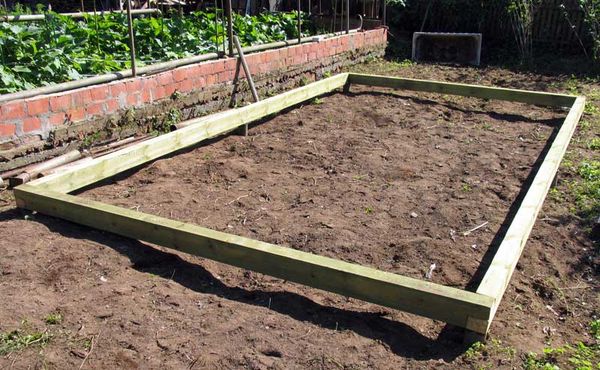
First, choose a location. It's best to choose a well-lit, elevated site for this farm structure. The soil should be uniform, level, stable, and moist.
Once a site has been selected, it should be cleared of vegetation and debris. The land is prepared in the fall so that construction can begin immediately in the spring. In the fall, the site is dug and fertilized. The soil should be leveled with a rake.
Assembling the frame
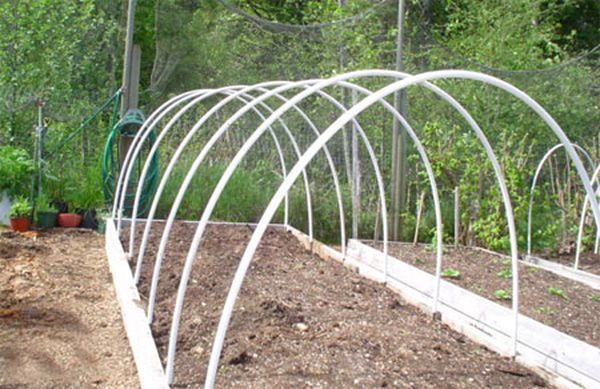
Most often, such structures are constructed using an arched design. The frame's structural members must be made of plastic and metal pipes. The frame must be assembled according to a drawing that outlines all the necessary components.
First, the walls are erected. To ensure greater structural strength, cross beams and additional bracing are required. It's especially important that the walls are firmly connected to each other to effectively withstand strong winds. Next, the roof frame is constructed on these walls. It can be arched (rounded) or traditionally pointed.
Film fastening and welding
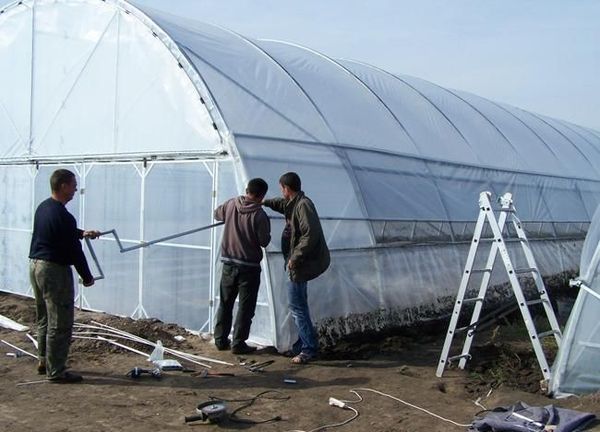
The finished frame needs to be covered with covering material. Today, several methods are used to attach the film to the frame:
- Slatted, with end-mounted fastening. The film is fixed only at the ends;
- Slatted. Fastening is done using wooden slats, nails, and screws. This method is only suitable for wooden frames;
- clamps and clips;
- Elastic cord and eyelets. The material is snapped onto the profile. This method is only suitable if a strong film is used;
Mesh. First, the greenhouse is covered with mesh, to which the material is then attached.
There are also several ways to glue pieces of film together:
- Hot method. This method requires a special tool—an iron or soldering iron—as well as fluoroplastic tape. The overlap width should be 1–2 cm. A blowtorch and wide strips of metal can also be used.
- Cold method. In this case, various adhesives are used for gluing (for example, Moment, BF-4, or BF-2). Before gluing, the edges of the material are treated with chromic anhydride (25% solution). After gluing, the seam should be ironed.
As you can see, building a DIY film greenhouse is quite simple. Just follow the step-by-step instructions, and you'll soon have a greenhouse for growing a wide variety of vegetables and berries.