
Main types and construction of industrial farm greenhouses
Content
Advantages and disadvantages
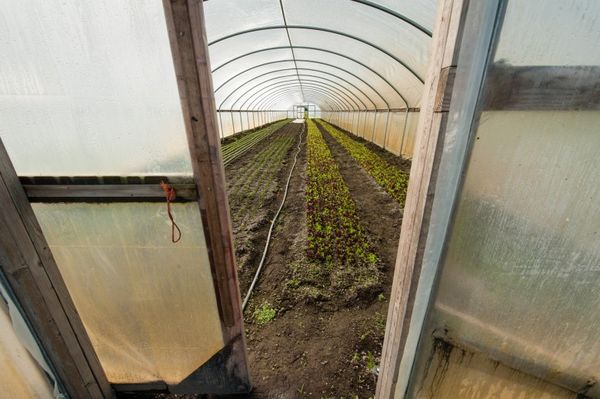
Building industrial-scale greenhouses is suitable for farmers who plan to build a business around regular harvesting. This is because such structures are much larger than garden greenhouses, making them impractical for private use.
With proper equipment, industrial greenhouses allow for year-round cultivation of various crops, as well as the creation of zones with different microclimates, despite harsh environmental conditions. The obvious advantage is the profitability and payback of such a business.
A stumbling block can be the significant investment required to install the greenhouse, secure the necessary technology, and perform the initial gardening work. Furthermore, building everything from scratch won't cut it—even the most minor project requires professional skills and knowledge.
Video: "Building an Industrial Hydroponic Greenhouse"
This video will show you how an industrial greenhouse is built and what makes it unique.
Main types
Depending on characteristics such as service life, size, and material composition, farm greenhouses are divided into several types. There are structures designed for short-term seasonal use and year-round use. Depending on area, there are:
- semi-industrial – not exceeding 500 sq. m;
- industrial – more than 500 sq. m.
The material used for the cladding also determines the type of greenhouse. Common coverings include:
- Film. The most cost-effective and easiest-to-install option. It's not very durable and isn't suitable for winter conditions;
- Glass. More expensive and more durable. Structures using this material must have a sturdy frame. The glass covering of a farm greenhouse promotes rapid heating of the air inside, which, in turn, raises the issue of providing adequate ventilation.
- Polycarbonate. A lightweight, highly durable plastic. Its production began relatively recently, but the material has already gained popularity. Distinguishing characteristics of this type of cladding include its flexibility, ability to maintain the required temperature, filtering radiation harmful to plants, and durability.
In addition, the design of industrial greenhouses differentiates them by their external appearance and internal structure into arched and block ones.
Greenhouses of the "Farmer" series from the "Volya" company
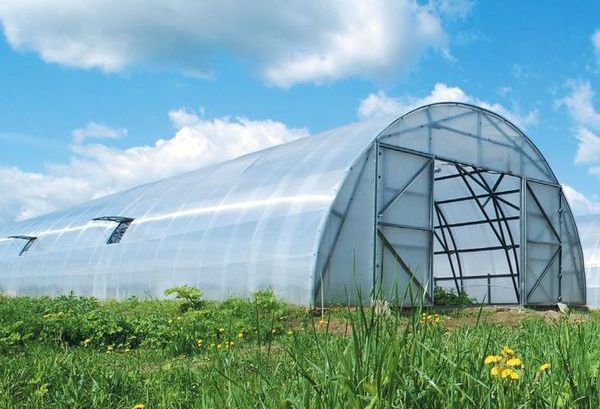
This manufacturer's products are arched greenhouses. A distinctive feature of these greenhouses is their unusual shape, reminiscent of an inverted boat, unlike the classic one. This deformation was created as a result of efforts to improve the prototype and increase the streamlining of the structure to prevent snow accumulation. The experiment proved successful, leading to the design of more advanced versions.
Volya greenhouse units feature a reinforced frame made of galvanized steel, ensuring stability and rust resistance. The cladding is constructed using materials with high thermal insulation properties, allowing the greenhouse to be used year-round.
The industrial greenhouse series comes in a variety of sizes. However, when setting up a greenhouse, it's important to focus only on height and width—the length can always be increased as the number of plants increases.
Greenhouse complex "Cold House"
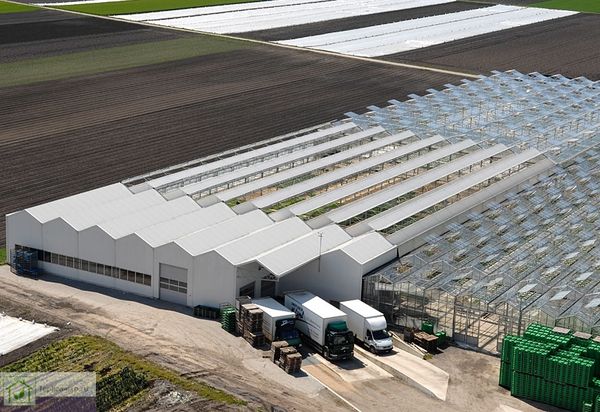
This type of greenhouse structure is intended exclusively for industrial use and is an example of a modular design. The complex consists of individual five-meter-tall modules, spaced at the same distance from one another. The width of each module ranges from 8 to 9.6 meters.
Both steel and aluminum are used for the frame elements. The key principle of this structure is that each individual unit can create a unique microclimate. This allows for the simultaneous cultivation of crops from virtually all over the world.
These greenhouses are often equipped with a water collection system consisting of gutters and containers. A typical feature of the "Cold House" is a sharp glass gable roof. If necessary, the complex can be insulated. It is important to note that the construction of this type of greenhouse requires a reinforced concrete foundation.
How to build it yourself
Despite the apparent simplicity of the "working" structure, fabricating parts of the future greenhouse from scrap materials isn't possible. The best option is to follow professional drawings, which are always included in the standard production kit along with the necessary elements for construction.
Foundation
The foundation of any construction, ensuring the structure's stability, is a wooden beam foundation. If the greenhouse is being built permanently, a concrete foundation is used. However, if the farmer and their property are planning to move, a collapsible metal structure is appropriate.
Frame and roof
It's preferable to choose a single- or double-pitched roof. These are considered classic options, preventing precipitation from accumulating and providing good air circulation.
The frame's essential characteristics include strength, the ability to withstand significant loads, and resist impacts from both external and internal sources. A "skeleton" made of hollow steel components is worth considering.
Sheathing
Polycarbonate sheets are deservedly popular for covering farm greenhouses. This new synthetic material is lightweight and durable, and installation is straightforward. Special fasteners are included, allowing for assembly without the need for additional tools.
If the greenhouse is not designed for growing produce during the winter season, the frame can be covered with film – less weather-resistant, but capable of saving the situation if financial resources are limited.
Equipment and operating rules
The construction of industrial greenhouses isn't the only challenge. Successful greenhouse gardening requires creating a microclimate tailored to each plant species. This requires the installation of automated equipment designed to regulate the environmental conditions within the greenhouse.
Ventilation and fogging
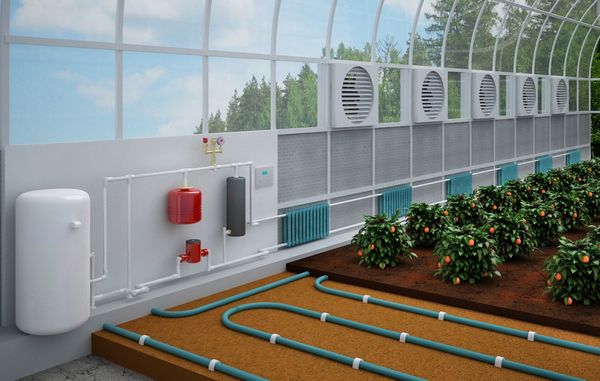
Both processes are aimed at preventing overheating and cooling the space. In addition to regulating air exchange, the ventilation system is capable of maintaining a stable indoor temperature. Sensors monitor all changes, enabling an automated mechanism to open and close the greenhouse windows if it becomes too hot or cold.
The fogging system primarily provides cooling and maintains the required humidity. Furthermore, the evaporative cooling mechanism allows for effective plant maintenance and pest control.
Heating system
Heating sources that can protect plantings from winter can vary. These include:
- gas. Its use is considered economical;
- air. The fastest way to warm up;
- water. Characterized by reliability and high heat transfer;
- Infrared heating. A modern technology that allows for even heat distribution not only within the greenhouse but also across the soil.
Depending on the heat source, installation of boilers, relays, pipes, etc. is permitted.
Lighting and shading
During periods when natural daylight is insufficient for normal plant development, farmers use lamps. These types of lighting have different purposes and effects. The following types of lamps are available:
- fluorescent – universal use;
- ultraviolet – disinfects;
- mercury - stimulates ripening;
- High pressure sodium - radiates heat;
- LED – universal;
- Infrared – as close as possible to natural light.
Curtaining is used when the opposite effect—shading—is needed. It can be done both horizontally and vertically.
In the latter case, the system allows for selective shade creation by dividing the greenhouse into different sections. This allows comfortable conditions to be created for the simultaneous growth of both sun-loving crops and shade-loving plants.