
Description of the early-ripening felt cherry Natalie
Content
Description and breeding history
The Natalie felt cherry variety was developed in 1979 by pollinating the Leto variety with a mixture of pollen from the Ogonyok, Damanka, and Krasnaya Sladkaya varieties. Breeding work was conducted at the Far Eastern Experimental Station of the Vavilov All-Union Research Institute of Plant Growing over a period of 20 years. In 1997, the variety was included in the state register.
The shrub is spreading, growing from 1.7 to 2 m. The crown is oval, medium density, and the shoots grow quickly. Young shoots are pubescent and brown. Older branches are gray and slightly flaky. The leaves are up to 6 cm long, pointed, and corrugated. They feel slightly fluffy to the touch, like felt, which is where this plant gets its name.
Grafted seedlings bear fruit for the first time in the 2nd year, own-rooted ones – 3–4 years after planting.
Flowering begins on average around May 10th–12th, lasts a long time, and is quite spectacular. The flowers are numerous, large, saucer-shaped, 2.5–3 cm across. The outer surface of the petals is pubescent. Initially, they are light pink, fading to white within a week or two. They are frost-resistant to -3°C.
Ripening is uniform, and the harvest can usually be picked in mid-July or in the second half of the month. Flowering and fruiting occur continuously along the branch.
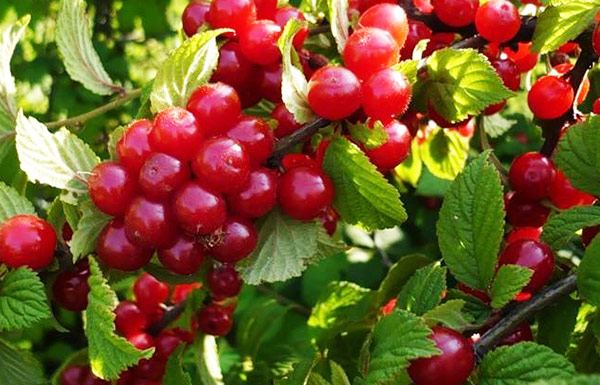
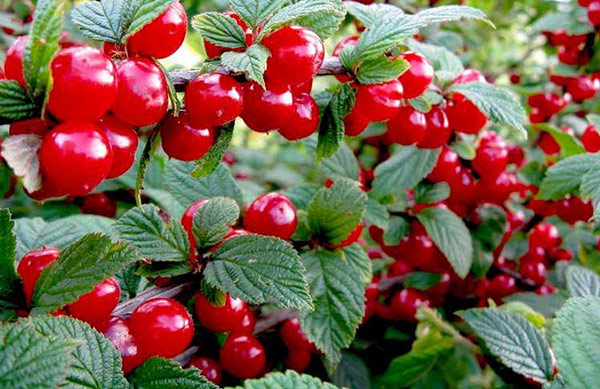
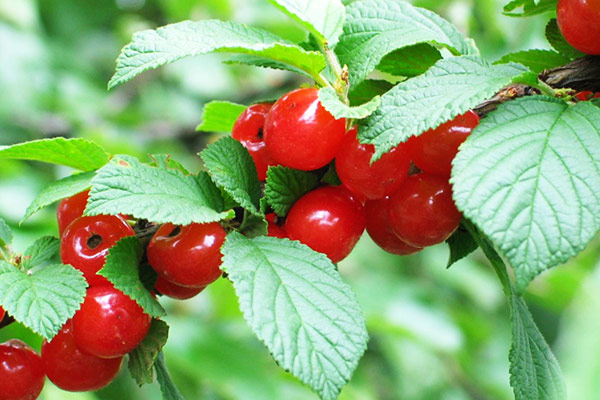
The Natalie felt cherry produces very large fruits—up to 4 g (they can become smaller in high-yield situations). The berries are wide, tapering ovals. The skin is slightly pubescent and dark red. The scarlet flesh has a sweet and sour taste, is juicy and firm, with small cartilages (resembling those of cherries). The juice is red. The peduncle is 5 mm long, and detaches easily and is semi-dry. The small, beige seeds account for only 5% of the berry's total weight. The yield is high, averaging 9 kg per bush.
Harvested berries can be stored in the refrigerator for 6 days without losing quality, or 3 days at room temperature. Besides eating raw, they are suitable for making juice, preserves, jams, and more.
The fruits have poor transportability.
An important characteristic of this variety is its hardiness: it is resistant to winter and spring frosts, drought, and coccomycosis. However, it does not tolerate overwatering: excess moisture is not only harmful to the roots but also weakens the plant's immunity to moniliosis.
Natalie is a self-sterile cherry tree. Good pollinators for it include cherry plums, plums, peaches, and apricots (provided they bloom at the same time). Other felt-bearing varieties are also suitable. Regular cherries are questionable: most experts claim that such pollination is impossible.
Thanks to its aesthetic appearance, Natalie is also suitable for landscaping and creating hedges.
Features of cultivation
Felt cherry can be planted in spring or fall. Spring planting (before bud break) is preferred; the seedlings will root better before the cold weather sets in and will survive the winter more easily. In fall, planting should be done no later than September.
Natalie prefers peaty, sandy loam, or loamy soil. The location should be well-lit, without standing water or groundwater close to the surface, and preferably elevated to avoid flooding.
The hole for the seedling should be 50 cm deep and 80 cm in diameter. Fill the bottom with a mixture of 3 buckets of humus, fertile soil, 300-400 g of lime or dolomite flour, and 1 tbsp of superphosphate. Do not bury the root collar of the seedling. After planting, water the plant generously—at a rate of 20-40 liters per bush. Subsequently, the felt cherry only needs watering once a month. Mulch can be applied around the plant to prevent it from drying out.
Fertilizing begins in the second year after planting: in the spring - mainly with nitrogen fertilizers, in the fall - containing phosphorus and potassium.
Pruning is done in the spring. Besides its sanitary function (removing dying and diseased branches), it also serves a formative purpose for a young tree, and a rejuvenating purpose for an aging tree (after five years). Although the average lifespan of the Natalie cherry tree is about 10 years, proper regular pruning can double that lifespan.
In the first year of life, seedlings are pruned at a height of 40–50 cm, leaving one-year-old shoots – these are the most productive. In the second year, the center of the crown must be thinned out, leaving up to 12 of the strongest shoots, and the side branches must be shortened by a third.
To rejuvenate felt cherry trees, several lateral shoots are removed at the ring, leaving the central part of the crown and peripheral skeletal branches intact. This is followed by a "retreating growth" treatment: when dormant buds near the pruning sites begin to sprout shoots, the old crown is removed.
It's important to monitor the plant's health. Dried shoot tips, ovaries, and flowers may indicate moniliosis. In this case, all affected shoots should be cut back 15 cm below the infestation level and burned, and the bush should be treated with Alirin-B or other biological fungicides.
If warts appear on the leaves, this indicates a pocket mite infestation. Effective treatments include Aktara, Karbofos, and Karate.
Video: "Where to plant felt cherry?"
This video will show you where to plant felt cherry trees to ensure they are healthy and bear fruit for a long time.