
Description of the mid-season cherry variety Vladimirskaya
Content
History and description of the variety
It is said that the Vladimir cherry has been cultivated since the 12th century, but we cannot know for sure. There are written accounts dating back to the 17th century—monks are known to have brought the first seedlings from Greece and begun growing cherries on sunny slopes near monasteries. The seedlings thrived, but frosty winters prevented their growth. The monks were very persistent and repeated their experiments, covering the trees for the winter. The resulting harvest was so popular with local residents that cherry orchards soon appeared in the city and spread throughout the surrounding area.
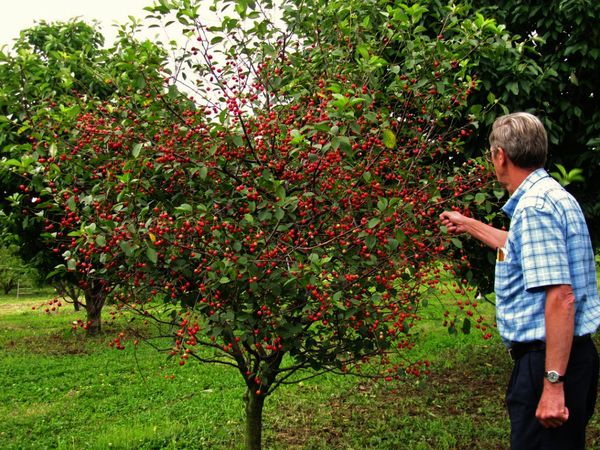
Residents propagated the cherry tree by layering, root suckers, and seeds. The result was the Vladimirskaya cherry variety and its many varieties, which are still known under the names Roditeleva (or Roditelskaya), Vyaznikovskaya, Gorbatovskaya, Izbyletskaya, Dobroselskaya, and Vladimirovskaya. Since 1947, the Vladimirskaya cherry has been registered as a zoned variety in the state registry. Its description states that it can grow into a wide bush just over 2 meters tall when propagated by suckers or layering. When grafted onto a standard, it develops into a large tree about 5 meters tall with a round crown that becomes more spreading with age. It grows in the Central Black Earth Region and the Middle Volga, as well as in the northwest.
The bark on the trunk and thick skeletal branches is grey, becoming covered with longitudinal cracks and peeling with age. Young shoots are brown, with a slight yellow or red tint, flexible, drooping; it is on them, as the variety description states, that most leaves grow and about 80% of the total yield grows. The dark green leaves are elongated, tapered at both ends, serrated along the perimeter, held on small petioles (slightly longer than 1 cm), they are of medium length (7–9 cm) and seem to fold along the longitudinal central vein.
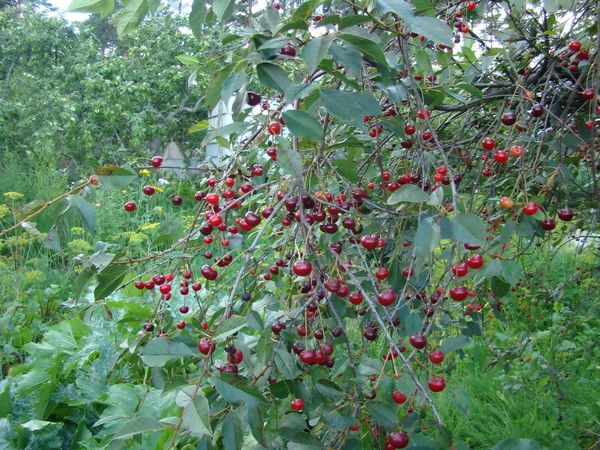
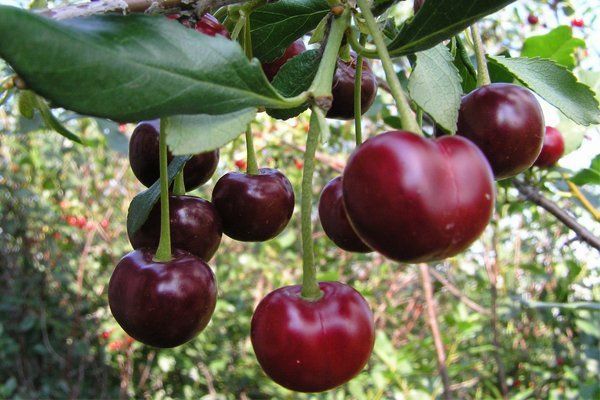
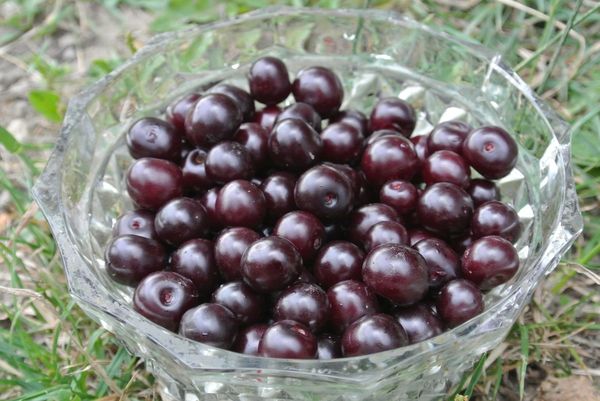
The flowers are white, clustered in clusters of 5–7. The berries are medium-sized, weighing 2.5–3.5 g, round, slightly flattened, with a barely visible seam, a shallow funnel, and a stalk approximately 4.5 cm long. The cherries are dark burgundy, almost black, with gray spots visible on the surface. The flesh is very juicy, bright red, with clearly visible fibers, and the pit is quite easy to separate.
Main characteristics
When planted at the right time (mid-October or early April) as a healthy one- or two-year-old sapling, the Vladimirskaya cherry tree begins to bear fruit in the second or third year. A single mature tree in the temperate zone can yield up to 25 kg of berries, but yield varies greatly depending on conditions; northern regions can boast yields of no more than 5 kg. The tree has good winter hardiness, but the generative buds that produce the fruit are not susceptible to severe frosts.
This is a mid-season variety, with berries ripening in July. Planting and caring for it are straightforward. Choose a sunny location, ideally on a southeast- or southwest-facing slope with natural protection from north winds. Cherry trees require watering, fertilizing, and protection from pests and diseases. It's important to know how to prune the tree properly to shape the crown. Pruning begins in the second year, shaping a trunk at least 50 cm tall and skeletal branches. For bush varieties, remove old or thickening shoots.
The soil should be non-acidic and fertile; black soil, loam, or sandy loam are ideal. Cherries are fertilized with compost, humus, urea, superphosphate, and potassium chloride. Nitrogen fertilizers are applied only before flowering.
Pollinators
This cherry is not self-fertile and requires other varieties for pollination. Excellent pollinators for the Vladimirskaya cherry variety include Rastunya, Lyubskaya, Zhukovskaya, Turgenevka, Morel Black, Amorel Pink, Vasilyevskaya, and Plodorodnaya Michurina. The pollinator must bloom at the same time as the Vladimirskaya cherry and grow nearby to ensure a successful harvest.
Harvesting and storage
Cherries ripen 60–65 days after flowering, a process that lasts for over two weeks. The harvest is typically between July 5th and 25th. If the cherries aren't picked in time, they fall off—their weak stems won't hold the berries for long.
The berries are sweet and sour in taste, very juicy, and versatile. Fresh cherries last no more than two weeks and travel well. Cherries make excellent juices, compotes, jams, and preserves.
Diseases and pests
Trees of this variety often suffer from fungal diseases, including coccomycosis, moniliosis, and holey spot. These diseases are treated and prevented with solutions of Bordeaux mixture, ferrous sulfate, and copper oxychloride, applied before flowering and after harvest. To combat possible anthracnose, use the product "Oxychom"; spray the trees before and after flowering, then repeat the treatment after two weeks.
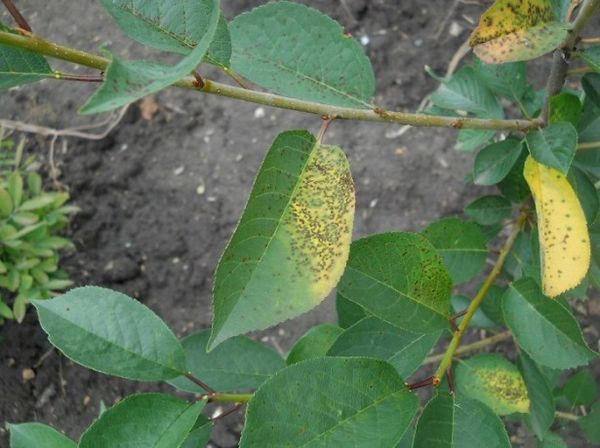
To prevent diseases, keep the tree trunk area clean, removing fallen leaves and pruned branches. All affected or mummified fruits and infected branches should be trimmed and destroyed.
Pests such as cherry aphids, slime sawflies, and moths can ruin a tree's life and create problems for gardeners. Use "Karbofos" against them during bud break and budding. To effectively combat slime sawflies, apply treatment in July, and use "Iskra" after harvest.
To prevent pests from getting a chance, it is necessary to loosen and dig up the tree trunk area and prevent root shoots from growing.
Video: How to Care for Cherries
This video will show you how to properly care for cherry trees in your garden.