
Description of the large black cherry variety Rossoshanskaya
Content
Description and characteristics
The Rossoshanskaya Black cherry was developed at the experimental horticultural station of the same name through open pollination of the local variety Form No. 2 and the Shirpotreb Black variety. In 1986, the variety was released to several regions of the European part of the country, but the trees' good winter hardiness allowed it to thrive in orchards in the Urals and Western Siberia, where it proved a worthy competitor to local varieties. Today, almost every cherry orchard in these regions can boast the Rossoshanskaya cherry, which will be described later in this article.
Trees
Cherry trees are short (3-4 m) and fairly compact, making them a favorite among gardeners and homeowners. The crown is rounded-pyramidal or stacked, with sparsely spaced branches and sparse foliage, the skeletal branches becoming bare with age. Young shoots are gray, usually straight, sometimes curved, the bark slightly rough and resistant to cracking, and the lenticels are convex. As the tree ages, the bark darkens, becoming almost black, while the trunk remains gray. The branches are flexible, making harvesting much easier and preventing damage.
The leaves are glossy, slightly pointed, rich green, and large (up to 10 cm long and 4–5 cm wide). The vegetative and reproductive buds are also quite large, convex, and approximately 5 mm long. The flowers are cup-shaped, gathered in inflorescences of 2–3. The petals are rounded and white, turning pinkish toward the end of flowering. The cherry tree blooms late, in May, but the fruits ripen en masse by mid- to late June. There is a slight tendency to shedding, so do not keep the berries on the tree for too long.
Grafted trees begin bearing fruit in the third to fourth year, but they don't reach their full potential until they're seven to ten years old. In the first few years, yields can reach 4-5 kg per tree, reaching around 15 kg by the age of 10-11, and in particularly productive years, up to 20-25 kg. The large-fruited Rossoshanskaya cherry tolerates cold winters and temperatures down to -30°C, but requires shelter if snow cover is light. Disease resistance is average: in rainy and cool summers, it can be affected by moniliosis.
fruits
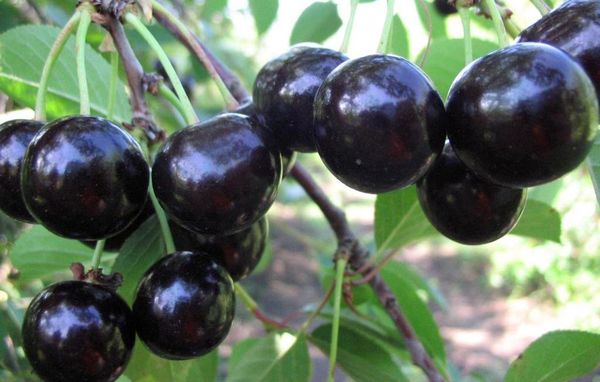
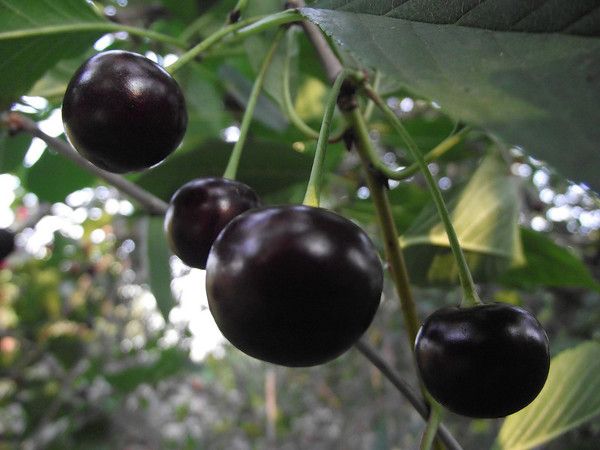
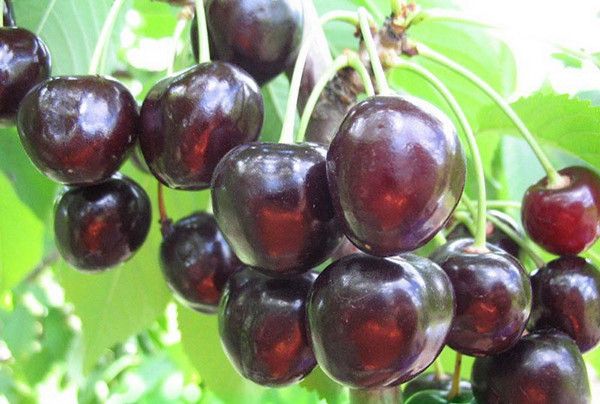
Ripe fruits are very attractive, resembling cherries in appearance. The skin is black, with dark burgundy veins. The cherries themselves are large (4.5–5 g), round or slightly elongated, with flattened sides. The flesh is dense, meaty, a rich dark burgundy color, sweet in taste (up to 12% sugar), with a slight, barely perceptible tart aftertaste, which is the hallmark of this variety. The pit is small and easily separated. The cherries are suitable for any processing, but fresh juice is considered especially tasty and nutritious.
Advantages and disadvantages
The high demand for cherries is due to their numerous advantages:
- the compact size of the tree, which makes it much easier to care for and harvest the fruit;
- good winter hardiness and the ability to cultivate the variety in cold regions;
- early and simultaneous ripening of berries;
- versatility of fruit use;
- with a wonderful sweet berry flavor and a bright aftertaste.
The disadvantages of the variety are not very high yield and low resistance to diseases.
It's also worth noting that the Rossoshanskaya black cherry variety is only partially self-fertile, so pollinators are essential for a bountiful harvest. Overall, gardeners have very positive reviews of the variety, especially the flavor of its berries. If you're still wondering which cherry variety is the sweetest, plant the Rossoshanskaya black cherry, and you won't be disappointed.
Video: Cherry Tree Planting Guidelines
This video will teach you how to choose a location for planting a cherry tree and how to plant the tree.