
Is it possible to graft a cherry tree onto a cherry tree, and how to do it correctly?
Content
Is it possible to graft a cherry tree onto a cherry tree?
Beginning gardeners who are trying to graft fruit and berry crops for the first time have many questions. Specifically, they want to know what to graft cherry tree cuttings onto and what to graft onto the cherry tree itself.
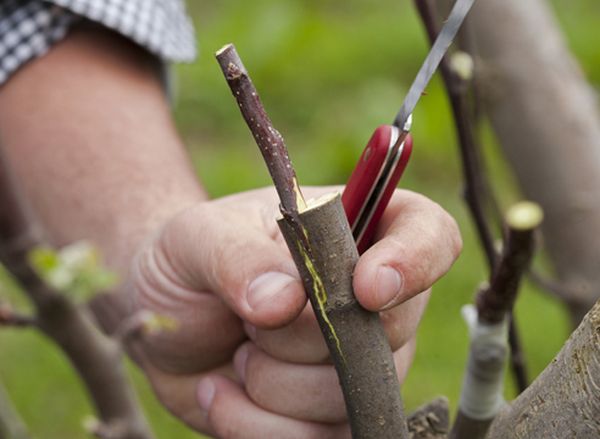
If you want to develop a new variety or grow fruits of different varieties on one tree, you need to graft a cherry onto a cherry.
Cherries can also be grafted onto other stone fruits: sweet cherries, cherry plums, plums, blackthorns, or bird cherries. Cherries are easiest to graft onto bird cherries, as the tree is widely grown throughout Russia and other CIS countries.
If you have a dwarf cherry tree in your garden or want to graft a felt cherry, you'll need a little more skill and experience. This variety is popular among modern gardeners due to its high frost resistance, beautiful appearance, and incredibly tasty berries. Felt cherry is propagated by cuttings grafted onto common cherry, blackthorn, or cherry plum.
Choosing the timing of vaccination
The next question that interests beginners concerns the timing of the procedure. When is the best time to graft a cherry tree: spring or summer?
Spring is considered the best time for propagating and planting plants—this is when the plants awaken and sap begins to actively flow. However, it's best to complete the process before sap begins to flow. Otherwise, drops of sap will form on the cut branches, which oxidize and prevent the cutting from attaching.
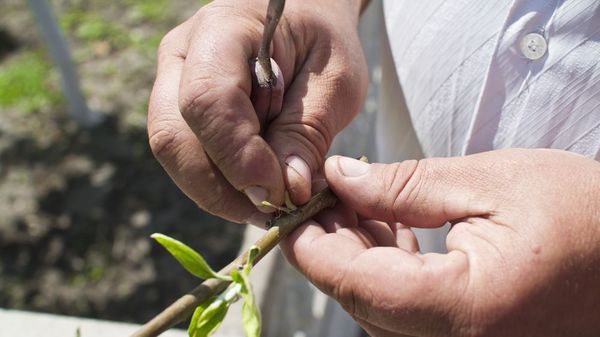
In summer, propagation is by green cuttings. Unfortunately, not every novice gardener can successfully handle this task, so spring grafting is considered more effective and efficient.
Preparing the rootstock and scion
Propagating fruit and berry crops from cuttings will only be successful if the rootstock and scion are selected and prepared correctly. First, let's clarify what a rootstock and scion are.
A rootstock is a fruit tree to which a cutting from another plant will be attached. It's best to choose a young, healthy tree with a trunk about 3–10 cm thick. A mature tree with young branches can also be used as a rootstock.
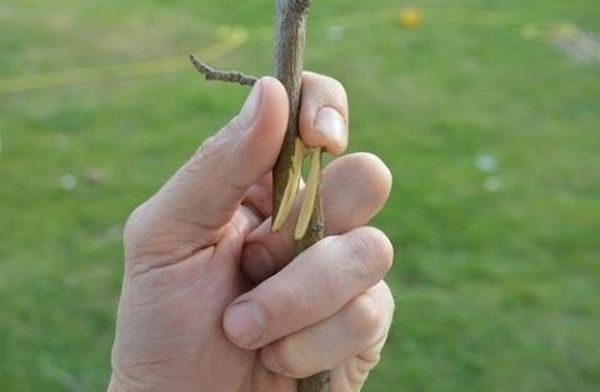
A scion is a small shoot with buds that will be grafted onto the rootstock. Typically, scions harvested in the fall are used for grafting. Late September marks the period of leaf shedding, nutrient supply ceases, and the tree enters dormancy. Select branches at least 5 mm in diameter and cut 10–15 cm long cuttings. Each cutting should have three buds: one growth bud, from which the branches will form, and two leaf buds located on the sides.
Methods of grafting
Cherry grafting can be done in several ways: standard copulation, improved copulation, cleft or semi-cleft grafting, bark grafting, and budding. Regardless of the method chosen, be sure to prepare all the necessary tools in advance. You'll need the following tools on hand:
- budding knife;
- pruning shears;
- garden saw;
- film made of dense polyethylene;
- insulating tape;
- paint based on drying oil or garden varnish.
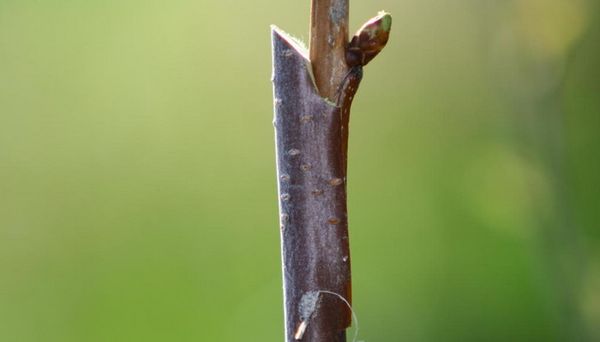
The most common methods of grafting and re-grafting cherries include:
Budding
Cherry bud grafting, or bud grafting, is one of the most labor-intensive and complex processes. Returning to the question, "When should I graft a cherry tree?", it's important to note that this procedure is performed in mid-June.
A T-shaped cut is made in the rootstock, capturing the wood. A small scion is prepared, with a single growth bud in the center. The scion is placed in the hollow in the rootstock, pressed firmly, and secured with plastic film or tape. After a month, the film can be removed.
Cleft grafting
One of the most popular and widespread methods of budding cherries among gardeners is cleft grafting. This procedure must be performed in the spring. Summer cleft grafting often fails.
Let's look at this method in more detail:
- Prepare the tools.
- Select a rootstock with a diameter of at least 10 cm.
- Split the tree trunk to a depth of approximately 2.5–3 cm.
- Make a diagonal cut on the scion in the shape of a “sharp tongue”.
- Graft the scion onto the rootstock. To do this, insert the scion into the hole you've made and secure it there with electrical tape.
- To protect a tree with "wounds" from harmful insects, treat the plant with garden pitch.
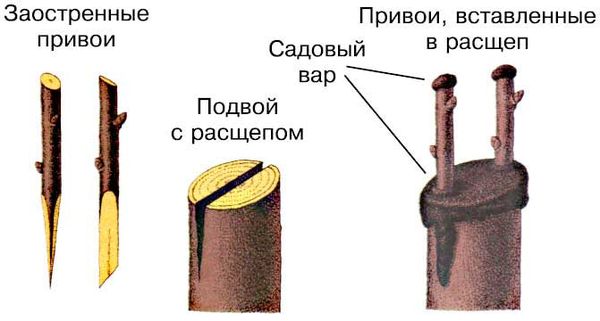
Copulation
Unlike the previous methods, copulation is considered the easiest method of grafting fruit and berry crops. It is most often used for grafting cherries onto cherries or cherries onto bird cherries.
The diameter of the rootstock and scion should be nearly identical. Make 2-3 cm long diagonal cuts on both the scion and the tree. Attach the scion tightly to the rootstock and wrap it with plastic wrap, which can be further reinforced with electrical tape. Treat the graft site with garden pitch or oil paint.
Further care
After completing the budding procedure, do not forget to provide the plant with additional care:
- strengthen the branch with a “splint” that will protect it from strong gusts of wind;
- After 1-2 weeks, remove the film and tape to allow oxygen access;
- Apply fertilizers rich in nitrogen, phosphorus and potassium.
Video: "Grafting Cherry Trees onto Cherry Trees"
This video will show you how to graft a cherry tree onto a cherry tree.