
Description and cultivation of the Duke cherry and sweet cherry hybrid
Content
Description of the hybrid variety
The Bel cherry and the Bela Winkler cherry were crossed by Ivan Michurin, resulting in the Krasa Severa variety, which marked the beginning of the development of Russian Dukes. It turned out that the generally frost-resistant tree could not produce large yields in the north due to the freezing of flower buds. Breeders then crossed different varieties, and today there are hybrids that are successfully grown in various regions of the country.
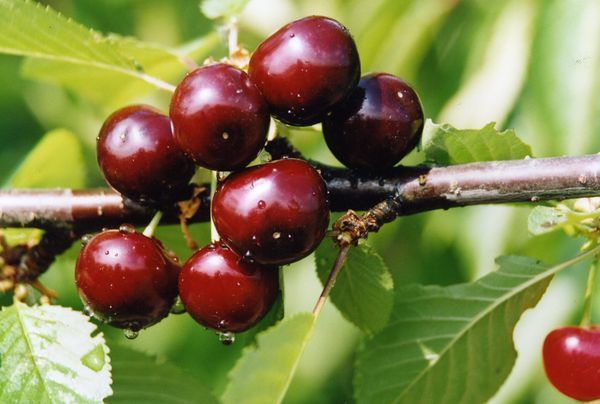
Thus, the Ivanovna and Spartanka varieties are cultivated successfully in Western Siberia, while the hybrids Krepkaya, Fesanna, Mayak, Nadezhda, Pamyati Vavilova, and others grow in the Khabarovsk Krai. Krasa Severa (Beauty of the North) is grown in the Moscow and Leningrad Oblasts. The best varieties for the Moscow region and central Russia include Dorodnaya, Zhukovskaya, and Kormilitsa. In the south, Chudo-Vishnya (Cherry) produces delicious fruit.
So what is a duke? A hybrid of cherry and sweet cherry, called a duke, is usually a tall, strong tree, and if left untreated, its crown will become pyramidal. The bark on the thick branches is smooth, even, and brown. The leaves are shaped like cherry leaves, but large, like those of cherries, and are a rich green, attached to the branches by long petioles and arranged alternately. The flowers are white or pink, larger than cherry blossoms, and borne in clusters. Blooming time varies by region: in the south, the trees bloom in early May, while in the north, they bloom in the second half of June.
The hybrid's main advantage is its magnificent berries. They are large, like those of a varietal cherry, but more delicate in texture and much richer in flavor (though not as tart as the cherry with which it was crossed): sweet, with interesting notes of acidity and a very pleasant aftertaste. The aroma also contains tantalizing cherry notes. Variety descriptions usually indicate the berry size. For example, the Nochka and Kormilitsa cherries produce medium-sized fruits weighing 7–8 g, while the Chudo-Vishnya produces berries weighing 10 g. They are usually dark red, and the pit separates easily from the pulp.
Main characteristics
Hybrids are easy to grow, have excellent winter hardiness, and are resistant to many diseases, such as coccomycosis and moniliosis, and are unaffected by the cherry blossom fly. Although they tolerate winter well, in the north, it's better to cultivate the bush form, as it's easier to protect the bushes from the cold and rodents.
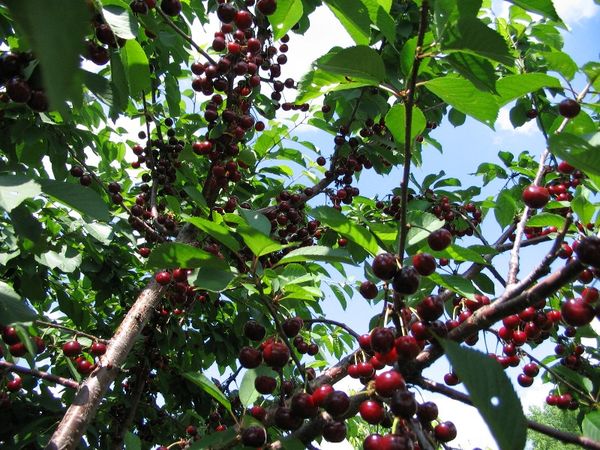
Dukes are drought-resistant and don't require, or rather are harmed by, extensive fertilizing, so fertilizers are used sparingly. With proper care, the trees can bear fruit for up to 30 years, starting at three or four years of age, with the first fruits already bearing at two years of age. The average yield of a mature tree is 15 kg. All characteristics are excellent, except one: the hybrids are self-sterile, and not every cherry variety can serve as a pollinator.
Planting a variety
Planting and care are almost traditional. Purchase a one-year-old seedling, check the root system, the condition and development of the trunk and shoots—they should have smooth, undamaged bark, and the central shoot should be at least 60 cm tall.
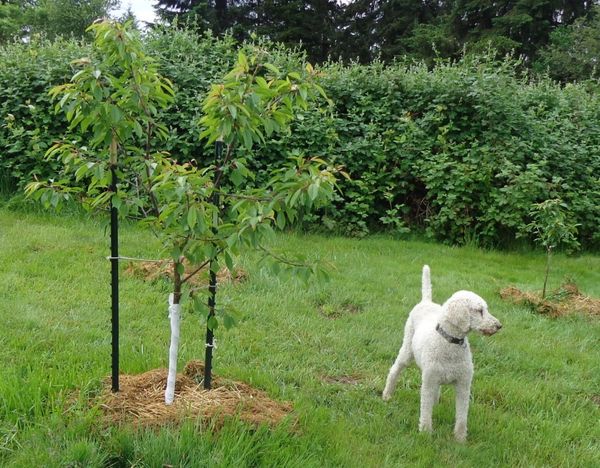
Choose a sunny location, protected from wind and drafts, with a deep (at least 2 m) water table. Maintain a 5 m distance from other trees. The soil should be fertile, moderately loose, and neutral or slightly acidic.
Planting can be done in spring or fall. It's best to dig a hole for planting in advance and mix the excavated soil with fertilizer (300-400 g superphosphate, 200-300 g potassium sulfate) and wood ash. If the soil is very poor, compost or humus can be added; if it's too clayey, mix it with sand. If the soil is too acidic, mix it with lime.
After planting, water generously, checking that the root collar remains at surface level.
Care and formation
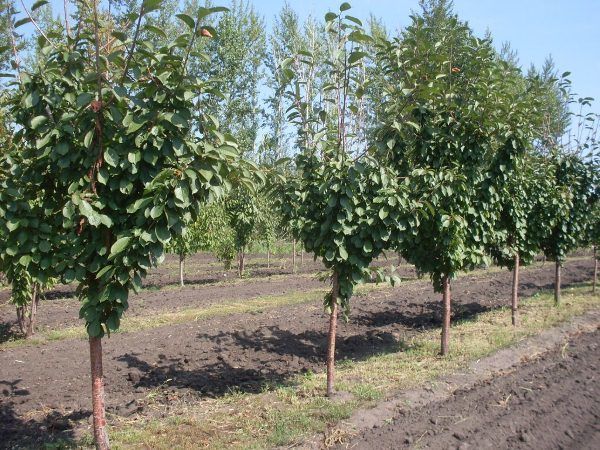
Water the tree for the first couple of months, then reduce the amount, and don't water the mature tree. Fertilizing is limited to two applications: nitrogen (15 g) in the spring, and potassium and phosphorus (20 and 30 g) in the fall. The soil under the tree should be kept clean, loosened, and mulched with hay or chopped grass.
Sometimes, treating the tree and the soil beneath it with Bordeaux mixture is recommended as a disease preventative. However, the most important part of care is pruning. In the first spring, the central shoot is shortened to 60 cm, and the lateral shoots to 40 cm. Subsequently, the shoots are shortened by a third, preventing the crown from becoming too dense, and the branches are guided downwards with ties or weights to create a rounded shape and prevent them from becoming too tall. Regular pruning stimulates the growth of bouquet branches.
Every 5 years, rejuvenating pruning is carried out, cutting branches back to 4-year-old wood.
Pollinators and fruiting
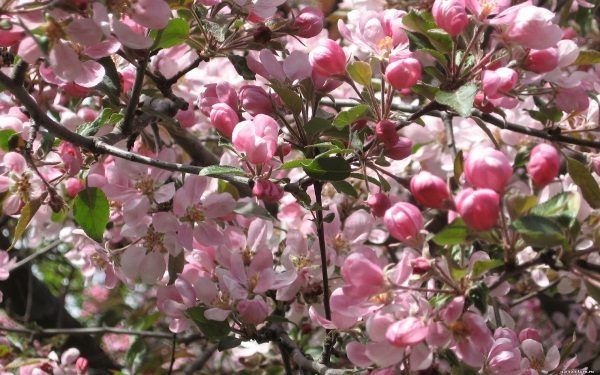
The hybrid begins to bloom with the onset of warm weather, with the exact time varying by region. Fruits form on cluster branches located at the tops of the trees, but only if a pollinator is nearby. This can't be done with just any cherry variety—for example, Valeria, Drogana zheltaya, and Krupnoplodnaya cannot be used as a pollinator. Incidentally, Chudo-Vishnya (Chudo-Cherry) also cannot act as a pollinator for anyone. You should choose from the following varieties: Sestrenka, Donchanka, Annushka, Priusadebnaya, and some others. Before purchasing a seedling, determine which variety will serve as its pollinator, try to buy a seedling of that variety, and plant them at the same time.
Some homeowners grow Duke's berries for ornamental purposes. The tree is very beautiful, especially when in bloom. It's a shame that the numerous barren flowers simply fall to the ground, never producing fruit, which is also very attractive. The incredibly tasty berries of these hybrids don't travel long distances; they are eaten fresh, used to make liqueurs, jams, or preserves, and are also dried and cured.
Video: "The Secret to the High Yield of the Duke Variety"
This video will tell you why the Duke cherry variety is one of the most productive.