
Description and tips for growing the early cherry Iput
Content
History of crop selection
The hybrid was developed by M. V. Kanshina and A. A. Astakhov, employees of the All-Russian Lupine Research Institute. It was named after the Iput River and the village of the same name where the institute was located. Work on the variety began in the 1980s, and in 1993, the cherry was finally added to the State Register of Breeding Achievements.
Description and characteristics of the Iput cherry
Like all hybrids, this one has absorbed many positive qualities from its parent pair. Thanks to these qualities, the variety has achieved success and is actively grown by gardeners in the central, and sometimes even northern, regions. Below are the characteristics of the Iput cherry.
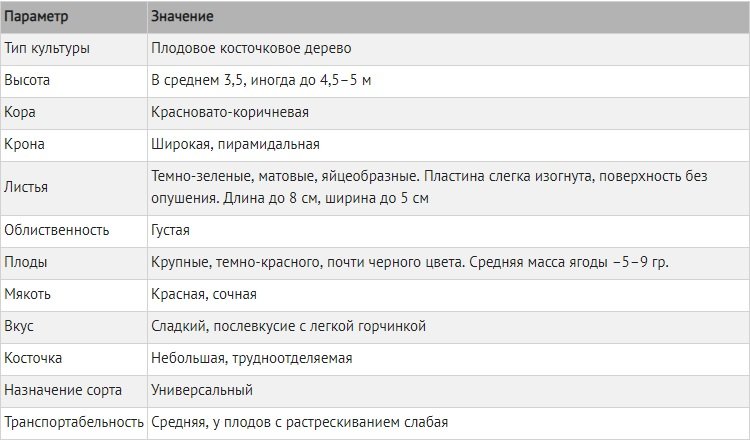
Description of the tree
According to the State Register, the plant is medium-sized. A mature tree reaches almost five meters and is distinguished by a dense pyramidal crown. The rich green leaf blades are oblong with pointed tips. The surface is textured, the edges are finely serrated, and the petiole is medium. The inflorescences are lush and full, consisting of three to four small, snow-white flowers of a simple structure.
Fruit characteristics
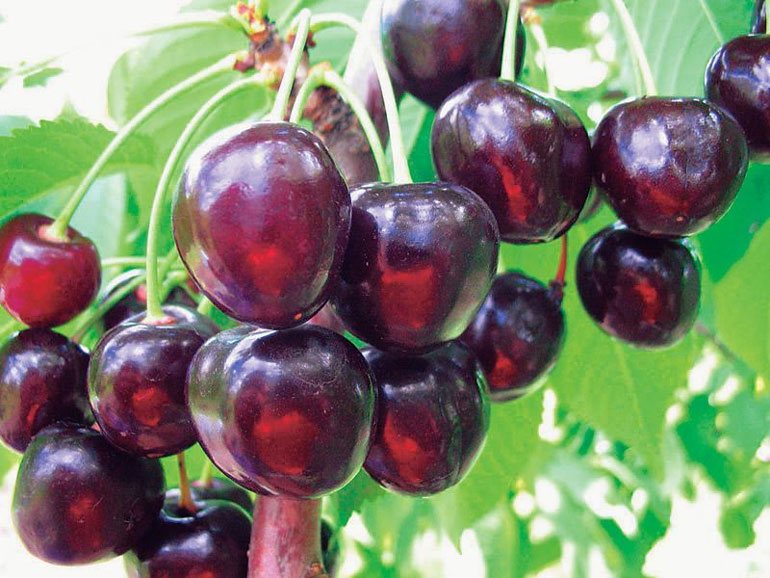
Iput berries are round, slightly heart-shaped, and weigh between 5 and 10 grams. The skin is smooth, glossy, and dense, with a burgundy-red hue. Fully ripened berries turn almost black. The flesh is fleshy, juicy, and scarlet. The pit is medium-sized.
The cherry tastes quite sweet, although the sugar content does not exceed 11%. The berries also contain only about 0.5% acid. On the tasting scale, the hybrid received a 4.6 score.
Ripening and fruiting periods
Iput is an early-ripening hybrid. It blooms from mid-April to mid-May, and the harvest can be collected by early July. Young seedlings begin bearing fruit in the fourth to fifth year after planting.
This variety is partially self-fertile, but requires an additional pollinator for best fruiting. Gardeners recommend planting it next to Revna, Raditsa, Tyutchevka, Ovstuzhenka, or Bryanskaya Rozovaya.
Productivity and scope of application
Cherry trees bear fruit regularly. The State Register lists productivity at approximately 30 kg per tree. However, under different growing conditions, this figure can range from 20 to 50 kg per tree.
Cherries are prized for their versatility. Harvested cherries can be eaten fresh or preserved for winter. They also make excellent compotes and juices.
Drought resistance, winter hardiness
This variety is prized by gardeners for its frost resistance, making it suitable for growing in regions with harsh winters. The plant is cold-resistant and thrives in temperatures down to -30°C.
The hybrid also tolerates hot, dry weather well. It doesn't require frequent watering, but excessive moisture can affect the commercial quality of the harvest, causing the berries to crack.
Advantages and disadvantages of the variety
The Iput cherry can be called one of the successful experiments of Bryansk breeders.
- resistance to critical temperatures;
- regular abundant fruiting;
- early maturity;
- increased immunity to infections;
- versatility;
- high taste qualities.
- young seedlings begin to bear fruit only in the 4th-5th year;
- If the berries are over-watered, they lose their marketable appearance;
- The stone does not separate from the pulp very well.
Video "Description of the Iput Cherry"
This video provides a brief overview of the varietal characteristics of the fruit crop.
Planting and caring for the Iput cherry tree
Numerous positive reviews indicate that gardeners love this hybrid for its ease of care. Even beginners can grow Iput, as the tree requires little or no special care. We'll discuss planting considerations in more detail below.
Recommended timeframes
Planting time varies by region. In the south of the country, the procedure can be carried out in spring or fall. Gardeners recommend the fall months, when the tree has completely shed its leaves.
In the central and northern regions, planting is best done in the spring, before the buds begin to appear.
Preparatory stage
Iput grows well in sunny, elevated areas, protected from drafts and strong winds. However, the groundwater table should not be higher than two meters. The hybrid prefers light, fertile soil with a neutral pH.
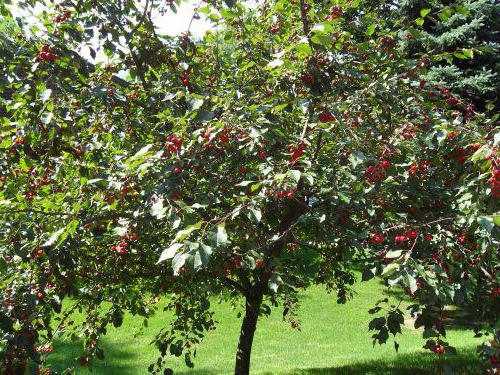
Cuttings are best planted near other cherry trees. They can also be planted near grapevines and elderberries. Certain bulbous flowers (daffodils, tulips) or primroses can also be planted under the tree.
When choosing planting material, gardeners recommend choosing two-year-old seedlings with a well-developed root system. The trunk should be smooth, even, and at least 1.5 cm in diameter. It's also important to ensure the cutting has several strong branches 30-40 cm long.
Landing algorithm
To ensure that young seedlings take root well, it is necessary to adhere to the following algorithm:
- Dig planting holes in advance measuring 100x100x80 cm at intervals of 3 m.
- Mix the removed soil with humus and superphosphate.
- Check the cutting again before planting.
- Place a support next to the hole.
- Pour the prepared substrate into the bottom of the hole.
- Place the seedling so that the root collar remains level with the surface, and then cover it with the remaining soil, compacting it lightly.
- Make a circle around the tree trunk and pour 3-4 buckets of water into it.
- Spread a mulched layer of dry grass or wood chips.
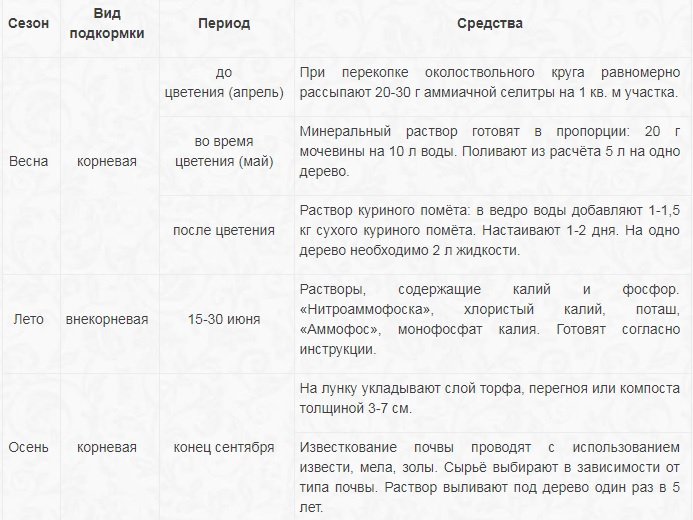
Watering and fertilizing
Gardeners recommend moistening cherries in this way:
- in spring, before the formation of ovaries;
- 2 weeks after the start of flowering;
- 20 days before fruit ripening;
- before wintering.
Young one-year-old seedlings are fed with superphosphate once. In the second year, rotted manure is added, and in the third year, they are fertilized twice – in May and June. When the tree begins to bear fruit, the frequency is increased to three times:
- in early spring, before the sap begins to flow;
- at the beginning of flowering;
- third ten days of August.
Crown formation
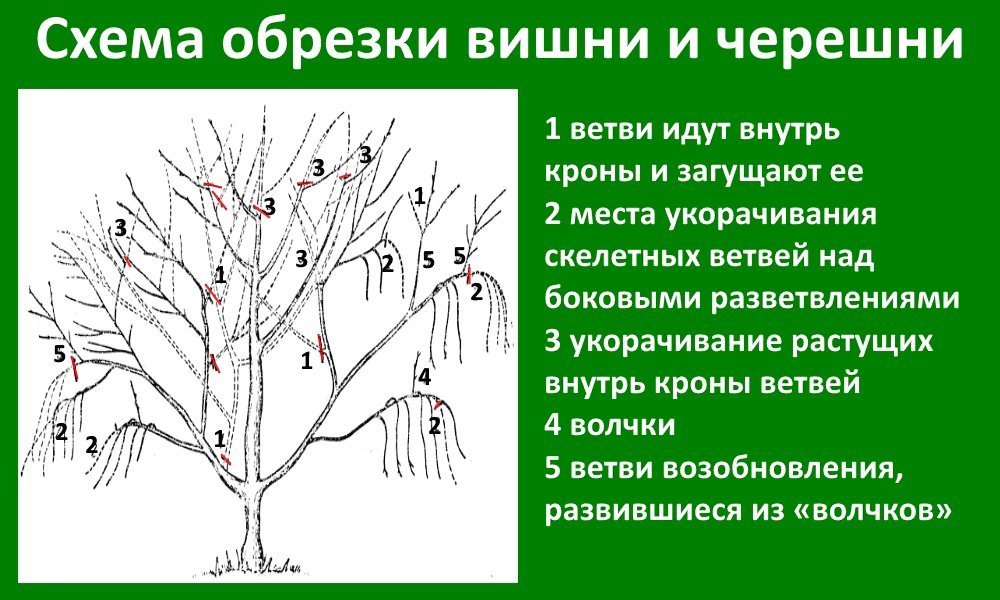
To ensure a good harvest, a tree needs to be pruned correctly, creating a multi-layered crown. Formative pruning is carried out in stages:
- In the second year after planting, only two pairs of branches are left at a height of half a meter from the ground.
- The following spring, a second tier is formed, consisting of two shoots at a distance of 50 cm from the bottom one.
- Next, the trunk is cut above the second tier, leaving only one main branch.
- In subsequent years, all shoots are cut back to half their length.
Sanitary pruning is also carried out annually, removing dried, broken or crooked branches.
Treatment against diseases and pests
The Iput cherry tree is quite resistant to infections and therefore rarely gets sick. Most often, improper care is the cause. However, the hybrid can sometimes be affected by the following diseases:
- rust;
- Clusterosporiosis;
- coccomycosis.
For prevention and treatment, trees are treated with fungicides, but no later than one and a half months before harvesting.
Pests also rarely attack the hybrid. The only insects that can cause significant damage are aphids and weevils. To protect the plants, they are sprayed with insecticides.
-
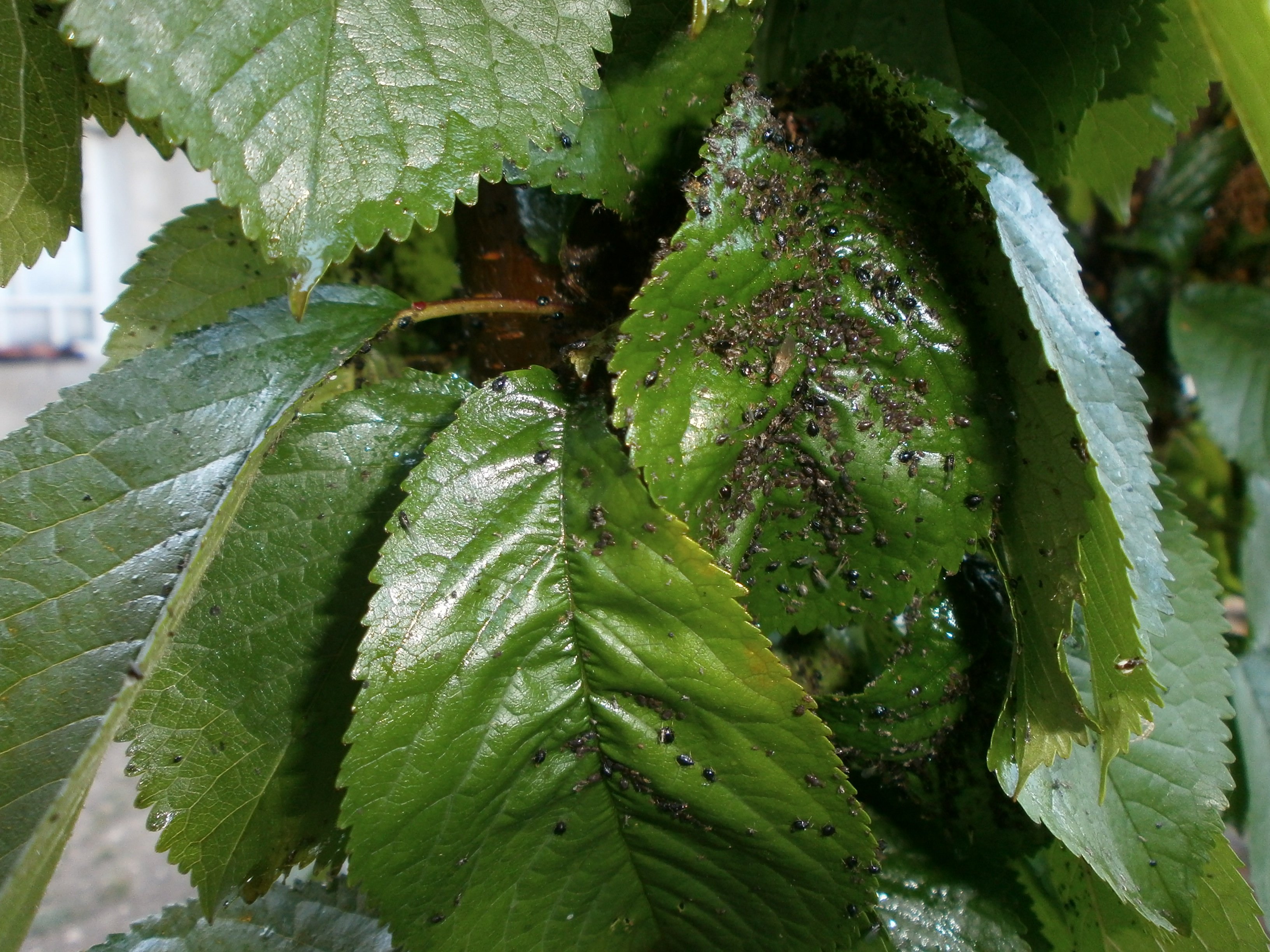
- Aphids on cherry trees
-
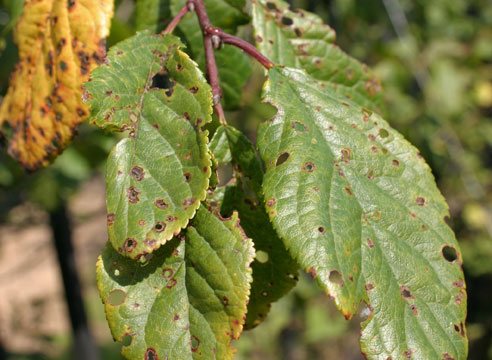
- Clusterosporiasis
-
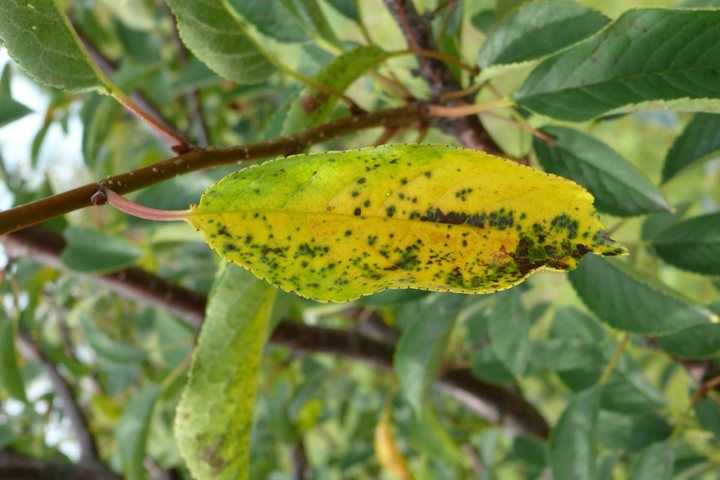
- Coccomycosis
Reviews from summer residents
We've been growing Iput for several years, and it's never let us down. It bears fruit well, rarely gets sick, and we harvest a couple of buckets from a single tree every year.
I planted Iput at my dacha back in the '90s. I like its low maintenance and winter hardiness. Even with minimal care, the cherry tree produces a wonderful harvest.
I took the seedlings relatively recently. All the cuttings took root well, and we're seeing vigorous growth. I'm pleased that the young trees survived the winter without any damage. Now we're waiting for the harvest.
It's no wonder Iput' is considered a successful experiment by Bryansk breeders. Although it doesn't stand out from other varieties, it has already become a favorite among many gardeners.