
Description and care of the hybrid cherry variety Ashinskaya
Content
History of variety selection
This variety was developed relatively recently. In 2002, the Ashinskaya cherry was added to the State Register. This variety was created by crossing a steppe (wild) shrub cherry with a domestic garden cherry.
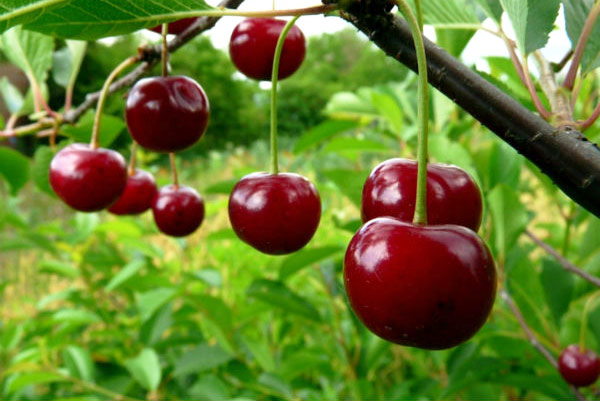
Scientists from the South Ural Research Institute worked on the breeding process. The researchers achieved a cherry tree that can be propagated by any method (cuttings, shoots, grafting, or pitting) without losing its varietal characteristics. This variety is good for large-scale industrial cultivation, for gardens and summer cottages. It grows throughout Russia, except for the far north. Ashinskaya cherry is also found in Asia and Europe.
Description and characteristics
The variety description is accurate and comprehensive. Like the steppe cherry, the Ashinskaya cherry is naturally resilient, symmetrical, and unpretentious, and its fruits are renowned for their remarkable taste. This fast-growing, tree-like cherry has a slender, strong trunk with virtually no crown joints. The cherry tree grows to a height of 2.5–3 m. The trunk measures 30–40 cm. It has a strong, dense, cylindrical-conical crown. The shoots are slightly rounded, light brown with a silvery sheen, and 35–40 cm long, with a small amount of fluff. The leaf blades are quite large, rich green, smooth, and round, slightly curved upward. The buds are medium-sized, recurved, smooth, and even. The flavor profile of the fruits is almost impeccable: sweetness combined with a slight tartness. The berries are large and heavy, slightly flattened, and burgundy in color. The structure is juicy and soft, despite the dense skin.
The tree's key characteristics include the following: this variety is exceptionally frost-hardy and resilient. It is drought-resistant and recovers quickly. It flowers and bears fruit later than other varieties. Fruit appears in the third year after planting, and the cherry tree continues to produce even after 30 years. It is self-fertile and partially self-pollinates. The tree bears fruit reliably, abundantly, and annually.
Features of cultivation
As mentioned earlier, planting and caring for cherry trees is extremely simple, and any planting method can be chosen. The most common and effective method is propagation by seedlings. You can prepare them yourself or purchase them ready for planting. For this, seedlings are prepared in early summer. The shoots should be firm at the base and light burgundy in color.
The optimal length is determined by the gardener, but more than 35 cm is recommended. Shoots are pruned when the sun has not yet risen high or is already setting; early morning and late evening are ideal. Cool, cloudy weather is ideal. After pruning, the shoot is placed in a solution of water with a growth stimulant to promote rapid root emergence and development. Keep the cutting in the solution for about a day. Don't immerse the shoot too deeply; a couple of centimeters is sufficient. Then the cuttings are planted shallowly in prepared soil and covered with film until it reaches the required height for the seedling.
In about a month, hard-to-root roots will appear. Sandy loam soil with a neutral or slightly alkaline pH is best for growing Ashinskaya cherries. Before planting, dig the soil, remove weeds, level it, and make holes. Dig the hole approximately 0.5 m deep and fill it with peat and sand to a depth of 1/5. Next, place the seedling. If the soil isn't sandy, cover it with coarse river sand, level it, and compact it. After planting, water the seedling generously and feed it with mineral fertilizer. Superphosphate is commonly used.
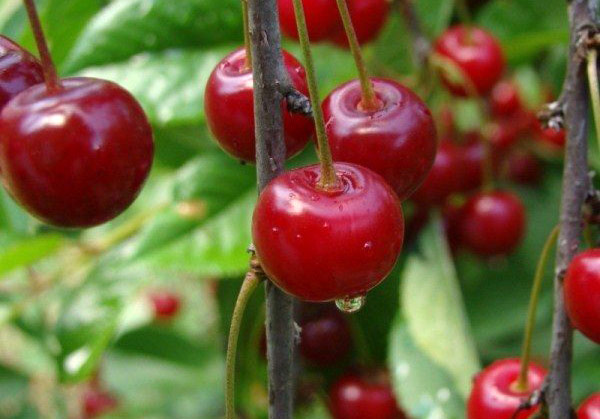
Although this variety is low-maintenance, regular care will positively impact the yield. Cherries need to be thinned periodically to ensure a comfortable harvest. However, remember that root shoots are natural for this variety and do not interfere with the tree's development. Fertilizers should be used prophylactically and sparingly. If the tree is not growing well, organic and mineral fertilizers are recommended. Steppe cherries are drought-resistant, but watering is still necessary if rainfall is insufficient. Covering or insulating the tree for the winter is not necessary; it easily tolerates severe frosts.
One of the greatest advantages of this variety is its resistance to fungal and viral diseases. Also, the cherry tree is rarely attacked by pests and pathogens, only under unfavorable conditions.
The Ashinskaya cherry tree is distinguished primarily by its advantages. Its disadvantages are perhaps only considered from an industrial perspective, as the fruit ripens too late and does not withstand long-distance transportation. This variety is ideal for growing in a regular garden: it offers high yields, regular fruiting, and excellent flavor. Moreover, the tree will delight you with harvests for many years.
Video "Description of Cherry Varieties"
In this video, a professional gardener shares his personal experience growing different varieties of cherries.