
What you need to know about growing grapes in a greenhouse
Content
Pros and cons of greenhouse growing
Growing grapes in a greenhouse has many advantages:
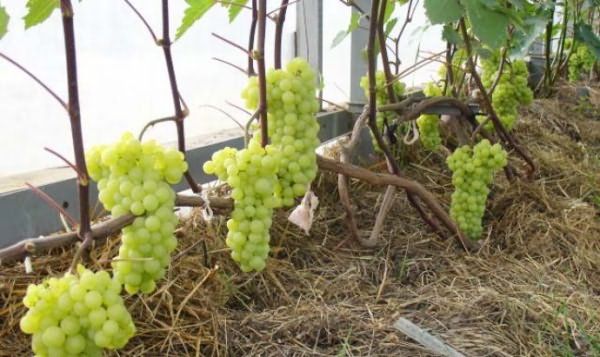
- You will always get an excellent harvest, since unfavorable climatic conditions will not affect your vineyards.
- The berries will have an incredible taste and will fully meet the stated taste characteristics of the selected variety.
- The harvest will ripen in record time.
- Caring for a greenhouse plant is much easier.
- The risk of disease is much lower than when growing crops in open ground.
- Growing bushes will not be threatened by various insects, such as wasps, which are a major problem for winegrowers.
- The berries will also not crack, since the plants in greenhouses are reliably protected from precipitation and high humidity.
- Growing grapes in a greenhouse allows you to plant a variety of dessert varieties that are very demanding of climate conditions.
- You can also use the greenhouse to grow other crops.
However, there are also some downsides you may encounter when choosing to grow grapes in a greenhouse. These are primarily related to the high costs of building the greenhouse and purchasing the seedlings. You'll need to carefully follow all the instructions to ensure the greenhouse is built correctly and provides optimal conditions for the plants. Furthermore, caring for grape vines is no easy task, so you'll need to thoroughly research the subject and put in a lot of effort to achieve the desired results.
Selecting a variety
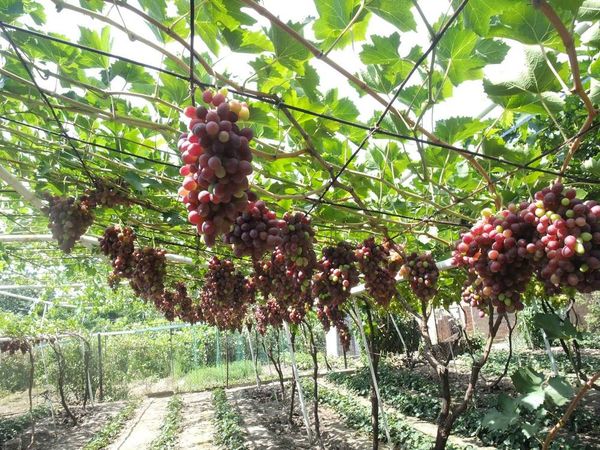
Beginners are better off choosing early varieties that have good frost resistance – this way you are guaranteed to get good results. This could be Kishmish, Michurinsky, Korinka Russian or any other variety with similar characteristics.
Once you've achieved good results with early varieties, you can move on to growing more demanding dessert varieties. However, don't attempt to grow them until you've gained experience with less demanding varieties.
What a greenhouse should be like
Half the battle is a well-built greenhouse. You must meet all the requirements to ensure the crop is as comfortable as possible, as a grape greenhouse has little in common with traditional cucumber greenhouses.
The height should be at least 2.5 m or higher (depending on the height of the trellises). The optimal area is around 25 m² – larger greenhouses are only suitable for those planning to grow crops for sale. A foundation is essential, otherwise the ground will freeze. It can be made of concrete.
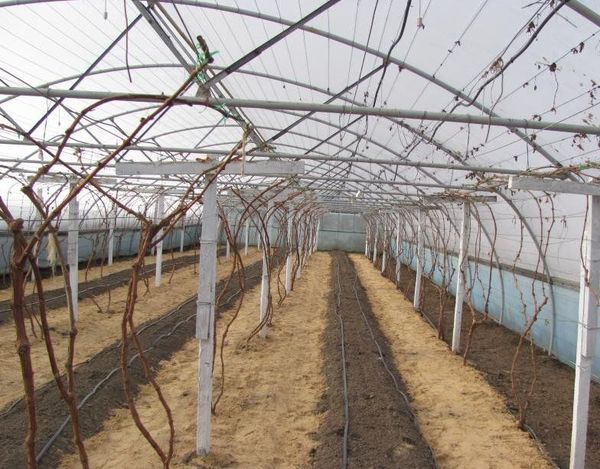
Polycarbonate is recommended for cladding, as this material transmits light well and has the necessary thermal insulation properties. It is also recommended for greenhouses that will be heated (for example, in cold regions). If you don't plan to heat the space, polyethylene film can be used for cladding.
The frame can be easily made from steel profile tubing—it's durable, so you can use the greenhouse for many years to come. Heating can be provided by infrared lamps mounted on the ceiling or by regular radiators—an effective and cost-effective solution.
If your region is cold and gloomy, you should use fluorescent lamps to prevent plants from growing in the dark. You can choose from a variety of available options (fluorescent, LED, or sodium) – they'll all work equally well.
And finally: don't forget about ventilation. For a standard-sized greenhouse, two small vents should be sufficient. Instead of opening them manually, you can equip them with special thermal cylinders that will open the vents at a certain room temperature.
Preparing the trellis
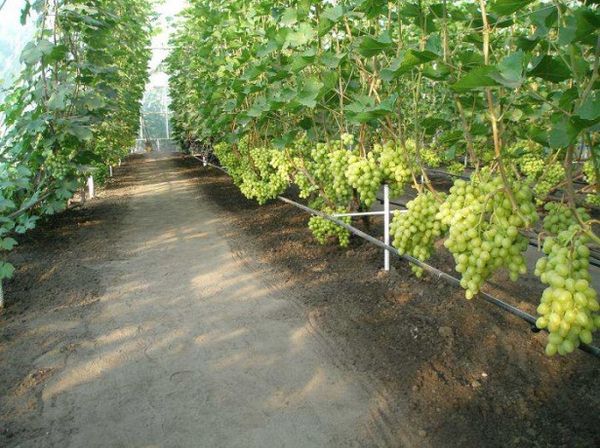
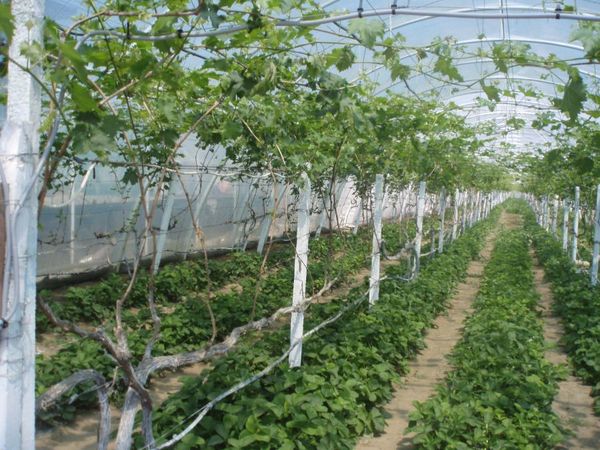
Trellis designs vary from elegant Italian pergolas to simple vertical trellises. To create a vertical trellis, you'll need a certain number of metal pipes and wire stretched between them.
First, mark where you'll place the pipes and drive them in. Each pipe should be about 2-3 meters above ground level, with a 6-cm gap between adjacent pipes. They should be driven in at least a meter deep to ensure a strong structure. The first wire should be stretched about 50 cm above the seedling, and subsequent wires should be placed every 35-40 cm. You can secure them with nails or eyelets.
Growing
If you've decided to plant grapes in a greenhouse, the growing process is quite simple. Let's look at the basic rules to follow.
Landing features
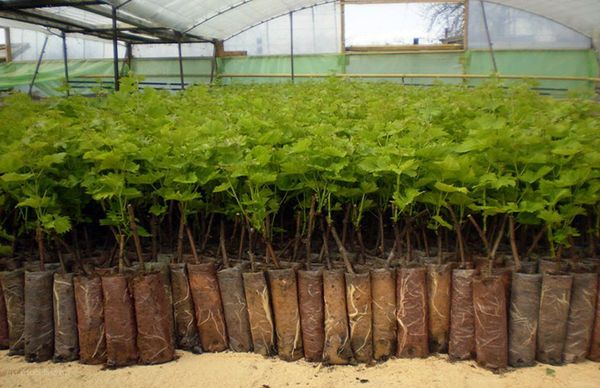
So, planting grapes in a greenhouse begins with the arrival of spring. Dig a hole measuring 80 x 80 cm and about 70 cm deep. Fill the bottom with ¼ of a bucket of wood ash, a 20 cm layer of drainage (remember to insert a tube extending 5–10 cm above ground level), and about 20 cm of prepared soil mixture. Now you can begin planting: place the seedling in the hole, spread its roots, and cover it with about 20 cm of soil. Place the seedling so that it is parallel to the casing.
Care and pollination
Adjust the greenhouse temperature according to the seedling's needs. In spring, it should be 10–20°C (at least 8°C at night), and during the flowering period, 25°C. During the ripening period, the temperature will need to be raised to 30°C.
Pollination is carried out independently - for this, you can lightly tap on the flowers of one of the plants and transfer the pollen in your hands to another plant.
Pruning and shaping
To ensure strong and sturdy shoots, be sure to remove side shoots and weak branches (before the first bud). You should also prune the tops of the shoots several times a season. To do this correctly, consult the relevant literature. Also, always remove diseased and small berries to prevent your plant from wasting energy.
Watering and fertilizing
The first watering should be done immediately after planting, and the next one should be done 7 days later. During the summer, watering should be done once a week. During the flowering period, reduce the frequency of watering to a minimum. Watering should be done only during the day, and always ventilate the room at night.
Before planting, fertilize the plant with organic fertilizer. When the buds begin to open, fertilize with ammonium nitrate, and before flowering, apply superphosphate. During further plant growth, apply foliar fertilizer.
Preparing for winter
Around mid-October, ensure the grape vines are securely covered. Bend them toward the ground and cover them with spruce branches, roofing felt, blankets, or synthetic padding.
Video "Greenhouse for Grapes"
This video will tell you what a greenhouse for grapes should be like.