
The best grape varieties and cultivation in Belarus
Content
Which variety to choose?
Of course, to grow a plant and get an excellent harvest, it's necessary to select grape varieties that are suited specifically to local climate conditions. Obviously, the further north you go, the more frost-resistant and early the plant should be.
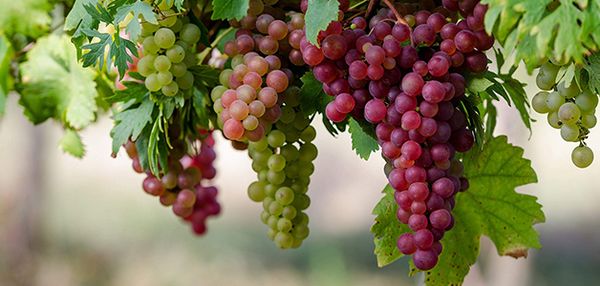
The most common varieties in Belarus are Isabella, Madeleine Angevin, and Chasselas Blanca. The easiest option for beginners is to grow varieties that are resistant to frost and fungus. Such varieties include, for example, non-covered grapes. They will be slightly inferior in flavor to gourmet varieties, but they are also much easier to care for.
Hardy varieties include Vostorg, Russian Concord, Lydia, Dnestrovsky Rozov, and others. In fact, there are numerous varieties suitable for growing in the north. Around 200 such varieties were developed in the Pinsk viticulture base (Belarus) alone.
For northern viticulture, there's perhaps no more important parameter than ripening time. Ripening time is the period from bud break to full ripening of the berry. It's also important to consider the sum of active temperatures during the vine's growing season. There's no need to calculate these parameters—they're already known and included in the description for each variety. The most suitable of the 8 categories for cultivation in Belarus are: extra-early (up to 105 days), very early (105–115 days), early (115–125 days), early-mid (125–135 days).
Landing features
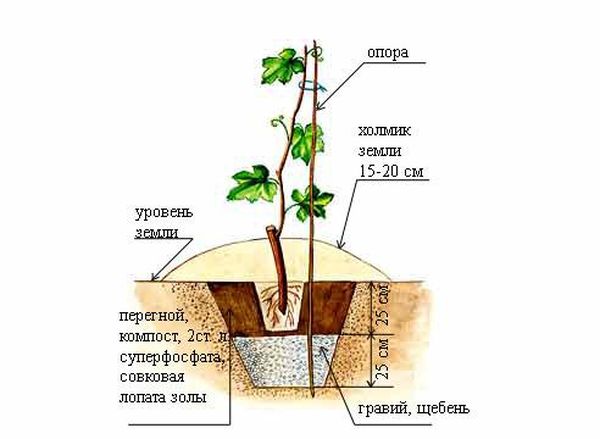
The main challenges for grape planting in Belarus are poor soil and low temperatures. The former is addressed by filling the hole with fertile soil for a couple of years ahead, while the latter is addressed by covering the soil for the winter.
Grapes should be planted in warm soil—the same time as for vegetable planting (May-June). They can also be planted in early fall, but then a small mound should be built over the seedlings for winter protection. Tall varieties should be planted 1.5–2 meters apart. Different varieties are best grown at greater distances. The deepest planting depth in Belarus is recommended in the southern region—30 cm. The minimum planting depth in the north is 20 cm.
As noted above, it's best to create a reserve of nutrients: to do this, add drainage to the bottom, then add enriched soil—usually soil mixed with manure, compost, and ash. A third of the hole is filled to form a mound, into which the seedling is placed, its roots are spread out, and soil is added. Prune the seedlings so that two buds remain above the surface. Plant at a 45° angle. Then, thoroughly water the soil with warm water and top up to the original level. With this type of planting, the vineyard does not need additional feeding during its first year.
Care instructions
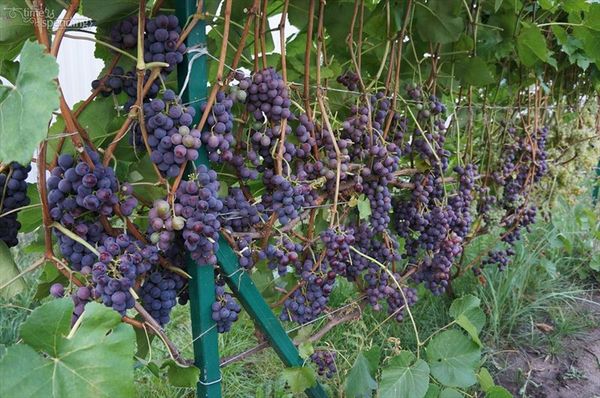
Of course, planting a grapevine won't guarantee you the desired harvest without some effort. Grapevines require some care. To ensure the vines form a fan-shaped form, you need to break off some of the shoots as they grow. The cutting should produce 2-3 shoots, each of which can produce 3-4 more. At this point, it's time to install supports to secure the vines as they grow. A well-known and easy method of support is using stakes with wire stretched between them.
Pruning and side-sonning are also critical for grapevine development. Weak shoots should be removed in the spring. Before flowering, the tops are pinched to promote lateral growth. In the fall, don't forget to care for the grapevines by pruning the youngest shoots and shortening any woody ones.
Mulching is good for keeping the soil around the trunk loose and weed-free. Although grapes require regular watering, they should not be watered in the second half of summer. If autumn rainfall is dry, the bushes should be thoroughly watered in winter. Mature grapes require fertilizing three times a year: in spring, before flowering, and when the berries are pea-sized.
Preparing for winter
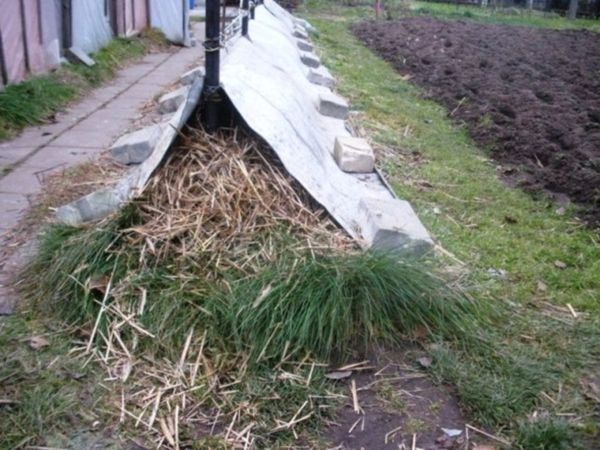
To ensure your vineyard survives the winter, it requires additional protection. Therefore, it is covered for the winter. This is best done when daytime temperatures consistently drop below freezing. In southern Belarus, this occurs at the end of November, and in central and northern Belarus, mid-November. However, due to warmer weather, this time has shifted by almost a month.
Before covering, grapevines need to be pruned. If the vine was planted this year, only the portion that was killed by the first frost needs to be removed. Afterward, treat with a 3% copper or iron sulfate solution. Natural materials such as straw, reeds, and the like, as well as artificial materials such as foamed polyethylene, are suitable for covering.
A common mistake is removing the cover late, which leads to either damping off of the bush or premature awakening. In the southern regions of the country, this should be done in the first ten days of March, in the central region – at the end of the second, and in the northern region – at the end of March.
You shouldn't open the grapes right away - for a while it's better to open the branches only on cloudy days, and only then on sunny days.
Video: "Caring for Grapes After Flowering"
This video will show you how to care for grapes after flowering.