
The best grape varieties for planting and growing in the Urals
Content
The best varieties
The first important question is: which varieties will take root and produce a harvest?
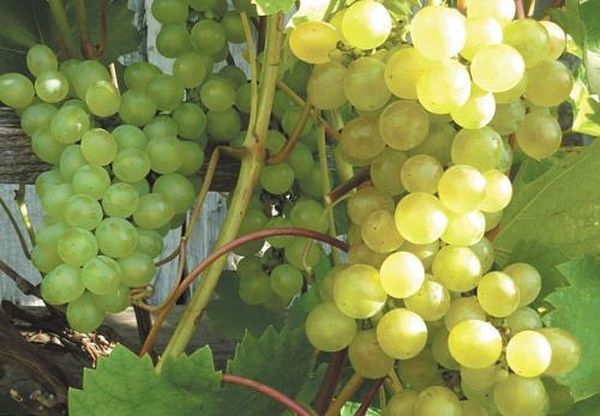
Zoned grape varieties for the Urals must have high winter hardiness. It's important to keep in mind that winter hardiness and frost hardiness are different. Frost hardiness refers to a plant's ability to withstand short, severe frosts. Winter-hardy varieties must withstand long winters without damage and be resilient not only to cold but also to stressful situations such as alternating thaws and frosts. These qualities are also important for greenhouse viticulture.
To ensure that the harvest has time to ripen before the onset of cold weather, you should choose early or mid-early ripening varieties (no more than 130 days).
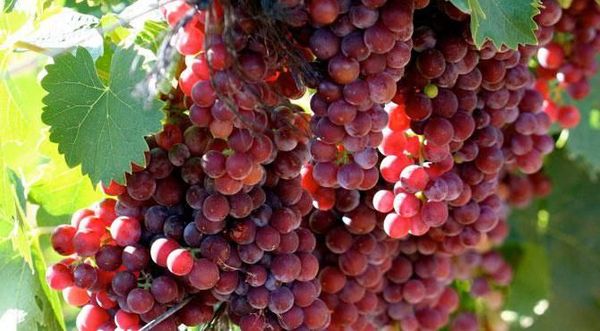
For beginners, undemanding and hardy varieties such as 'Alyosha,' 'In Memory of Dombrovskaya,' and 'In Memory of Shatilov' are recommended. Other varieties with good winter hardiness include 'Samokhvalovich,' 'Olga,' 'Lidiya,' 'Negritenok,' 'Muscat Pink Early,' and 'Muscat White Shatilov.'
Grapes can also be grown in a greenhouse. To do this, choose varieties with loose clusters (such as Kodryanka), otherwise the risk of fungal diseases increases.
Difficulties of growing in cold climates
Planting and caring for grapes in the Urals requires a special approach due to the short summers and cold winters. Even when choosing a regionalized variety, you'll need to ensure the vines are properly protected for the winter.
Due to the short growing season, the vines grow relatively short. For example, while in the south, vines can grow up to 30 meters in length, even in the southern Urals, their maximum length is 2–3 meters. For these reasons, many gardeners prefer growing them in greenhouses.
Landing rules
Planting grapes in the Urals requires strict adherence to the rules; otherwise, the seedlings will grow very slowly or even die. Let's look at how to properly plant grapes in open ground and in a greenhouse.
Place
A suitable location for a vineyard should be dry and as sunny as possible, ideally on the south or southwest side of the plot. It should be well-ventilated, as stagnant air promotes fungal diseases. Groundwater levels should be deep. Trees should be absent nearby, as they will shade the vines; furthermore, the plants' root systems will compete with each other. The soil should be loose and fertile. If the plot is located near a road, the vines will need protection from dust.
The greenhouse should allow plenty of sunlight and be well ventilated. For a Ural greenhouse, excellent thermal insulation (especially on the north side) and strength are particularly important to prevent it from being damaged by snow in winter. In colder regions, additional heating may be required.
Time
Plant grapes either in June (in the second half of the month) or in July. It's important for the soil to warm to at least 15°C and for the risk of frost to pass. The planting hole itself should be prepared in advance, in March or April.
In a greenhouse, bushes can be planted at an internal temperature of about +10 °C.
Preparing the pit
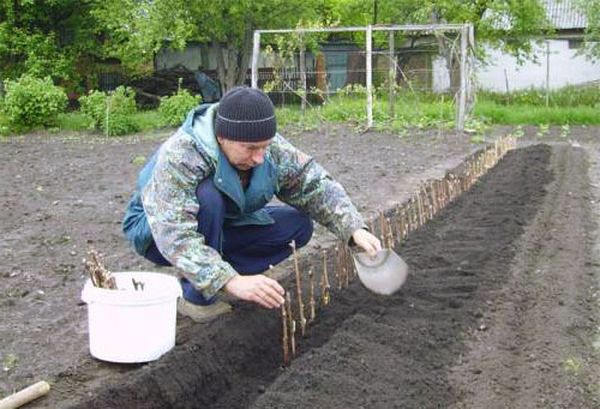
For a single bush, the hole diameter should be 1 m. When planting in a row in the garden, dig a trench 1 m deep and wide, with a length of 2.5 m per bush. Ideally, the trench should run north to south. The distance between rows should be at least 2 m. The distance to the walls in the greenhouse should be at least 50–80 cm.
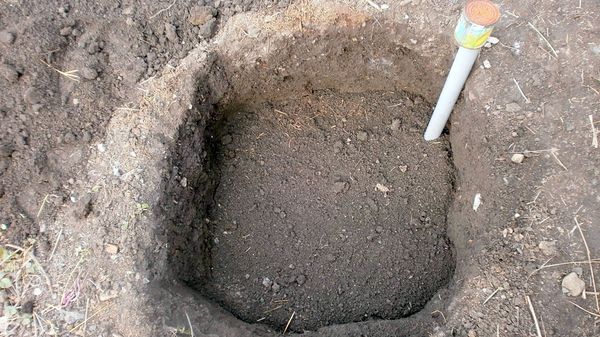
Good drainage is essential. The following is recommended: the bottom layer (20–30 cm) should be large stones, the middle layer (10–15 cm) should be crushed stone or expanded clay, and the top layer should be garden soil with humus, sand, and fertilizer. Mineral fertilizers (phosphorus and potassium) and ash should also be added to the soil. Before planting the grapes, the hole should be watered several times to compact the soil. Ideally, the soil should settle 20 cm below the rim. The hole should be filled with soil one year after planting.
Landing
Now let's learn how to plant a new bush. The task itself is simple: on the day of planting, dig a small hole in the prepared soil, water it thoroughly, and plant the plant, then firm the soil around it.
The young bush should be watered as the soil dries out, but not too much, and only until it begins to grow. After that, stop watering.
Care
It's time to learn how to care for grapes.
Watering
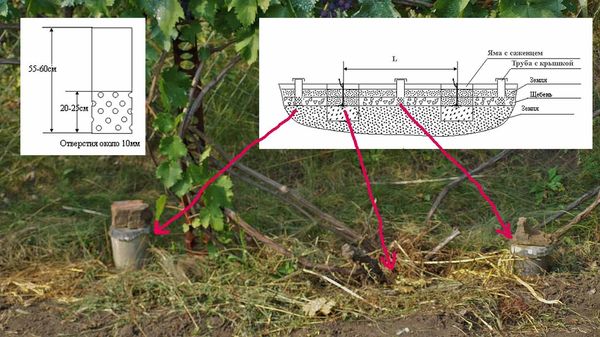
In the Urals, vineyard maintenance requires infrequent but abundant watering. Depending on the warmth of the summer, mature plants are watered 2 to 6 times per season, at the roots, taking care not to let moisture get on the leaves. This is best done in the evening.
Top dressing
Care requires mandatory fertilizing. For the first 2-3 years, this isn't necessary; the fertilizer applied at planting is sufficient. Subsequently, organic fertilizers are used, which are more important for grapes than mineral ones. Bird droppings, green manure (rotted or fermented grass), and wood ash are good choices.
In the fall, add rotted manure or composted grass, sawdust, food scraps, and other organic waste. It's recommended to plant green manure (annual grasses) near the bush. After mowing, the topsoil mulches the soil, and the roots decompose in the soil, enriching it with nutrients.
Trimming
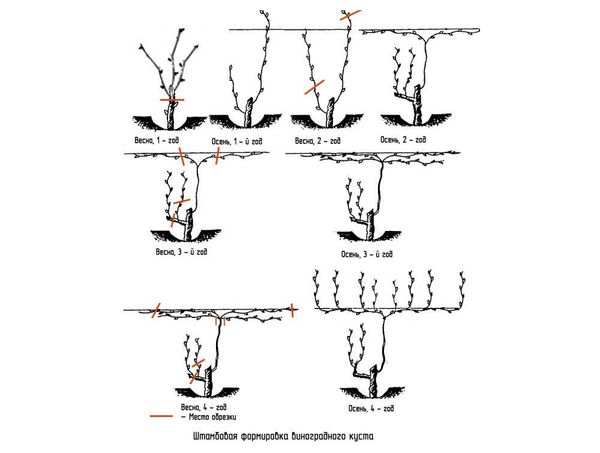
Pruning grapevines begins when they are two or three years old. It increases yield, makes wintering easier, and helps shape the vine properly.
In spring, only frozen parts of the plant are removed. Summer pruning is only permitted for sanitary purposes (including removing side shoots). In August, cuttings are taken as needed.
After harvesting, the main pruning takes place. At this time, fruiting branches and replacement shoots are formed. The latter should have at least two buds, from which a new fruiting vine and another replacement shoot will grow. It's best to leave more buds in case some freeze during the winter. It's recommended to grow grapes in the Urals using a fan-shaped system with four branches.
Disease prevention
Growing grapes in the Urals requires preventative treatments against infections and pests. Immediately after spring pruning, it is recommended to spray the plant with ferrous sulfate. Subsequently, alternate systemic and contact fungicides to prevent dangerous fungal diseases.
Ripening and harvesting
When the berries begin to ripen, carefully inspect the bush and remove damaged and diseased clusters. In September, remove some leaves to allow the berries to receive more sunlight.
After harvesting, the vineyard needs to be watered generously, at a rate of 20 liters per bush (except in cases where the grapes grow on clay soil or with a close groundwater table).
Preparing for winter
One of the most important questions is how to cover grapes for the winter in the Urals. This should be done after the top layer of soil begins to freeze and the temperature drops to -5°C (for the southern Urals, this is approximately mid-November). If you cover the vines too early, they will become moldy.
To prevent the vines from getting wet and rotting in the spring, place them on a layer of dry pine needles or a wooden lattice.
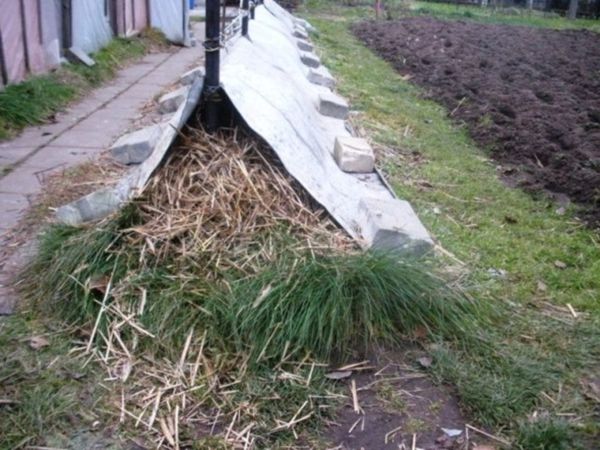
Winter grapevine shelter in the Urals should be warm. Cover the vines with spruce branches, several layers of non-woven fabric, and a tarp. For a small vine, you can make a shelter out of a box. Lay the vines in a ring and cover them with spruce branches, then with the box. Finally, cover the box with spruce branches.
Please note that the snow cover above the shelter must be at least 40 cm. If there is little snow, you will need to create a snowdrift of the required height yourself.
In a greenhouse, the vines can be simply bent down and covered with synthetic padding, sawdust, or even old blankets. If the greenhouse roof is removable, they can be covered in the usual way, under the snow.
It's recommended to open the vineyards in early June. Before then, ensure the temperature under the plastic wrap remains below 5°C, otherwise rot may occur. After the snow melts, remove the plastic wrap periodically to allow the vines to breathe.
Although planting and growing grapes in the Urals requires a special approach, the bountiful harvest grown on your own plot will be worth all the effort.
Video: Growing Grapes in Northern Conditions
This video will teach you how to properly grow grapes in northern conditions.