
All the secrets of spring grape pruning for beginners
Content
Pros and cons of spring pruning
You can find a wealth of information online about proper grape pruning for beginners. Of course, seeing is believing. However, it's important to approach the matter responsibly, so a theoretical foundation is also essential. Some advocate autumn pruning, but a decision can only be made after weighing all the advantages and disadvantages of spring pruning.
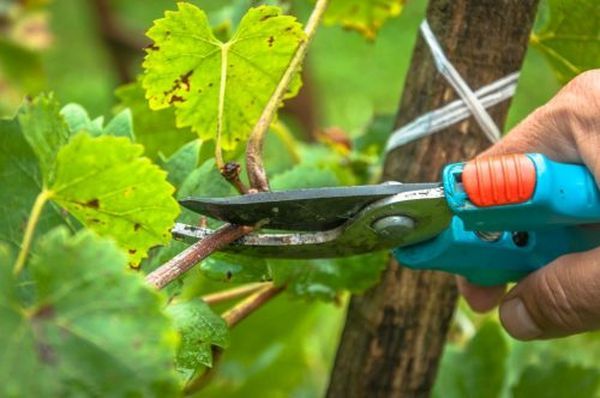
Speaking of the benefits, the first thing to note is the increased grape yield. The berries become more numerous, their marketability and flavor improve, and they often become larger in size. Furthermore, the harvest ripens faster on pruned vines. It goes without saying that pruning and shortening the shoots significantly simplifies grapevine care. Formative pruning helps shape the plant so that its shoots grow more orderly, while sanitary pruning ensures light access to branches at all levels, adequate ventilation, and prevents the spread of diseases and pests.
It would be fair to note that the procedure also has its downsides. Any intervention is stressful for a living organism. In spring, when the plant awakens from its dormant period and actively begins absorbing nutrients released by the sap, any damage can cause dehydration and loss of vitality. This is why experienced gardeners insist on the utmost importance of pruning before the sap begins to flow.
A novice gardener may also prune too many shoots, which will affect the grape's immunity, weakening its resistance to diseases, pests, and adverse weather conditions.
Video: Pruning, Cutting, and Pinching Grapes
In this video, an expert will explain how to prune, feed, remove side shoots, and propagate grapes by cuttings.
Rules for conducting the procedure
Before pruning grapevines in the spring, you need to decide on the timing. Pruning too early can lead to significant frost damage and the death of the vine. Theoretically, the process can be carried out in two ways: during the first warm days, when the air temperature reaches at least 6°C and the vines begin to awaken; or later pruning, during bud swelling. However, years of experience show that the latter option carries the risk of under-nutrition.
One of the most important things to do is prepare your tools. You'll need a small saw, a sharp knife, and pruning shears.
Everything must be thoroughly disinfected, otherwise fungal spores or pest larvae may get into the cuts. If large cuts remain after pruning large shoots, they must be sealed.
The saw teeth should be small and fine, and the blade thin to prevent the saw from wobbling during cutting. The pruning shears and knife should be sharpened so they cut the shoots in one go without breaking them. Following these rules will help prevent mistakes:
- remove dry, diseased, damaged branches, even if your plan requires them to remain;
- Shoots can only be trimmed with pre-treated (disinfected) tools. The cuts should not be jagged or burrs, but rather smooth and even.
- cut the vine at a right angle, leaving just over 10 buds;
- Leave the shoots growing closest to the trunk for replacement;
- The vine left as a fruiting vine should be fairly thick, at least 6 mm in diameter.
Features of spring formation
Pictures will help reinforce the theoretical material. Properly pruning grapes in spring is a task that isn't difficult to solve. The key is to remove all excess vines (dried, weak, infected, or growing incorrectly) and leave the shoots necessary for further development and fruiting.
It is recommended to preserve the so-called "sleeves," or old vines, which regulate the flow of nutrients for the normal growth and development of young shoots. For this purpose, strong, not very old branches growing close to the trunk are selected. If, over time, a "sleeve" ceases to function properly, it is replaced.
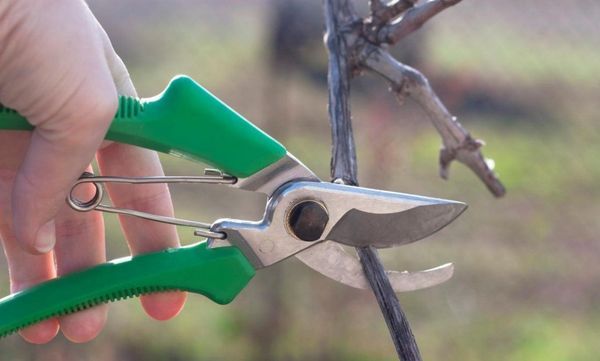
Then, healthy young vines are left, which will produce the bulk of the harvest. Typically, up to four mature vines are left and excess young shoots (weak or poorly growing) are removed. A good rule of thumb for beginners is to leave one vine for every ten buds. At first, you might be daunted by the bare appearance of the bush, but very soon it will be covered with young vines and leaves. And the resulting harvest will surprise you.
Healthy cut branches should not be thrown away; they can be used for medicinal purposes.
After pruning, sap may leak from the cuts (especially large ones). Significant sap loss will impact the grapevine's yield, so the wounds should be sealed. This can be done with paint, wax, magnesium chlorate solution, or by tying them with aluminum wire. Use wire very carefully; if you tie the wire too tightly, the branch may dry out.
Properly shaping the vine is also important. To do this, the vine head is positioned almost at ground level. In the second year, the vine is pruned by half, leaving two shoots with several buds. The following year, four vines are left and tied to wire in a fan-shaped formation. This forms a "sleeve" of vines that will produce additional shoots. Typically, only the top, the fruiting stem, is retained each year.
This method is used for spring grape pruning. Proper pruning ensures the growth and development of the vine, as well as a bountiful and delicious harvest. However, it's important to remember that without following all the care instructions, even pruning won't save the vine.