
Is it possible to plant a grape bush in the summer and how to do it correctly?
Content
Timing and Features of Summer Planting
Any experienced gardener will tell you yes if it's possible to transplant grapes in the summer. It's in early summer that mature, vegetative seedlings, obtained from cuttings taken during spring pruning, become available for sale en masse. These are typically high-quality planting stock with a closed root system, which theoretically can be planted at any time during the grape's growing season.
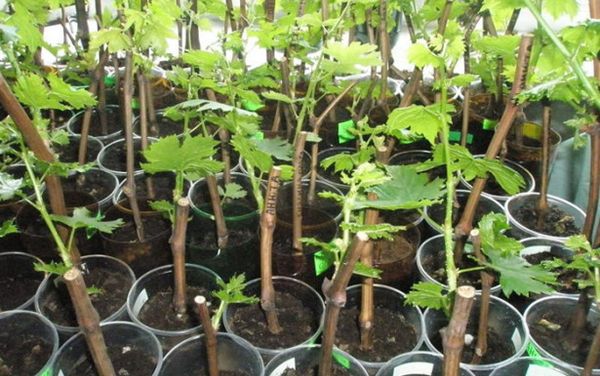
The only problem you might encounter when planting grapes in the summer is too hot weather, which can cause the soil to overheat and dry out. Therefore, the optimal time for planting is considered to be before the end of June. By this time, the seedlings will have already developed 5-6 buds, ensuring rapid rooting, and the soil has not yet become too warm. If the summer is not hot and the seedlings are not overgrown, you can plant grapes in July, but it is best to do this on a cloudy day.
In August, green grape seedlings are usually no longer planted. Growing seedlings in containers before this time is impossible, and prolonged confinement adversely affects root and foliage development. Therefore, a seedling planted in the second half of summer has little chance of survival. To ensure rapid rooting of grapes, only two conditions must be met:
- the soil should warm up to at least 15°C, and the night temperature should not fall below 10°C, which is not a problem in the summer;
- The seedlings need to be transplanted from the container along with the root ball.
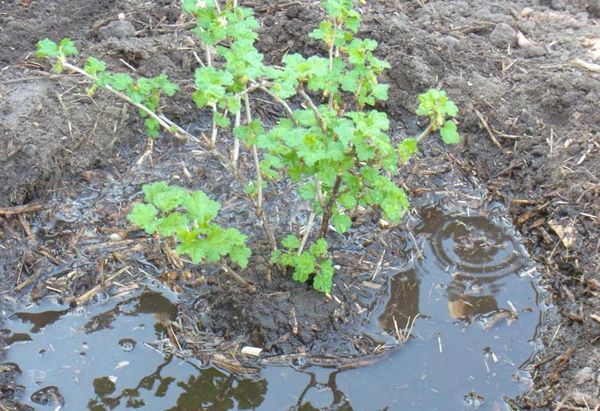
These are the basic recommendations on how to properly plant grapes in the summer.
Pros and cons
When discussing the pros and cons of summer planting, it's worth noting just one problem you'll encounter: dry soil, which prevents plants from establishing properly. However, this can easily be resolved with timely watering. Overall, summer planting has many advantages:
- the process is simple – you just need to dig and prepare a planting hole, and then move the rooted cutting there along with the soil;
- Plants with closed roots take root better and faster;
- by summer the soil will definitely warm up to the required temperature, and sudden frosts or other vagaries of the weather are completely excluded;
- In summer, pests are no longer as active, so the risk of young shoots being destroyed by insects decreases;
- During the summer, the young plant will be able to get stronger, build up its root system and vegetative mass, which will allow it to easily survive the first winter.
How to choose a location and prepare the soil
To grow and harvest a good crop every year, choosing the right location for your vineyard is essential. This is a crucial factor in determining the vine's survival, disease resistance, yield, and berry quality. Above all, vines require ample light and sun.
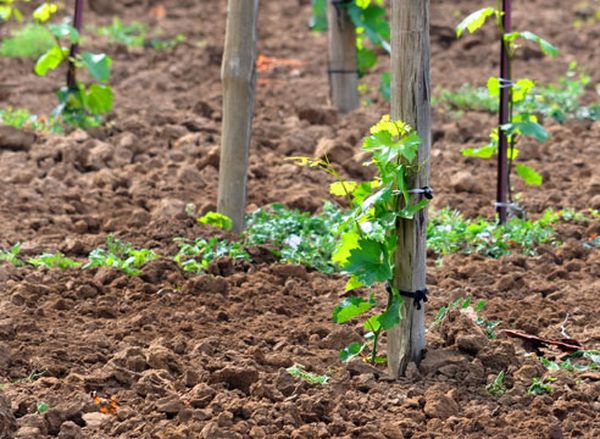
The future vineyard should not be blocked by tall trees or buildings that create shade.
It's also not recommended to plant it in a low-lying area or a wind-blown location, as cold air masses will accumulate there in winter, and the plants may freeze. It's best to plant the vineyard on the south side of the house, where the vines are protected from the wind. Plants should be spaced 2–2.5 meters apart and 3–6 meters from the wall. This arrangement accelerates the ripening of the berries, as the vines are well-heated by the sun during the day and warmed by the heated walls at night.
Grapevine soil must be permeable and fertile. Vines perform best in loose black soil, but with regular fertilizing, they can also grow in sandy loam and loamy soil. The key to healthy growth is neutral pH and good drainage. To ensure adequate root aeration, add fine gravel to the soil, and to improve fertility, add organic matter (2 buckets of compost, 1 liter of ash). Planting holes are dug 2-4 weeks in advance.
Preparing and planting a seedling
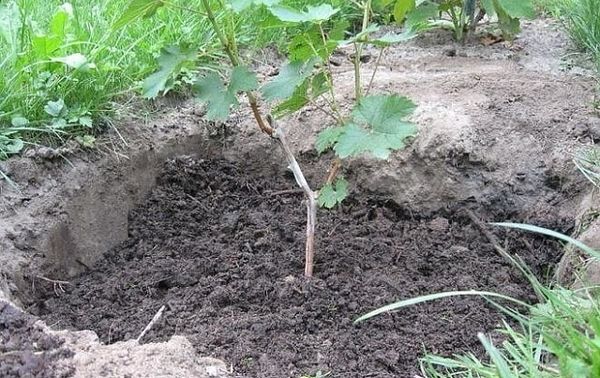
Particular attention should be paid to the planting material. The seedling should look fresh and have at least 5-6 healthy vegetative buds. The roots should be white or slightly greenish (brown shoots are unsuitable, but if they are isolated, they can be trimmed off).
Summer seedlings need to be hardened off before planting. This is done to prevent them from fading in the sun on the first day after planting. What does this process entail? Containerized plants are brought outside for 10-12 days, gradually increasing their sun exposure.
A couple of days before transplanting, water the seedling thoroughly, and moisten the prepared holes with two buckets of water. Immediately before planting, remove the seedling from the container, trim off any tendrils and damaged roots (if necessary), and shorten the shoots to 2-3 buds. Form a mound in the planting hole, set the seedling on it at a 45° angle, and cover with soil. When covering the soil to a depth of 10 cm, gently pull the plant up to ensure the roots are aligned. After covering the soil, water the seedling again.
Further care
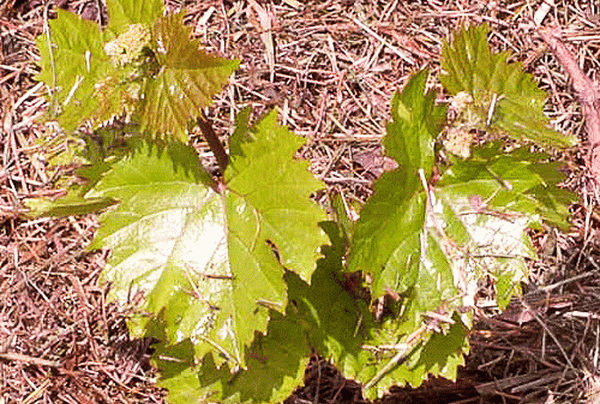
Until the seedlings are fully established, care consists primarily of watering. To ensure better moisture delivery to the roots, it is recommended to install a drainage pipe 8–10 cm in diameter in the hole. During unusually hot weather, the plants should be shaded. Immediately after planting, consider installing a trellis in the vineyard to which the vines can be tied as they grow.
At the end of summer, the apical buds of the shoots should be pinched off—this will speed up the ripening of the vines by fall. For the winter, the grape roots are covered. The air-dry method is usually used, where the vines are bent to the ground and covered with insulation. However, you can simply mound the roots with soil, cover them with a layer of organic matter, and then cover everything with plastic wrap. Now that you know how to plant grape seedlings in the summer, success and a bountiful harvest in 3-4 years are guaranteed.
Video: Planting Grapes in Summer
This video will show you how to properly plant grapes in the summer.