
How to properly tie up grape vines
Content
What to tie to?
In the first year, ordinary pegs will be enough for a young plant, but starting from the age of two, a solid structure is needed.
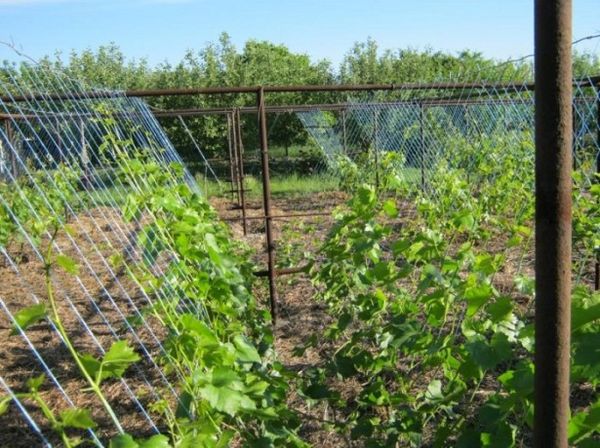
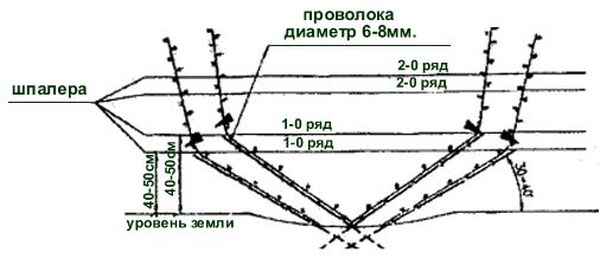
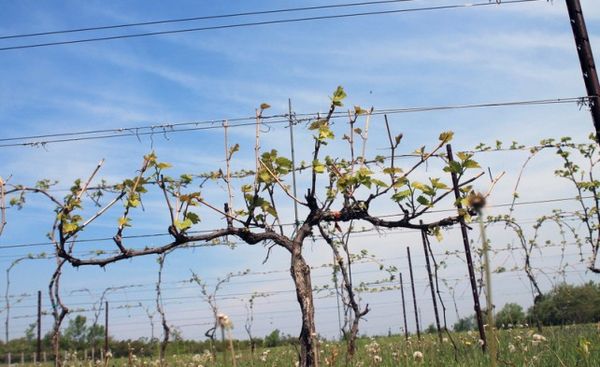
To create a trellis at your dacha, dig two supports into the ground at least 3 meters apart: posts approximately 15 cm thick and up to 2 meters high (above ground level). Sturdy wood, such as oak, works well—it's easy to attach wire staples to it. You can also use metal or reinforced concrete posts with holes drilled into them. Stretch at least three rows of strong wire between the supports—the distance from the ground to the bottom row and between the wires themselves should be about 40 cm.
If you want to tie the grapes to a trellis at an angle so that they receive more sunlight, you need to make a two-plane trellis: each should consist of two posts converging at the top or diverging in different directions from ground level (in the shape of an inverted or straight V). You can also nail slats to the top of the support to create a Y-shaped structure. Wire is stretched along the sides of the triangle, forming two planes.
When to tie up
When temperatures reach above freezing, remove the grapevines' covering. It's important to choose the right moment; the plant shouldn't be frozen by frost, but if it's left too long, some of the buds will rot. Allow the grapevines to air out for a few more days before staking them. During this time, they should be shaded from direct sunlight.
In spring, grapevine pruning is only necessary if part of the vine has frozen—this can be determined by the presence of unopened buds after tying. Before pruning, simply trim off any broken parts and remove any remaining branches.
Tying grapes to a trellis is done after the sap begins to flow, when the vine becomes flexible enough, but before the buds open, otherwise they can be easily damaged.
Green and dry garter
Dry staking is performed first. Fruiting shoots and replacement branches are bent horizontally toward the bottom wire. This must be done very carefully to avoid breaking them. Branches growing near the wire should also be tied to it. This ensures all buds receive good light and space for shoot development.
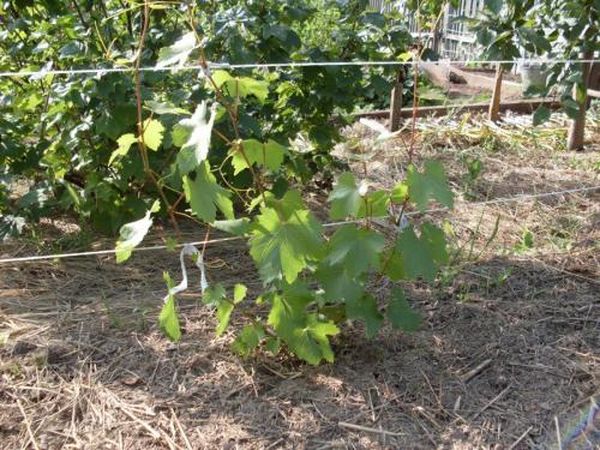
Green tying is done when the new vine reaches 30 cm. The tied stems should be evenly spaced so that they all receive enough sun and pollinate well.
As the vines grow, they are secured to increasingly higher rows of wire, so 3–4 ties may be needed during the growing season. If the shoots outgrow the top wire, they should be laid horizontally or pinned down.
Step-by-step instructions
There are different ways to tie up grapes. Depending on the growing method, young grapevines can be secured horizontally, at an angle, or vertically.
For tall-stemmed or long-armed vines, vertical staking is used, meaning the vine is attached to the trellis perpendicularly. This method is not recommended for sheltered cultivation, as the lower buds and middle part develop poorly, and the older part of the vine elongates. Maintaining such a vine is difficult: pruning and winter protection are difficult, dry staking is more difficult, and there is a higher risk of breaking branches during the process.
If the shoots are tied upward at an angle, this accelerates the growth of the stems near the base, but slows the development of the upper part. With the arch or ring method, the plant develops unevenly.
So, what's the proper way to tie up grapes that need winter shelter? The best method is considered horizontal. It ensures ventilation and even nutrition along the shoots, resulting in even clusters and rapid development of the central part.
Now let's look at how to tie up grapes using this method. Carefully bend the shoot and tie it tightly to the wire below the leaf node using a strip of fabric, wrapping it around several times. This can be done with a simple loop or a figure-eight (the tape passes between the shoot and the wire).
The latter method is more reliable—the shoot won't rub against the wire in the wind. Don't squeeze too tightly, as this can impede sap flow. The stem should curve smoothly, otherwise the upper buds will receive less nutrition. Young vines should not be tied to the upper internodes.
The pruned shoots should be placed strictly horizontally or with the cut side down: if the sap flows down the vine, it can burn the buds.
Another tying method: tie a rope to one support at the same height as the wire and place it on the ground between the supports. Bring all the branches to one side, laying them on top of the rope, then lift it, tighten it, and tie it to the second support. Carefully straighten the vines and tie the rope to the wire every 50 cm. Repeat this process for all rows. In the fall, simply trim the rope on both sides and remove it from under the bush.
Some winegrowers string two wires in each row and guide the vines between them. This makes tying up the vines easier, but it makes harvesting the grapes more difficult in the fall.
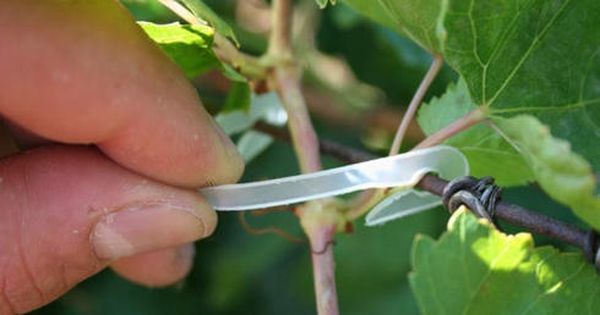
Owners of large vineyards will find a grape tying stapler (tapener) useful. It secures shoots using a soft film that wraps around the vine and wire and is secured with a staple (like a regular stapler). A grape tying stapler speeds up the process by 3-5 times, requires no special skills, and is suitable even for beginners.
Winegrower's advice
Since vines need to be tied with strong but soft materials, it's best to use a bast soaked in water. Fabric scraps, plastic tape, sida and kenaf fibers, and willow shoots also work well. Avoid using fishing line or stiff rope, as they will chafe the stems.
If you plan to install wooden supports, remove the bark from their lower parts beforehand. Then, place the posts in a container with a copper sulfate solution (500 g per 10 liters) for several days. After digging in, the exposed part can be tarred and wrapped with roofing felt.
Video “Garter of a vine on a trellis”
This video will show you how to tie grape vines to a trellis.