
Basic schemes and rules for grape formation
Content
Why shape a bush?
Since we're dealing with a vine, its growth has specific characteristics. Therefore, shaping the grape bush is an extremely important aspect of growing this berry in your garden.
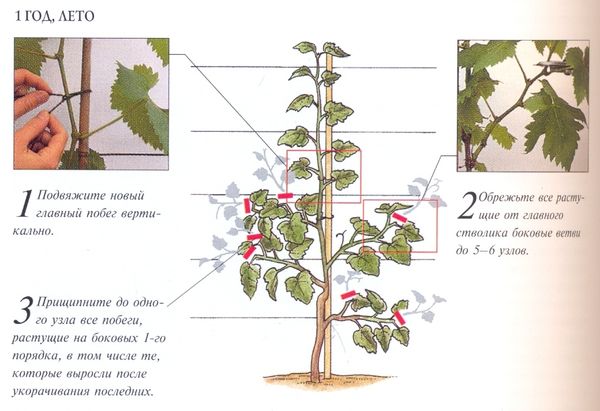
The most appropriate method should be chosen based on environmental factors. Consider the climate of your region, the location of the plot, and the varietal characteristics of the crop.
The future harvest depends on how comfortable the plant feels. A well-placed vine this year is the key to a successful harvest next year.
If you neglect the formation of grapes in the first year, the plant will develop chaotically and produce a poor harvest.
Basic schemes
There are several basic methods for shaping a bush, including:
- Guyau scheme;
- sleeve;
- fan-shaped;
- cordon;
- standard.
The Lenz-Moser method can also be distinguished, although it is much less common.
Guyau's scheme
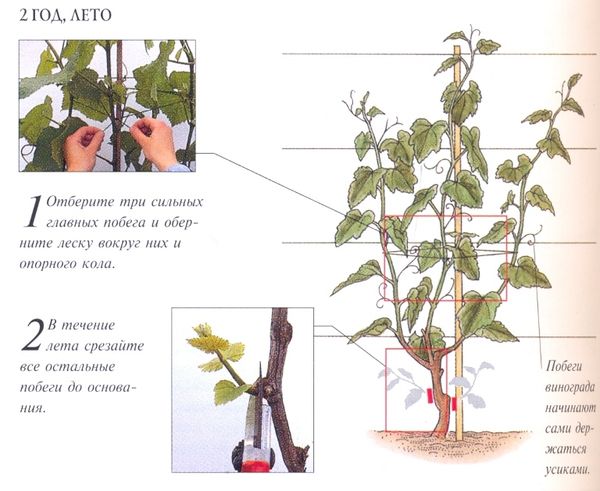
About 150 years ago, Guyau devised a method for training grapevines without using standard trees. The simple rules of this system are well suited for beginners. To begin, you need to grow a single strong shoot. Regardless of the varietal characteristics, training grapes using Guyau's method requires covering the plant for the winter.
In summer, grow 2-3 strong shoots, pruning the rest. In autumn, prune the lower of the two shoots as a replacement, and shorten the upper one to 5-6 buds; it will produce fruit. The following year, tie the fruiting branches horizontally to the trellis, pointing them in opposite directions. Tie the shoots vertically as they grow.
The first harvest can be collected in three years. After that, the fruiting shoots will need to be pruned back to the vine. Leave only two shoots. A year later, these will form a new vine and a new shoot. Repeat this process every year.
Thus, growing using the Guyot method is the most convenient practice, which is considered a classic.
Forming sleeves
The advantage of this type of training is that it takes up less space in the garden. The sleeve is the main branch that will continually produce fruiting grape vines. The standard type requires labor-intensive initial stages of development, unlike the process of creating a growing system with sleeves. The bush will need to be properly trained every year, including careful pruning. If not cared for properly, the sleeve will quickly become depleted.
The main disadvantage of this method is that these forms have a short lifespan, on average about 10 years.
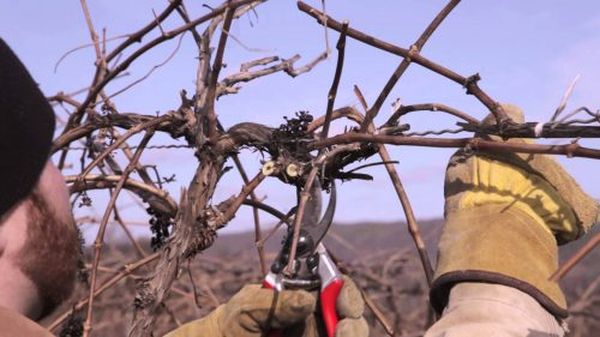
Guyau described how to properly form branches quite well. The goal of the first year is to select the strongest shoots growing close together. The rest need to be removed. One is cut short, leaving three buds, the other is left longer, with about 8-9 buds.
At the end of the second year, in the fall, prune the long branch with all its shoots. On the short branch, find the two strongest vines and leave only these. Pruning follows the same principle: one replacement vine, one short vine. The second, the long, fruiting one, will bear fruit.
We repeat the procedure every year.
Fan formation
Fan-shaped grape vine training is similar to sleeve training. The key is that there will be more sleeves—about 5–6 branches. They will be located on opposite sides of the root system. This type of vine will have comparatively greater immunity, meaning it will be stronger than a single sleeve.
The first stages are no different from forming sleeves. However, in this case, we need to grow 5–6 instead of just 2, depending on how much space you have available in your plot.
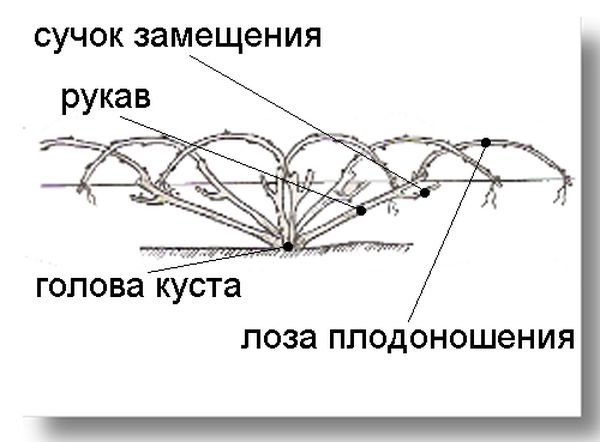
After two years, each branch should have two strong vines. The fan should be tied vertically. Pruning of annual shoots occurs throughout the entire growth cycle. To lengthen the main vines, two or three shoots can be left.
Eventually, 6–8 branches are grown. They are arranged on a support in a fan-shaped pattern. This type of bush produces an excellent harvest and is much easier to care for.
Cordon formations
This is how bushes are formed in regions where the plant is exposed to frost. Pruning is done in the fall, after which the branches can be bent down and covered before the onset of cold weather. Due to its close proximity to the ground, this variety is more susceptible to various diseases.
It's worth noting that a cordon takes up a lot of space and requires more labor-intensive maintenance. It can be extended in one direction or both, but this will take up much more space on the property.
The cordon is formed by creating one perennial strong branch, from which a fruiting link extends at a distance of approximately 0.3 m.
The main shoot is pruned back to a strong bud each year. It should be laid horizontally. Healthy buds are left at a distance of 0.3 m, and the rest should be thinned out. All shoots should be grown vertically, and only the outermost one should be horizontal, to continue the cordon.
After the first year, the shoots that have grown are pruned back to 2-3 buds for replacement, and to 5-6 for fruiting. The main shoot is left as long as the desired branch length. The cordon is renewed only in the working section.
Standard
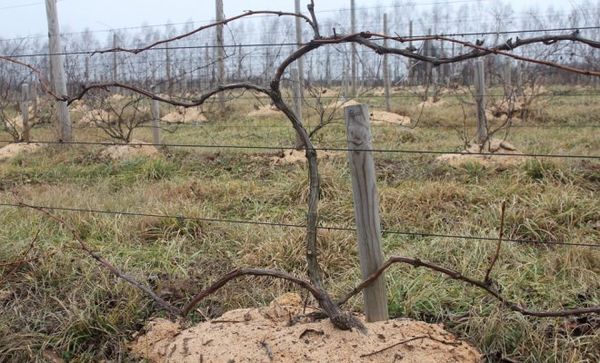
A standard is a form similar to a cordon, but the main branch will be located much higher.
If your climate is warm and there's no risk of severe frost, this system is perfect for you. It will require a lot of space in the garden to properly train the grapes. The berries will grow to about human height, but the yield will be slightly higher. This is because nutrients will flow abundantly directly from the strong trunk. Pest infestations are also less common.
Formation according to Moser
There's a specific training system invented by Lenz Moser. It's designed to simplify both the care and cultivation of the berries.
The vines are planted at a height of approximately 1 m 20 cm, with only the fruiting shoots, which will bear the clusters, tied to the trellis. This is to prevent gusts of wind from bending the vines and knocking down the berries. The remaining branches are left to hang freely.
But in our region, there may be a problem with ripening, and next year it will be difficult to distinguish replacement shoots from fruiting ones in order to prune them correctly.
Terms and basic rules of formation
It will take approximately 4–6 years for a grapevine to develop. This process will begin around the second year of cultivation.
All you need to do is choose the most suitable model and know how to properly shape the bush. On average, after three years of growth, the berries will begin to produce fruit. After that, you just need to maintain the desired shape based on the model of your bush.
To prevent the young grape clusters from becoming too depleted in the summer, it is extremely important to carry out proper autumn pruning.
To prevent plant diseases or alter its flavor, another variety can be grafted onto it. Thus, grafting can solve a number of growing problems associated with this crop.
By following all the rules, deadlines, and procedures, you'll get not only a delicious harvest, but also a beautifully landscaped plot!
Video: "Forming a Grape Bush"
This video will show you how to properly shape a grape bush.