
Varieties of Kesha grapes and the peculiarities of their cultivation in the countryside
Content
The history of Kesha grape selection
Kesha is a table grape variety developed at the Potapenko All-Russian Research Institute of Viticulture and Winemaking. For several decades, the institute has been researching new varieties for cold regions, and this hybrid is the most successful development in this area. Kesha's parent variety was the Moldovan Frumoas Albă and the domestic Vostorg, which is why it was given its second name—Improved Vostorg.
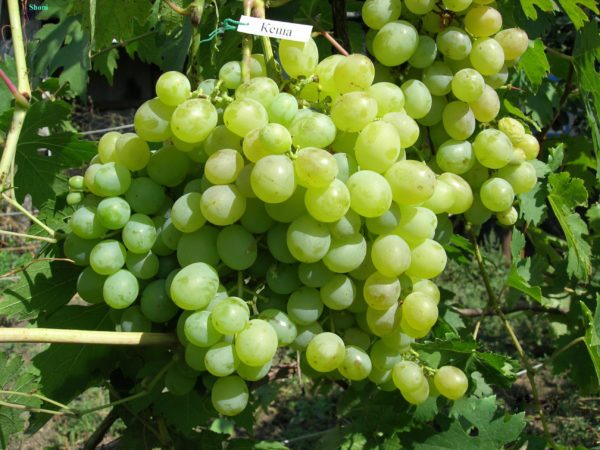
Varieties and description of the variety
In terms of ripening time, this is a mid-season variety, yielding a harvest 4-4.5 months after the start of the growing season.
The bushes are tall, growing 5-6 m per season. The vines are light brown, and the leaves are large, up to 15 cm long, dissected into 3-5 parts, and light green. The flowers are bisexual, but females predominate, so additional pollination is necessary.
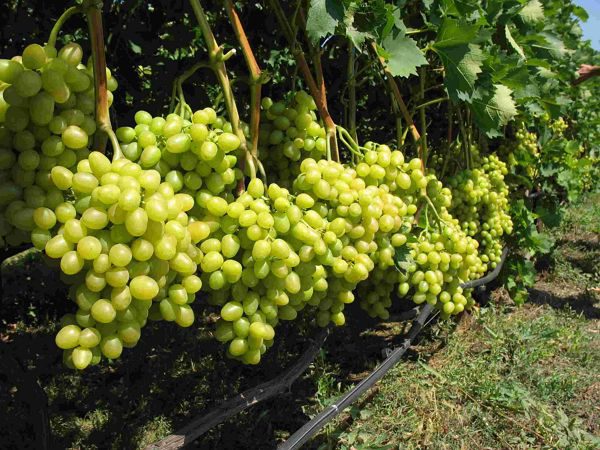
Kesha grape clusters vary; there is no standard. They can be conical or cylindrical, but are more often shapeless, weighing 0.6-1 kg. The berries are large, up to 3 cm in diameter and weighing 9-15 g, and greenish-yellow in color. The pulp is tender and sweet (with over 20% sugar), and there are few seeds. The bunches do not fall apart or become crushed during transportation and can be stored refrigerated for about a week.
In parallel with Kesha, a whole line of hybrids with similar characteristics was bred, a description of which is presented below.
Kesha 1
The hybrid differs from the main variety only in the weight and size of its berries. They reach 15 grams, and the cluster weight is up to 1.2 kg, significantly increasing the overall yield. The appearance and taste are identical. It ripens later, in 130-140 days, but is more winter-hardy than the main variety. Kesha 1 produces only female flowers, so pollinators are needed for fruiting.
Kesha 2
An early-ripening (110-115 days) hybrid with beautiful conical clusters weighing 1.1-1.2 kg. It was bred by crossing Kesha 1 with Kishmish. It is known as Zlatogor, or Muscat, because its Muscat flavor is more pronounced than that of other varieties. The berries are amber-colored and very sweet.
Kesha red
This is actually a variety of Kesha 1, but with pinkish berries. This hybrid also ripens in 135 days. The clusters are dense, conical, and very heavy (1.5-1.8 kg), and do not bruise during transportation. The berries are reddish or cherry-colored, with a light waxy coating, and the flavor is sweet, with a hint of apple.
Radiant
The Luchezarny hybrid was developed using the Kishmish Radiant variety. This variety is distinguished by large (up to 2 kg), heavy, conical clusters. The amber or pinkish berries, with a noticeable waxy coating, reach a weight of 15-20 g and are sweet in taste. Ripening time is average – 130 days from the start of the growing season.
Mascot
It doesn't differ much from the main variety, except that the bunches are approximately 100 grams larger. The berries are yellow-green and taste similar to the original, although the skin is slightly thicker. Talisman ripens in 135-140 days. Since the flowers are only female, pollination is required.
-
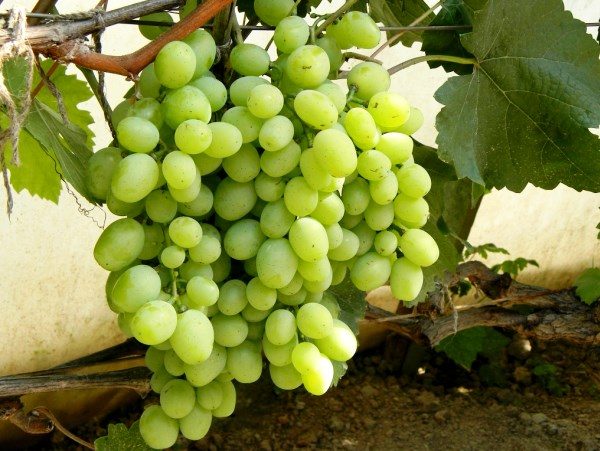
- Kesha 1
-
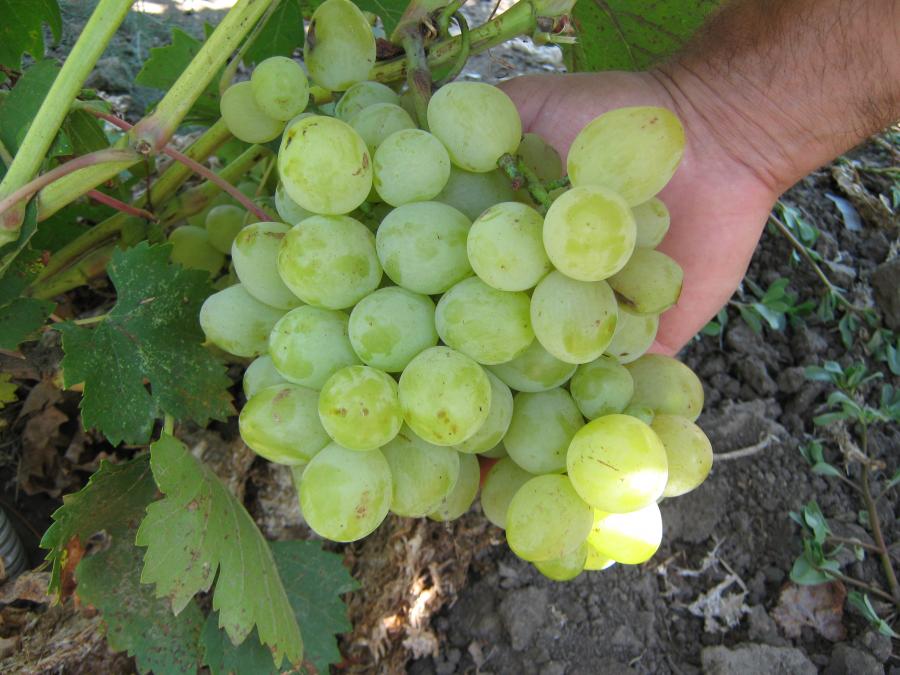
- Kesha 2
-
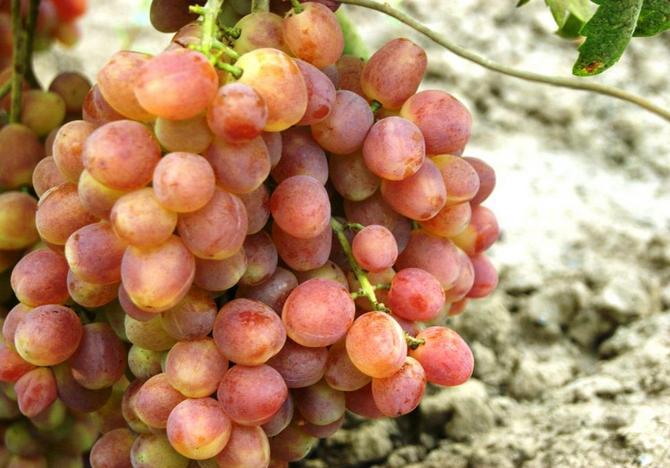
- Red
-
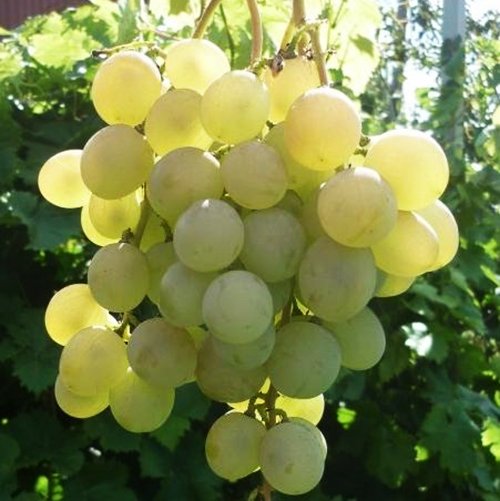
- Radiant
-
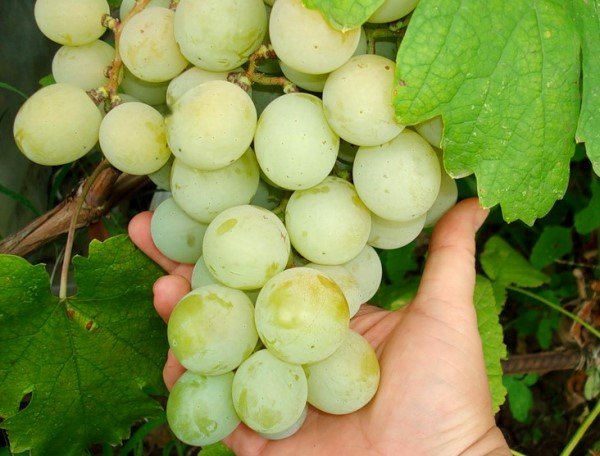
- Mascot
Video "Description of Kesha grapes"
This video provides a complete description of the fruit and berry crop.
Rules for planting grapes
Both the original variety and its hybrids prefer sun and warmth, so the site should be sunny, not waterlogged, sheltered from winds, and fertile. The best location for a vineyard is a slight rise or slope, but an area along a south-facing wall is also suitable.
In most regions, planting is best done in the spring, when the soil warms to 10–13°C. By this time, the vines should not have developed leaves, so the seedlings should be kept in a cool place. In warmer regions, planting can be done in the fall, but no later than the end of September.
Planting holes are prepared in advance. The soil is mixed with compost and humus; if the soil is low, 40-50 g of superphosphate is added. The resulting mixture is then used to fill the holes one-third full and left until planting. Typically, holes 40-50 cm deep and in diameter are sufficient for young seedlings. They are dug 1.5-2 m apart.
Important! Since all Kesha varieties require full or partial pollination, it is recommended to plant the vines interspersed with seedlings of other varieties.
Aftercare of Kesha grapes
The hybrid isn't particularly demanding in terms of care. The main thing is to tie the vines to supports in a timely manner, remove growing side shoots, and regulate the yield. Otherwise, the bush will become overgrown and the clusters will become small. The following steps should also be taken throughout the season:
Watering and fertilizing
As a rule, if there's sufficient rainfall, grapevines are watered twice a season: before flowering and during cluster formation. In hot climates, additional watering may be required a couple more times. Water consumption depends on the size of the vine and is calculated using the formula: approximately 5 liters for each shoot emanating from the base.
For good fruiting, the vine is fed with potassium and phosphorus no more than 2 times a year:
- the first time at the end of June;
- the second - a month before harvest.
Nitrogen fertilizers are applied only when necessary, as they stimulate the growth of green mass at the expense of fruiting.
Pruning grape vines
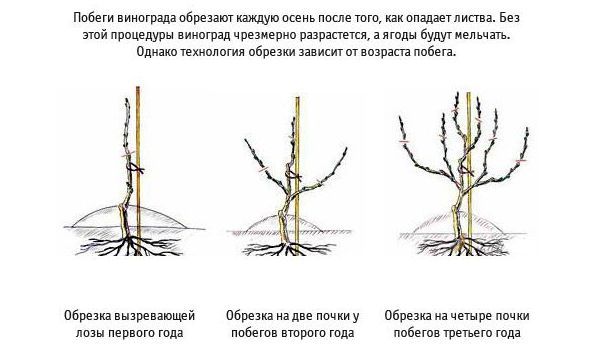
Vines are pruned twice a year: in the spring, for sanitary purposes, removing shoots that have died or been damaged over the winter; in the fall, for formative pruning, which is also the main pruning. Formative pruning determines the health and yield of the vine, as a compact bush survives the winter more easily and begins to develop more vigorously in the spring.
In the first year, the mature vine is pruned to 2-3 buds. In subsequent years, 2-3 large shoots with 4-5 offshoots are left on the bush, which are also pruned to 2-3 buds. This results in a bush with 13-15 fruiting shoots, which is considered optimal for this hybrid.
Preparing crops for winter
According to the originator, the vine can overwinter without cover in climates with temperatures no lower than -22°C. However, gardeners' reviews warn against taking risks, as winters in the temperate zone are unstable, with sudden thaws, which are very harmful to the plant. Therefore, the vine can only be left uncovered in the south. In other regions, it must be removed from the trellises, tied, laid on the ground, covered with a layer of leaves, and covered with agrofibre.
Protecting crops from birds and insects
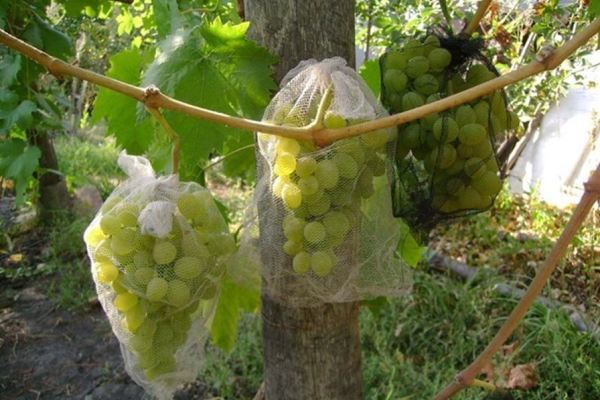
Large, sweet berries attract birds and various insects, particularly wasps. It's recommended to cover ripening bunches with fine nylon mesh to protect them. Another pest is phylloxera. Although it doesn't feed on the berries, it causes maximum damage to the crop by damaging leaves and roots. To protect against these insects, spray the vines with Fitoverm, and plant parsley between the bushes—its aroma repels the pest.
Reviews from winegrowers
I've been growing Kesha for several years now. It's the best variety for our climate—it's practically disease-resistant and the berries are delicious, even though they take a long time to ripen. This year, the harvest didn't arrive until late September.
Finally, I found a variety that's easy to grow. Of course, the vines need to be thoroughly covered for the winter, but it's still one of the few varieties suitable for our climate.
Gardeners from various regions consider Kesha to be the most suitable variety for home growing. They note its sweet, harmonious flavor, attractive clusters, and wide variety of shapes, from which everyone can choose to suit their taste.