
The main rules of agricultural technology for high-yielding grapes Aleshenkin
Content
History and description of the variety
Voronezh breeders have succeeded in creating a variety adapted to even the harshest climates. Many grape varieties don't thrive in central Russia, so the development of a high-yielding and easy-to-grow variety was long-awaited. Pollen from three table grape varieties was used for the cross:
- "East";
- "Muscat of Hamburg";
- Madeleine Angevine.
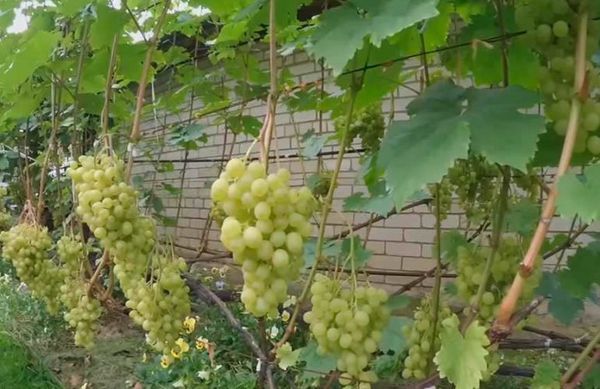
The newcomer was named by the founder of the cultivar, V.E. Tsekhmisterenko, who named it in honor of his grandson. In catalogs, the plant is also referred to as:
- Alyosha
- "No. 328";
- "Aleshkin Dar";
- "Alyosha Popovich."
Over the past 50 years, the Aleshenkin variety has spread throughout the neighboring countries. It is successfully grown in Ukraine, Belarus, Turkmenistan, the Caucasus, Karelia, and the northern Astrakhan region. With proper care, it can even yield a good harvest in Siberia.
Video: Planting Grape Seedlings
This video will show you how to properly plant grape seedlings.
Description of the bush, vine and bunches
Like its ancestors, the Alyoshenka grape is also considered a table grape variety for its excellent flavor. Here's a brief description of the variety.
- The bushes grow quickly and vigorously, producing abundant and consistent harvests. Seedlings easily establish themselves in new locations, firmly rooting from cuttings and layering.
- The shoots form and ripen quickly, densely covered with fruit buds. The gardener must ensure that no more than 2-3 clusters ripen on a single shoot; the clusters become large and can easily overload and break the branches.
- The foliage is five-lobed and dark green.
- Flowers are produced by both sexes, so the crop is considered self-pollinating.
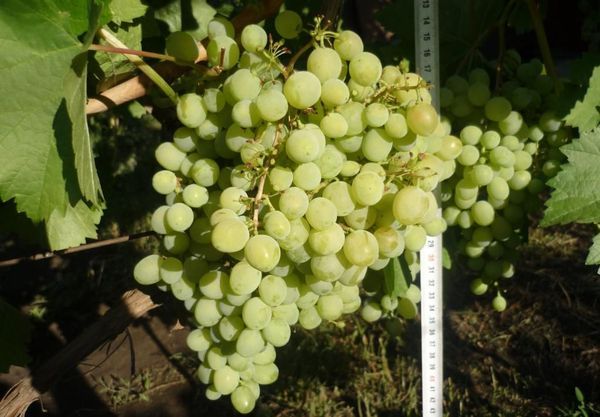
- The fruits are golden and oval-shaped. The cluster extends up to 25 cm.
Fruiting and yield
A single bunch of grapes weighs between 500 grams and 1 kilogram, often reaching one and a half kilograms or more. As a result, the harvest is so abundant that the crop requires mandatory thinning, otherwise the viability of the vine will be significantly reduced.
With proper agricultural practices, a single bush can yield up to 25 kg of ripe fruit in the seventh year. On average, each bush yields 8-10 kg, and around 5 kg in the first couple of years.
-
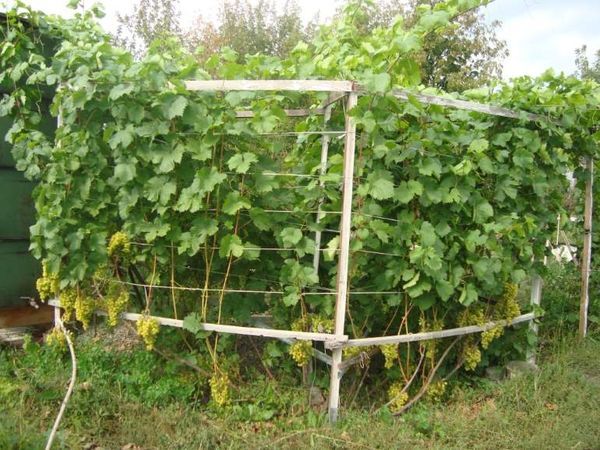
- In the 7th year, one bush can produce up to 25 kg of fruit.
-
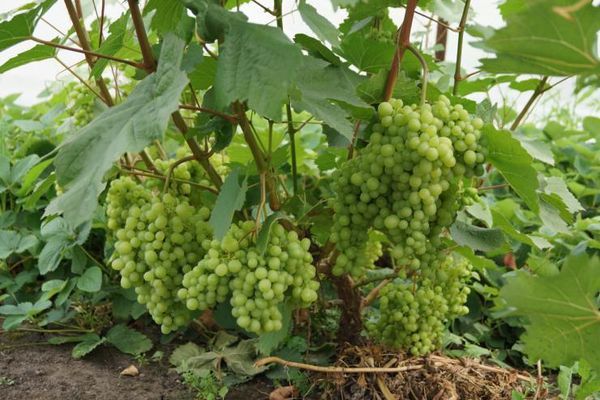
- The bunch stretches up to 25 cm
-
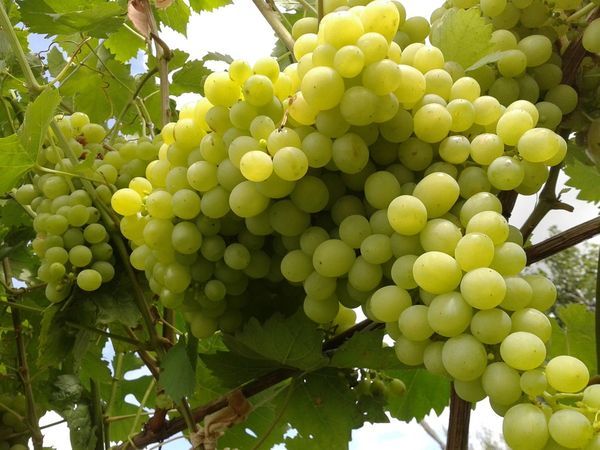
- One bunch of grapes weighs from 500 g to 1 kg.
Taste and use of fruits
The berries combine a sweet taste (around 20%) with a hint of tartness (no more than 5%), earning the variety a high tasting score. The core is fleshy and juicy. The skin is firm and strong, so the harvest withstands transportation well.
Fresh grapes are pleasant to eat fresh, but for processing large quantities, it is permissible to prepare from them:
- compotes and juices;
- table wine;
- raisin.
Harvesting and storage
The crop is early, maturing in 100-120 days. If the maturation period needs to be accelerated, greenhouses or unheated hothouses are used.
There's no need to rush harvesting; the fruits don't fall off or crack, and in open ground, the harvest can ripen until the end of August. Even if conditions are unfavorable, such as drought or heavy rains, the crop will still ripen on time.
Drought and frost resistance
Botanists have succeeded in cultivating a variety capable of withstanding both scorching heat and freezing winters. Aleshenkin inherited its drought-resistant qualities from the Vostok variety, so the plant thrives in southern regions. Madeleine Angevin contributed its frost resistance to the variety. The plant is resistant to the cold temperatures common in Siberia and the Far East.
If the grapes are grown in the south, there is no need to cover them for the winter - the temperature at this time of year here rarely drops below—25°C. If the plant grows in areas with a harsher climate, winter shelter is necessary.
Experts recommend covering grape bushes in other cases as well:
- During a high seasonal harvest, the more ovaries and clusters are formed, the more the vines are depleted, releasing their beneficial components into the fruit. As a result, the vineyard's condition deteriorates, and a cold winter can destroy it.
- Until young seedlings reach five years of age. Their ability to withstand adverse weather and cold only improves with age; initially, young plants require some assistance.
Advantages and disadvantages of the variety
- early ripening;
- small number of seeds;
- sweet taste;
- quick adaptation and acclimatization in a new place;
- maintaining marketable appearance during transportation.
- mandatory standardization of brushes;
- inability of the root system to withstand severe frosts;
- average resistance to diseases, susceptible to attack by birds and garden insects;
- In massive clusters, the internal berries (peas) ripen poorly.
Grapes can be protected from most negative factors by following proper agricultural practices. Overall, the benefits far outweigh the disadvantages.
Planting and caring for Aleshenkin grapes
If you follow the rules, you can harvest your first grapes by the second year. The cultivation techniques are simple, within the reach of even novice winegrowers.
Recommended timing and location
Planting can be done from mid-April to early July. The key criteria for readiness are that the soil has warmed to 12 degrees Celsius and the threat of late frost has passed.
The ideal location is a south-facing plot where the sun will warm the plant for most of the day. The soil should meet the following requirements:
- the soil is fertile and light, preferably sandy loam;
- rainwater does not stagnate, groundwater levels are deeper than 2 meters;
- The acidity level is neutral, salinity is minimal.
Landing algorithm
The selected site is prepared. To do this, before winter, the soil is dug, manure is added for fertilization, and weeds are cleared.
In the spring, 2-3 weeks before planting, the soil is loosened and more organic fertilizers are added.
The hole is dug to a size two to three times larger than the seedling's root volume. The bottom of the hole is made multi-layered:
- drainage;
- fertile soil mixed with peat, ash and sand.
Then water is poured on it and it is allowed to soak in.
The seedling is rooted, a layer of soil is added, and it is compacted lightly. A shallow ring trench is dug around it to retain moisture.
Watering and proper fertilizing
It's best to water young seedlings once every six weeks. If it gets hot, water more frequently; if it rains, stop.
Mature bushes begin watering in June, once or twice a month being sufficient. Two to three buckets of settled water are needed per bush. Watering is reduced before the fruit ripening season.
You will have to feed the grapes three times per season:
- In the spring, when the first buds appear, use fertilizers containing nitrogen, potassium, and calcium.
- At the flower setting stage, you'll need superphosphate and nitrophoska.
- After harvesting, during preparation of the plantation for winter.
Vines that have become too bent toward the ground are raised and secured to trellises until the buds open. As the shoots grow, they are tied up every 30 cm.
Pruning the crop
To avoid overburdening the branches, side shoots are pruned from the bushes, leaving no more than 7-8 buds. Also subject to pruning:
- double shoots;
- weak vines.
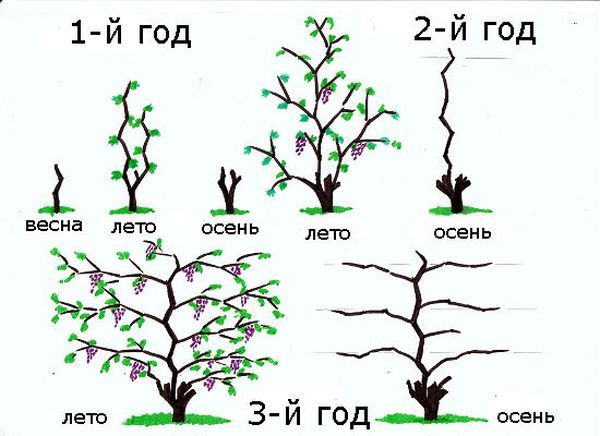
The operation is performed three times per season. In spring and fall, for preventative and sanitary purposes, and in summer, for removing diseased and damaged shoots. There shouldn't be too many shoots remaining, otherwise the bush won't be able to ventilate properly. 30-40 buds per mature bush are sufficient.
Preparing for winter
For the winter, the soil needs to be fertilized. This is done by applying nitrogen-containing fertilizers and pruning. In the south, the topsoil is hilled; in the northern regions, the vines are removed from the trellises, laid on the ground, tied, and covered with plastic.
Disease prevention and pest control
This variety doesn't have the strongest immunity. To prevent fungal infections, mildew, or powdery mildew from damaging the harvest, the bushes are sprayed prophylactically at least twice a season. It's best to do this after heavy rainfall.
Plantations are protected from rodents using smoke traps or sound effects. If there are no pets, poison is used. In winter, the crop is covered with plastic.
To prevent birds from pecking the berries, gauze or special nets are stretched over the vineyard.
Reviews of Aleshenkin grapes
My father planted the Alyoshenka variety about 10 years ago, and it's been growing ever since. It's a tough crop, but with proper care, it produces consistently good yields.
One of the best varieties. We eat it with the whole family, preserve it in compotes, and make juice for the kids for the winter.
Based on numerous reviews, it's safe to say that the Aleshenkin grape variety can be grown in virtually any region of Russia where people enjoy farming. The grapes will provide the whole family with vitamins, delight them with ripe fruit, and require only minimal care.