
How to tie up tomatoes in open ground – simple methods for a good harvest
Content
What does a garter give?
You've probably heard experienced gardeners say staking tomatoes is completely unnecessary. And they're partly right. Indeed, staking isn't always necessary. Determinate varieties, due to their short stature, practically don't need it. But indeterminate tomatoes, with their rapid, upright growth, do require support.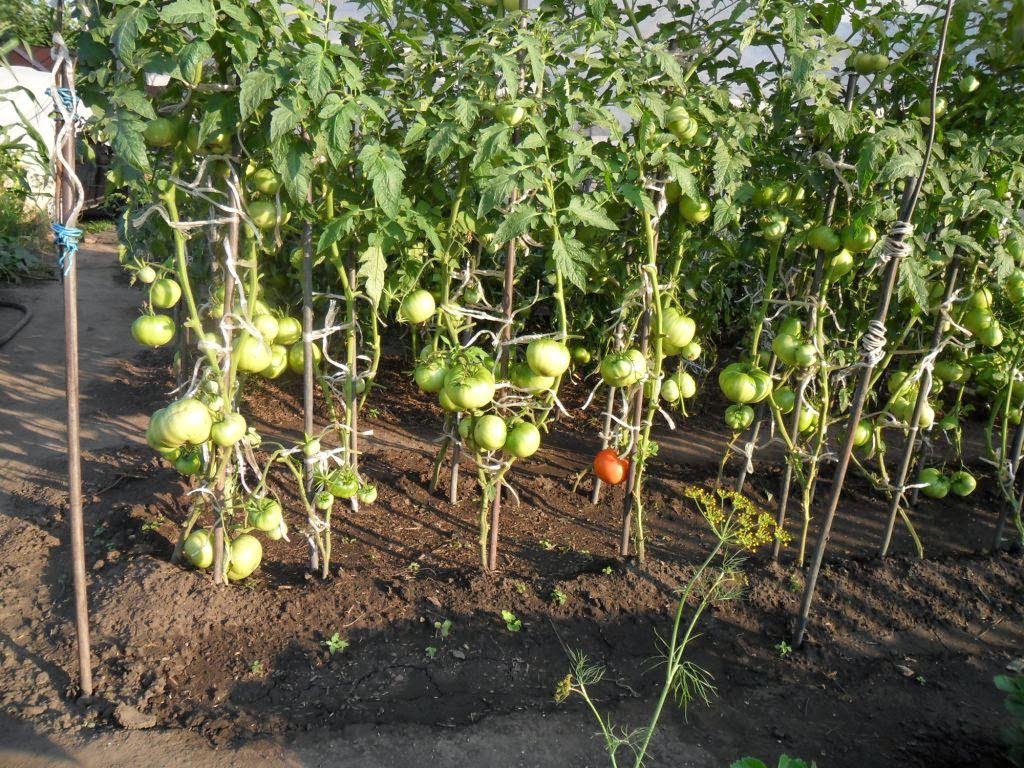
However, let's put all the arguments in favor of a garter on the shelves:
- Tall tomato varieties need to be tied up to preserve the branches and prevent them from breaking under the weight of the fruit;
- a tied-up bush will receive significantly more sun and fresh air, and therefore will produce a higher yield;
- If branches under the weight of ripening fruits fall to the ground, they are defenseless against pest attacks, and this means a loss of harvest;
- even bushes with strong stems in open ground may not withstand strong winds or heavy rain without being tied up;
- an untied plant spends a lot of energy to stand, and has significantly less energy left to fight diseases and pests;
- soil is a haven for pathogens that cause late blight; tomatoes lying on the ground will almost certainly be affected by the disease;
- When watering tied-up tomatoes, you don't risk splashing the fruits and leaves with water - this also harms the health and appearance of the tomatoes;
- It is much more convenient to care for tomatoes, remove side shoots, and harvest if the bushes are tied up.
Therefore, tomatoes are not tied up simply because it's the custom. It's important for the sake of harvest, the health of the plants, and the convenience of the gardener.

Video: "Why do you need a garter?"
This video will tell you when and why you need to tie up tomatoes.
Methods
All methods of tying tomatoes are aimed at achieving maximum yield without harming the plant. Through trial and error, vegetable growers have selected the most effective and gentle options:
- garter with stakes;
- on the trellis;
- cells;
- caps.
Each has its advantages, and each is quite effective. When choosing any of them, it's important to remember: when tying up tomatoes, avoid using materials that will be detrimental to their health. It would be a mistake to assume that natural fabrics are best. In a greenhouse, perhaps. However, when tying up tomatoes outdoors, rags and strings are completely impractical. Rain, wind, intense sun, temperature fluctuations, and changes in humidity will quickly cause such fabric to simply deteriorate.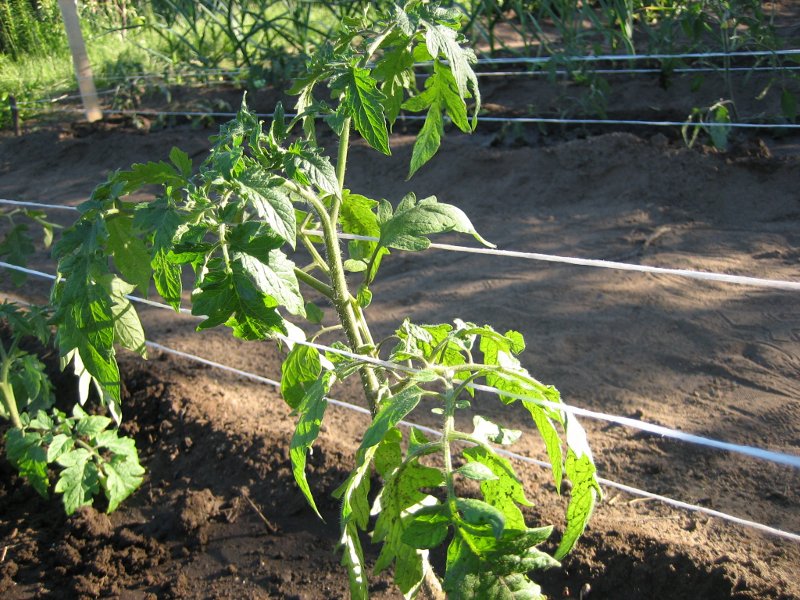
Neither fishing line nor wire are suitable. They're strong, but too thin, and you risk cutting the stems. Therefore, synthetics are the best option, but they're gentle, soft, and flexible enough.
And, of course, any ties can only be used for one season. Even if they're completely undamaged, they should be discarded. Used ties for new seedlings could be carriers of infection. So it's best not to take any chances. The cost of new ties is mere pennies, but the risk of losing your harvest is high.
With stakes
Staking is probably the most common method for staking tomatoes in open ground. This method is common, proven, and simple. The only caveat is that it's not ideal for indeterminate varieties, which can grow very tall. These varieties require stakes 2-2.5 meters high.
What can be used as stakes? Any scraps—wood, metal, or plastic—can be found in any garden. The stake should be firmly anchored in the ground, ensuring both its strength and the preservation of the root system. The optimal distance from the stem is 10 cm.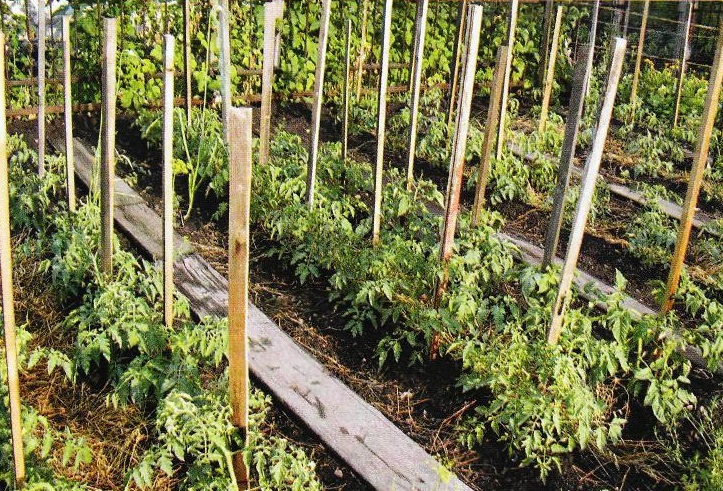
When preparing the garter, make sure it's disinfected. Next, secure the garter to the stake, securing the bush stem at the very top. This is a loose garter method; there's no need to tie the bush tightly. Wrap the stem several times and secure.
That's it. The only drawback to this method is that you'll have to move the garter several times. After all, as the bush grows, you need to move the "reinforcement" that keeps it stable. Staking is typically used by gardeners growing tomatoes for family consumption, not for commercial production.
On the trellis
But how do you properly tie up tomatoes if you have a lot of them in your garden? In such cases, many people rightly prefer a trellis. It's truly more convenient for managing the planting. Besides, there's no better way to tie up tall tomatoes.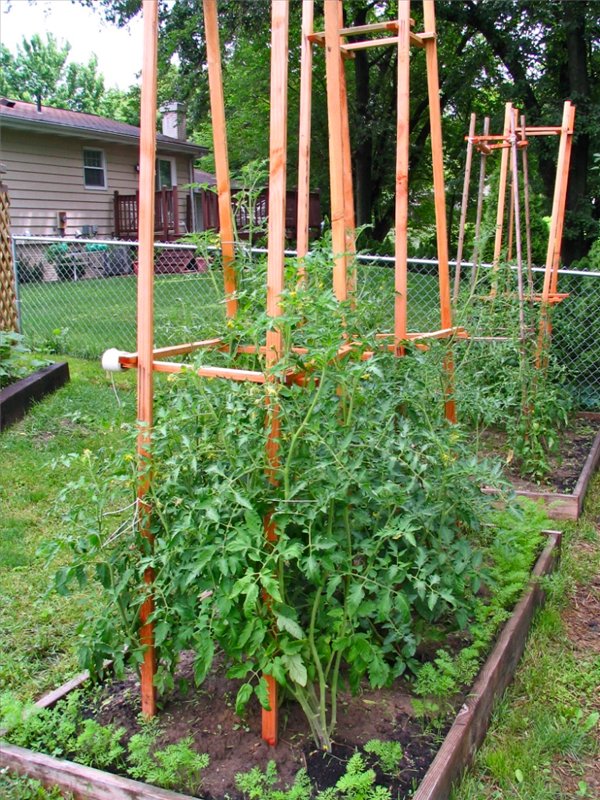
Building a trellis isn't difficult. You'll need two stakes for each bed. Attach them to the edges of the beds, and stretch wire between them. Attach strings to the wire, one for each tomato plant. Tie each string around a plant. As the plant begins to grow, wrap it around the string.
You can build a more solid trellis:
- supports are installed every 4 meters;
- at the top they are connected by a strip;
- the wire is stretched in three rows at a distance of 1 m;
- Tie nylon threads across the wire at a distance of 20 cm - you will get a mesh.
Trellis are reliable, including in terms of preventing pest attacks: the ground will be at a distance even from the lowest leaves.
If you choose this type of structure, you need to start with it. First, erect the trellis, then plant the tomatoes near it. The tied-up bush is secured to the very bottom row of wire. As the bushes grow, you'll secure them higher and higher.
With this method, as with the stake method, you do not need to tighten the ropes on the bushes too tightly.
Cells
If your tomato business is serious and long-term, this is the most thorough way to tie up tomatoes outdoors. Don't be lazy and build a cage for your tomatoes. The effort is worth it: it will serve you faithfully for a long time and will reliably protect the plants planted outdoors.
You need as many cages as you have bushes. Strong rebar wire is used as the starting material. Vertical posts are made from it and installed near the bushes. Wire rings are placed on the posts. The stems are tied to this frame with string.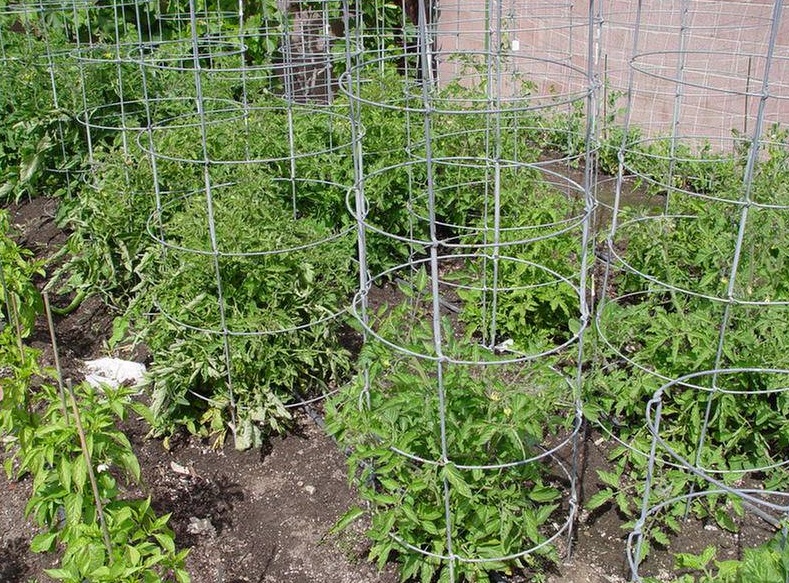
You can also build a wooden cage. It looks like a gazebo without a roof. A wooden cage can accommodate several bushes. The plants are attached to wooden slats. It's practical and even looks beautiful, truly resembling a garden arbors covered in greenery.
Caps
The ingenuity of vegetable growers knows no bounds. This is evidenced by the clever method of tying up tomatoes, known as "caps." In reality, these structures resemble pyramids, huts, and teepees. They are constructed from literally anything at hand. Resourceful gardeners use sticks, branches, vines, wire, and rope.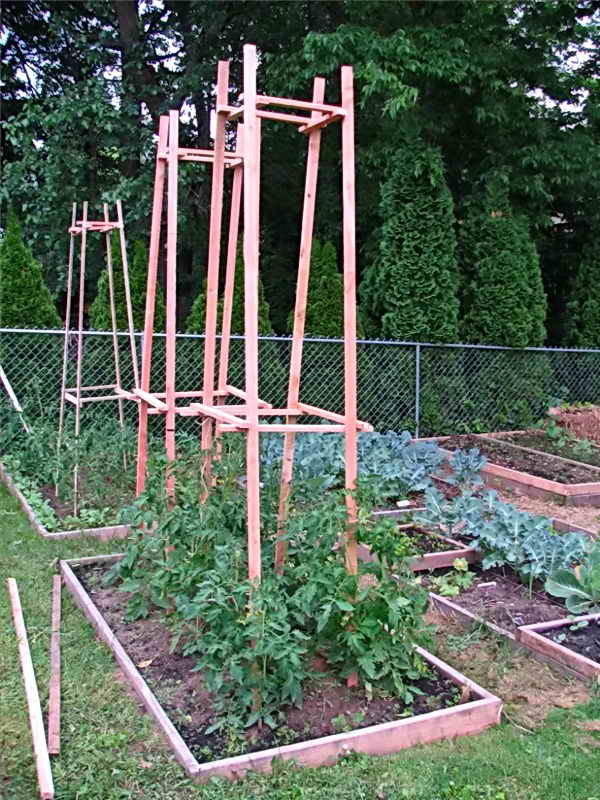
The system is as follows: a plant is planted and a hood is immediately constructed over it. One hood can be sufficient for several plants. The base of the structure is a vertical central stake. Three or four more stakes are driven in around it, converging at the top to form a "roof." The stakes are connected with several strands of wire. Inside the "house" are three or four tomato plants. The plant stems are secured to the tiers of wire. The method is simple and economical, requiring virtually no special investment, yet highly effective.
Video "Tips"
This video will show you how to avoid mistakes when tying up tomatoes.