
Best days to plant tomatoes outdoors: expert advice
Landing rules
To plant tomatoes, you need to prepare the bed in advance. It's best to begin this work in the fall: dig the soil and add organic matter (humus, manure) at a rate of 4 kg per 1 m². Then, before planting the seedlings, all you need to do is loosen the soil and, if it's not fertile enough, add a little mineral fertilizer. If you plan to prepare the bed in the spring, you should do it about a week in advance. The plan is the same—dig the area and add fertilizer—but now you should also add a mineral complex along with the organic matter.
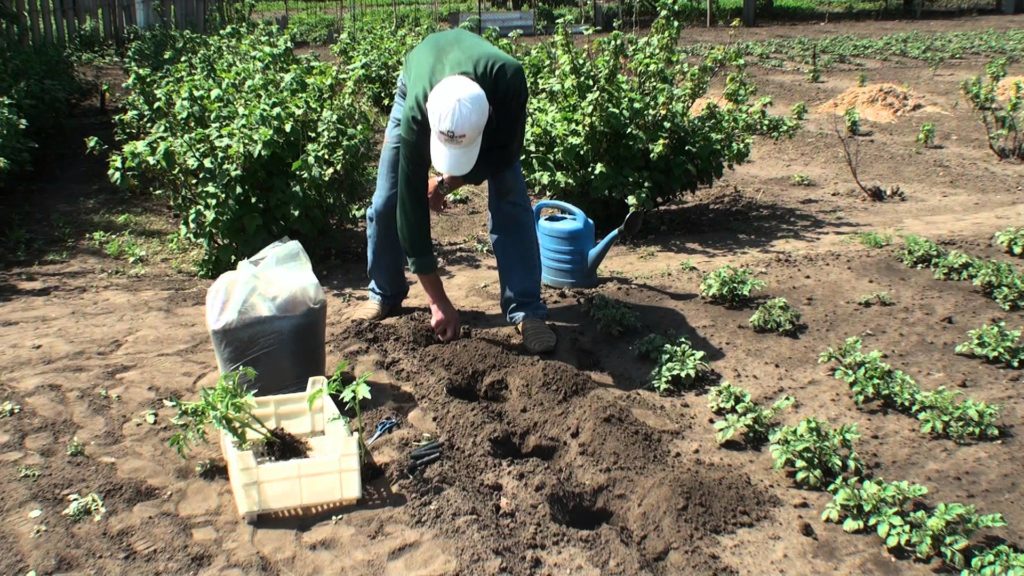
The next step is preparing the holes for the seedlings. Their depth depends on the tomato variety. Low-growing tomato plants typically have shallow but lateral root systems. For these plants, dig holes that are wide but not too deep. Taller tomatoes have longer root systems but fewer lateral shoots, so dig deeper but not too wide holes. Before planting, moisten the bottom of each hole with warm water. You can also add a handful of ash, compost, or 1 teaspoon of superphosphate.
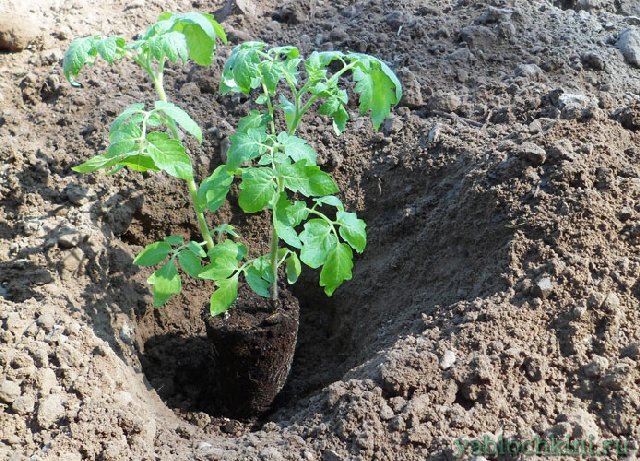
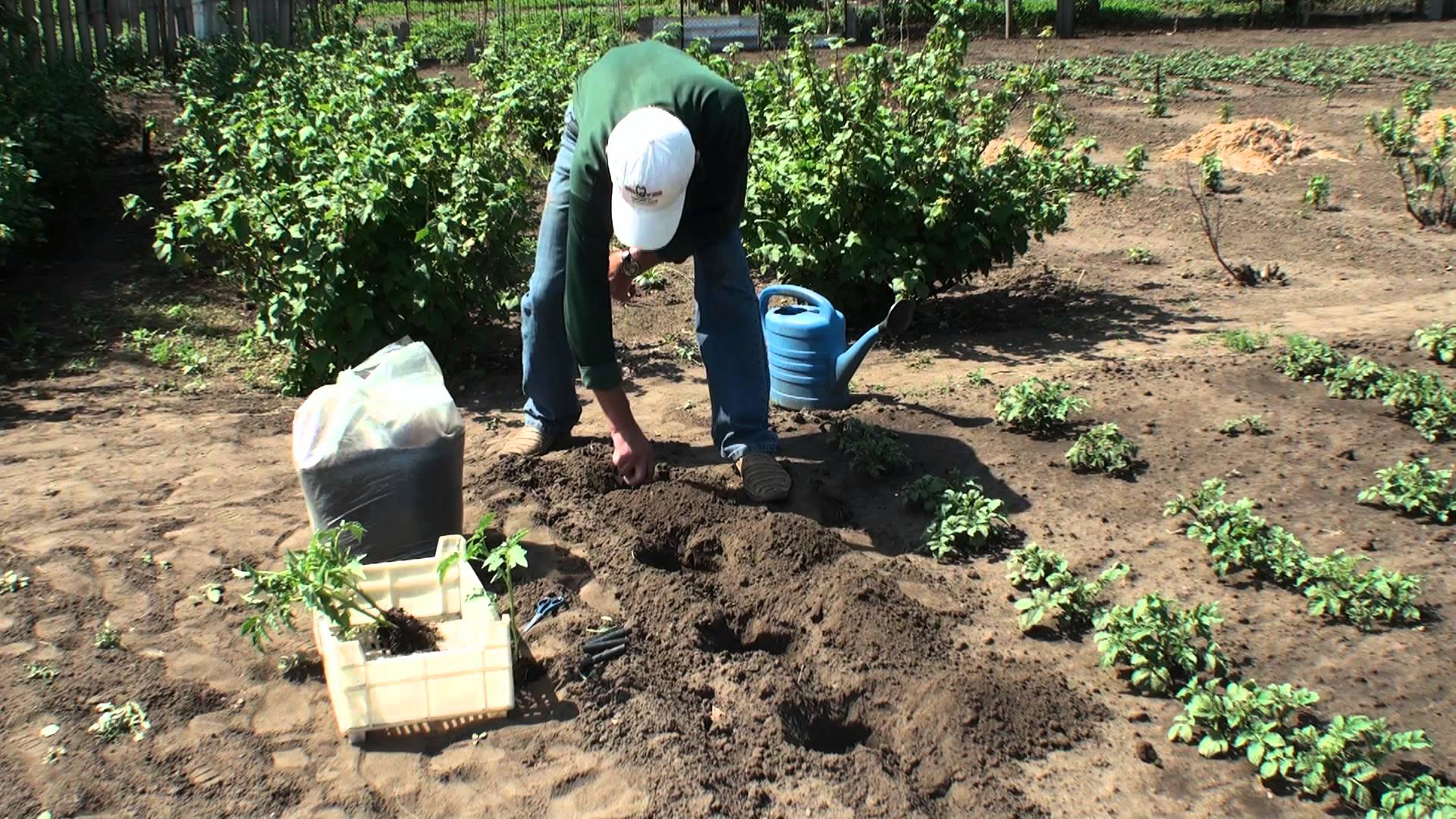
It's recommended to transplant seedlings from pots into open ground with the soil still attached. Before removing the plants from the container, the soil should be thoroughly moistened to avoid damaging the root system. The seedling should be planted deep enough so that only the roots are in the soil, with all the leaves exposed. If you're planting indeterminate (tall) tomatoes, consider providing stakes in advance to tie the young plants to, or install a trellis right away.
Video "Landing"
This video will show you how to properly plant tomatoes in open ground.
Time for landing
Tomatoes can be transplanted outdoors no earlier than after the threat of spring night frosts has passed and stable weather has set in. In the central and mid-latitude regions, this time is late May to early June. In southern climates, planting can be done a few weeks earlier, in mid-May. However, in northern regions, it is recommended to plant seedlings outdoors only in June.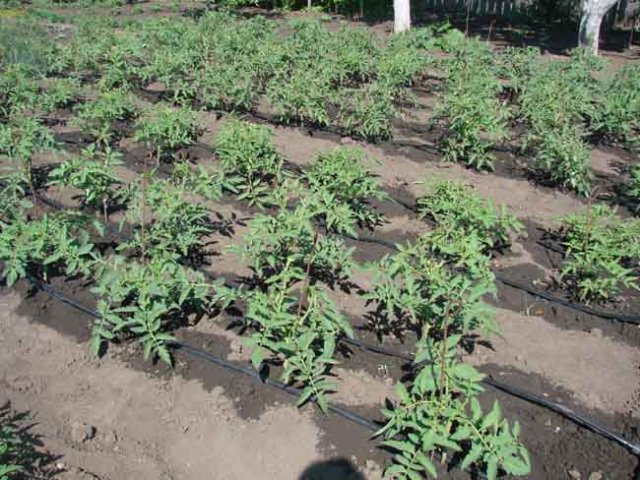
Since seedlings should be 60-70 days old and 25-35 cm tall by the time they're transplanted to their permanent location, it's important to time the sowing of seeds carefully to avoid a situation where the seedlings are already flowering but it's too early to transplant them into the ground due to cold weather. Although many vegetable growers prefer to plant seedlings with already formed and even flowering fruit clusters for an early harvest, it's still a good idea to avoid allowing the seedlings to overgrow. Planting bushes that are already flowering will delay fruit set, as the plants will need time to adapt.
The best time to sow seeds is considered to be mid-March—at this time, plants don't need to be illuminated. However, this can be started as early as mid-February. Most gardeners use a lunar sowing calendar to select favorable days for planting tomatoes. According to this guide, it's best to sow seeds when the moon is in its first phase under the influence of Scorpio, Libra, or Pisces. This year, favorable days in March are considered to be the last ten days of the month: the 20th, 25th, 30th, and 31st. If that's too late for you, you can sow seeds in the last days of February—the 27th and 28th are also considered favorable days.
According to the lunar calendar, opening and transplanting seedlings to their permanent location is recommended on May 15, 19, 24, and 31. For those who prefer to plant stronger seedlings later, favorable days in June are the 1st, 11th, 16th, and 20th.
 If something, such as bad weather, prevents you from planting tomato seedlings during these days, don't despair. This can also be done on less favorable (neutral) days. The main thing is that the moon isn't in its waning phase, full moon, or new moon at this time—planting is not recommended during these periods.
Planting density
To get a good tomato harvest, it's important not only to choose a favorable day for planting seedlings but also to arrange the plants so they're comfortable and not crowded. If your planting space allows, don't skimp on space—the more open the plants are, the more vigorous they will grow, but this also depends on the tomato variety. So, tomato planting can be done using the following schemes:
- row (the simplest, but most often used by gardeners) involves planting at a distance of 25, 35 or 45 cm (depending on the variety) between plants and 60-70 cm between rows;
- tape-nest - seedlings are planted in two rows at a distance of 40 cm between them, after which a path 0.8-1 m wide is formed, with plants located at a distance of 40-60 cm from each other (depending on the variety);
- square-nest involves planting 3 seedlings in one hole at a distance of 60 cm from each other and 80 cm between rows (later the weakest seedling can be removed);
- checkerboard - bushes are placed in two strips (the second row is planted in the spaces between the first), the distance between the holes is 40-60 cm, between the rows - 70-80 cm, between the strips - 1 m.
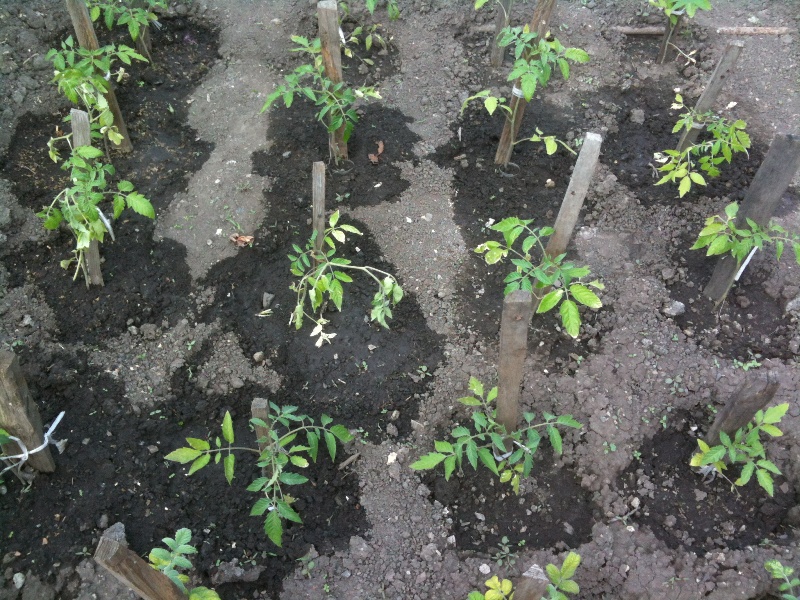
Of course, there's no need to calculate the distance down to the centimeter—it's all relative. The main thing is that the plants don't crowd each other and develop harmoniously. When choosing favorable days for planting tomatoes outdoors, try to consider all factors: the climate of your region, the variety's characteristics, and the tomato's light requirements. If you succeed, a good tomato harvest is guaranteed.
Video "Schemes"
This video will show you how to plant tomatoes.