
Guidelines for planting tomato seedlings in a polycarbonate greenhouse
Content
What you need to know about tomatoes and polycarbonate
Polycarbonate greenhouses are lighter and stronger than glass ones, and much more reliable than film ones. Their popularity is growing, but gardeners planning to plant tomatoes there should also be aware of the material's drawbacks.
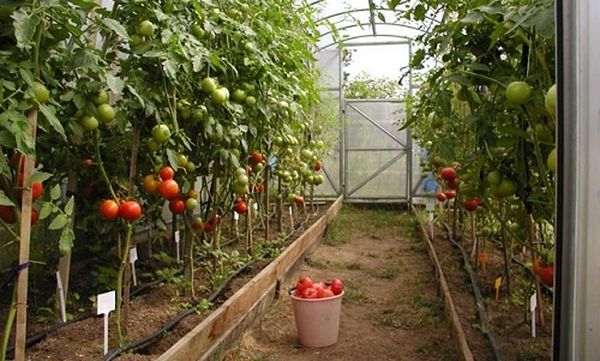
First, tomatoes need ventilation. Unlike framed glass and film structures, which provide airflow, polycarbonate greenhouses lack natural ventilation. This problem can be solved with vents. At least three are needed: two on the sides and one at the top. Ideally, one of the vents should have a temperature sensor inside the greenhouse and open automatically at the top threshold (for example, using an Arduino controller).
Secondly, such greenhouses don't transmit as much light, and tomatoes are sun-loving. The structure should be located in a location that isn't shaded by trees or shrubs. Alternatively, you can transplant the tomatoes themselves.
When to plant seedlings
The soil should warm up to 12–15 °C up to 20 cm. Roots will rot in cold soil. To artificially warm the soil, some gardeners cover it with dark plastic. In temperate climates, seedlings can be planted in early May.
Selecting a variety and preparing tomatoes
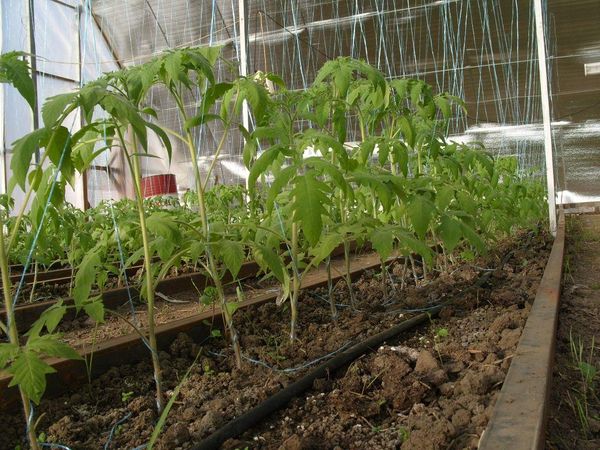
It's important to keep in mind that tomatoes take 110–130 days to fully ripen. Therefore, in northern latitudes, where they need to be planted later, it's better to choose early-ripening varieties.
In spring, night temperatures drop sharply, causing condensation on the polycarbonate greenhouse walls, which promotes the growth of harmful bacteria. Hybrid varieties (labeled F1) are the best choice. They are more expensive, but are disease-resistant, produce a higher yield, and don't require artificial pollination (which is also important when growing in a greenhouse). F1 hybrids include varieties with large or small cherry-like fruits. However, their seeds lose their parental qualities.
A polycarbonate greenhouse can accommodate both determinate tomatoes (0.7–1.5 m tall, stopping growth after 6–8 fruit sets) and indeterminate varieties (with unlimited growth and flowering). Indeterminate varieties are preferable: they ripen faster and have a longer fruiting period.
To plant the F1 hybrid, prepare a container up to 7 cm deep. It should have drainage holes in the bottom. Fill it with store-bought tomato soil or a 1:1:1 mix of humus, peat, and turf soil with wood ash and superphosphate. Water it with a humate solution (prepared according to the instructions).
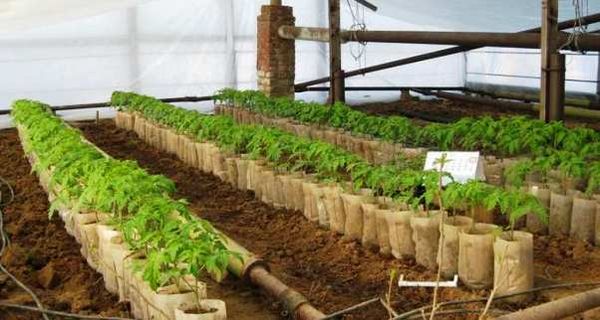
The seeds are planted densely, using a "school" pattern: in 1.5 cm deep grooves with a distance of 5–7 cm between them. The roots need air flow, so we place the container not on a flat surface, but on supports (bricks, etc.).
The seedlings should be watered for the first time when the sprouts first appear, then twice more as the soil dries, but no more than three times a month. Rotate the pot periodically to prevent the seedlings from becoming crooked.
When 2-3 leaves (not cotyledons) appear on the tomatoes, transplant them into individual 8 cm pots. Water once a week. After 12 days, fertilize with azophoska and nitrophoska, and after another 15 days, use a specialized tomato fertilizer. Tomato stems should be 25-30 cm tall before planting.
How to plant in a greenhouse
Before planting tomatoes, the greenhouse should be disinfected with pest and bacteria control products. Then, prepare the seedling beds. A U-shaped planting pattern with the legs facing the greenhouse entrance is preferred. Leave 10 cm from the border, and the minimum distance between beds is 50 cm. The width of the bed depends on the size of the greenhouse and can range from 60 to 110 cm. The seedling beds should be raised 20 to 40 cm above ground level.
The recommended pattern for planting tomato seedlings is a checkerboard, zigzag, or opposite-the-same pattern. Tomato plants should be spaced 50–60 cm apart—no more, otherwise they will begin to branch, and side shoots will reduce the yield. Planting them too densely will hinder their development and lead to disease.
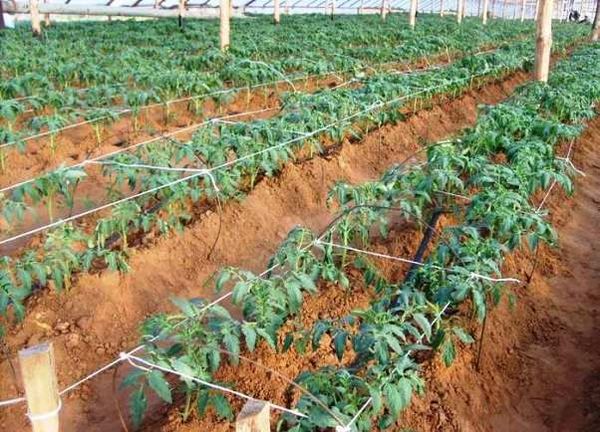
Before planting, remove the bottom two leaves from the seedlings. Turn the pot upside down and lightly tap the bottom to loosen the soil. Place the cotyledons in the hole with the cotyledons above the surface. If they are below or at ground level, remove them.
After 3-4 days, the seedlings need to be tied up. In a polycarbonate greenhouse, you can use frame or linear trellises. Tomato seedlings should be watered for the first time 10 days after planting, otherwise the stems will begin to grow too quickly. The water temperature should be 20-22°C.
Gardener's tips
To avoid condensation, you can use polycarbonate sheets with an inner layer.
After planting, avoid overdoing it with nitrogen fertilizers, otherwise the tomatoes will have lush foliage and minimal fruit. It's best to plant seedlings in the greenhouse in the evening or on a cloudy day. The day before planting, each hole can be watered with a hot, strong solution of potassium permanganate to kill harmful microorganisms.
You can't plant cucumbers and tomatoes in the same greenhouse, as they require different temperatures and humidity levels.
Video: Planting Tomatoes in a Greenhouse
This video will teach you how to properly plant tomatoes in a greenhouse.