
Honey Drop Tomato: Growing the Yellow Babies
Content
Description of the variety
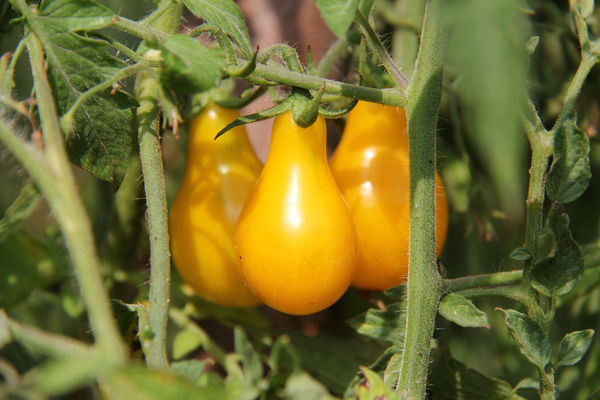
Honey Drop tomatoes are tall plants from the cherry family. The fruits are small yellow, clustered in clusters. The tomatoes are elongated and pear-shaped. The variety's name stems not only from its color but also from its sweet taste.
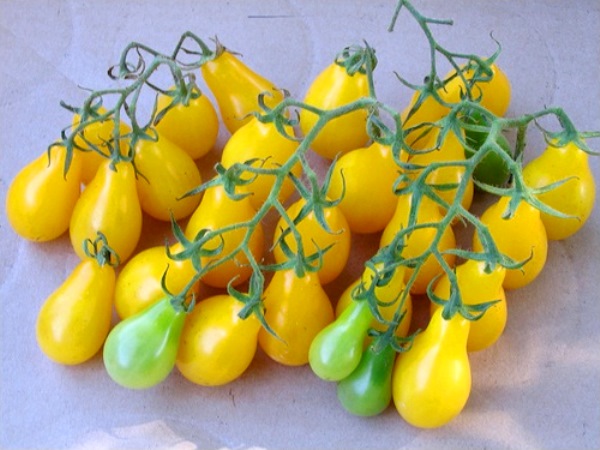
One of the characteristics of this tomato variety is that it can be grown both in greenhouses and open ground. The bushes grow massive, up to 1.5-2 meters tall, with large leaves.
Side shoots appear on the bushes, which must be removed to prevent thickets from forming. Most often, tomatoes are grown with 2-3 stems above the first fruits. The Honey Drop tomato is rarely susceptible to diseases; even in conditions of widespread infestation, this tomato variety appears healthy compared to other varieties. In greenhouse conditions, due to high humidity, the plant is more susceptible to diseases. Honey Drop does not require frequent watering, yet produces a good harvest. This makes these tomatoes suitable for growing in a wide range of climates.
Video: Preserving Light Bulb Tomatoes
A demonstration video with useful tips on preserving bulb tomatoes.
Application
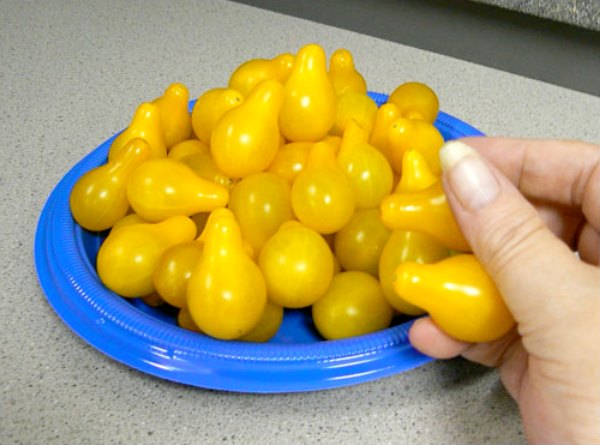
The use of this tomato variety is largely determined by the nutrients it contains. As mentioned above, the fruits of the Honey Drop variety are very sweet. Therefore, many housewives make jam from them. The small, yellow, pear-shaped tomatoes look very attractive preserved in jars.
The fruits are often eaten fresh, not only in salads but also as a substitute for their red counterparts. Yellow fruits are lower in calories and therefore less likely to harm your figure. This makes them suitable for dieters. This variety also contains a small amount of vitamin C.
Therefore, even people with high stomach acidity should consume them. At the same time, the vitamin A content in Honey Drop significantly exceeds that of red tomatoes. Long-term consumption of yellow tomatoes has a positive effect on blood vessel walls, strengthening them.
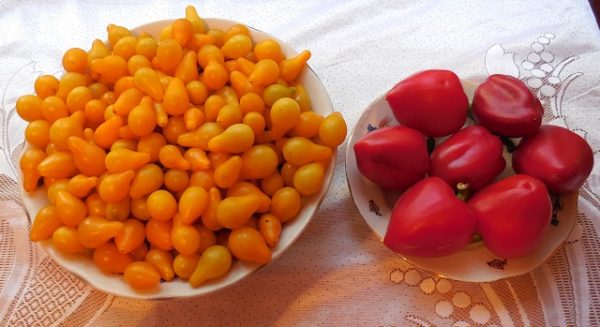
The fruit of this variety is rarely used for making pasta or tomato paste. This is most likely due to the unconventional appearance and color of the finished product, as well as the excessive sweetness of yellow tomatoes. Yellow teardrop tomatoes also serve an aesthetic purpose: they beautifully decorate any salad and add a touch of distinctive flavor. The fruits are also excellent for drying or pickling.
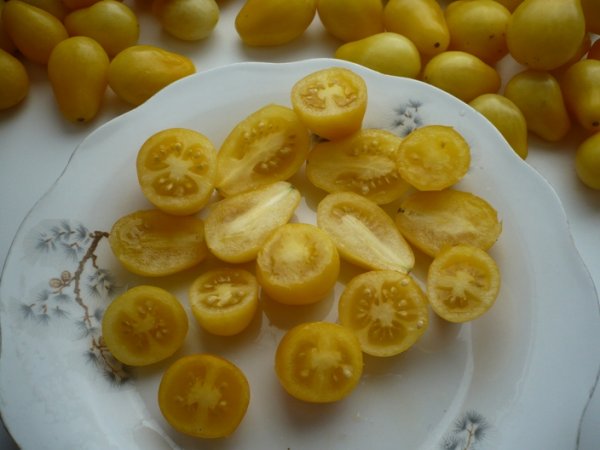
Honey Drop is a tomato cultivar, not a hybrid. Therefore, your hand-grown tomatoes can be used to harvest seeds. Ripe tomatoes should be cut, strained through a sieve, and rinsed. Any seeds remaining in the sieve should be dried and stored until planting time.Tomato seeds are considered suitable for 5-7 years, but they are best harvested in 2-3 years.
Care Features
The description above indicated that this tomato variety can be grown in various conditions: in the ground or in a greenhouse. In any case, the seeds should be sown for seedlings at the end of March, preferably in individual containers. Before planting, the seeds must be treated.
Choose the most fertile soil for planting seedlings and plant the seeds to a depth of 2 centimeters. Water the planted seeds regularly, but not too much (to avoid overwatering). The first shoots will appear in 7-10 days. If you planted the seedlings in a box, the plants should be pricked out when the first leaf appears. To do this, generously water the soil in the boxes and transplant the tomatoes into individual containers. It is also recommended to pinch the roots, which will encourage new roots to emerge, and to push the stems into the soil down to the leaves.
Seedlings need to be fertilized several times, just like soil-grown plants. Transplanting into the ground should only be done when the weather is warm and frost is not expected. It is recommended to plant tomatoes in soil using a 70x40 cm spacing. However, tomatoes will yield a good harvest even if the plants are spaced 45 cm apart. However, in this case, you will need to carefully monitor the plants to prevent them from becoming too dense.
Plants already planted in the ground require little care—they just need to be kept free of weeds and the soil loosened regularly. Staking is essential, regardless of the growing environment. Excess shoots should be removed, leaving one or two stems to prevent the formation of thickets. Periodically, mist the green parts of the plant.
Tomatoes require periodic fertilization, as this variety is a vigorous plant. During the growing season, they should be fertilized a couple of times, alternating between organic and mineral fertilizers. During fruiting, the timing of fertilization depends on the emergence of new clusters. When tomatoes ripen in large quantities, they should be fed with mineral fertilizer and ash.
Mulching is a useful technique for growing yellow tomatoes. This involves layering artificial or organic materials on plant beds to regulate water and air circulation. The main purpose of mulch is to protect the topsoil from drying out. This creates a dense crust on the soil surface, which, by its very nature, hinders air circulation. But this isn't the only benefit of mulching:
- Thanks to the layer on the soil surface that does not allow the sun's rays to pass through, weeds practically do not appear.
- Mulch keeps the soil moist longer and prevents it from drying out after watering. Therefore, you'll need to water and loosen the soil less frequently.
- If you use organic material for mulch, the bottom layer rots and becomes excellent food for worms. This creates humus and fertilizes the soil under your tomatoes. After a while, you'll be able to do without fertilizer altogether.
- Tomatoes are watered excessively, which creates high humidity indoors, which can lead to disease. Mulch protects against this.
One of the characteristics of these tomatoes is their resistance to disease, but for preventative purposes, the plant is treated with phytosporin. This treatment is essential in a greenhouse. The Honey Drop tomato variety is a mid-season variety, so the harvest can be picked with the first red tomato harvest. This way, you can enjoy sweet yellow fruits for several months.
Reviews
Reviews of the Honey Drop are overwhelmingly positive. Many gardeners love the unusual color, shape, and flavor of these small vegetables. Some rave about their nutritional value and health benefits, while others rave about their ease of care. So, plant this unusual variety in your gardens or summer cottages and enjoy!
"One day, I went to visit my grandmother in the village. After a joyful reunion and a short rest, we decided to have some tea. Grandma opened a jar of some yellow jam. She didn't answer my questions about what it was made of, but just smiled mysteriously. The jam turned out to be delicious. I devoured almost half the jar, but still couldn't figure out what it was made of.
After much questioning, Grandma confessed that this delicious jam was made from Honey Drop tomatoes. I didn't believe her and just laughed. But Grandma wasn't joking. She took me to the garden bed and picked… a yellow pear! I couldn't believe my eyes and couldn't understand a thing. Grandma cut open this strange vegetable, and inside it really did look like a tomato, and it tasted just like one, too, only sweeter. I've never seen, much less tasted, anything like it! I highly recommend it.
Video: "Lots of Information About Different Tomatoes"
A demonstrative video with lots of interesting information about different tomato varieties.