
The intricacies of planting and growing the high-yielding Banana Legs tomato variety
Content
The History of the Original Yellow Tomato Variety
This tomato with an unusual name was developed by breeder T. Wagner in the United States back in 1988, but only became popular in Europe a few years ago. The original catalog name for this variety is Banana Legs. It ripens early and adapts well to a variety of climates, making it a favorite among gardeners.
Video: Planting Tomatoes in the Ground
This video will show you how to properly plant tomatoes in open ground.
Description and characteristics of the variety
Banana Legs is a mid-early variety distinguished by high productivity, compact bushes, and beautiful fruits. Let's take a closer look at all these characteristics.
Plant parameters
This is a determinate variety, meaning its growth is limited by the formation of the inflorescence at the top. In garden beds, its height typically does not exceed 0.8 m, but in greenhouses it can reach 1.5 m. The bush is branched, the foliage is dense, lacy, velvety to the touch, and the petioles are covered with fine hairs. The shoots produce numerous flower clusters, each bearing 6-10 fruits.
Commercial and taste qualities of fruits
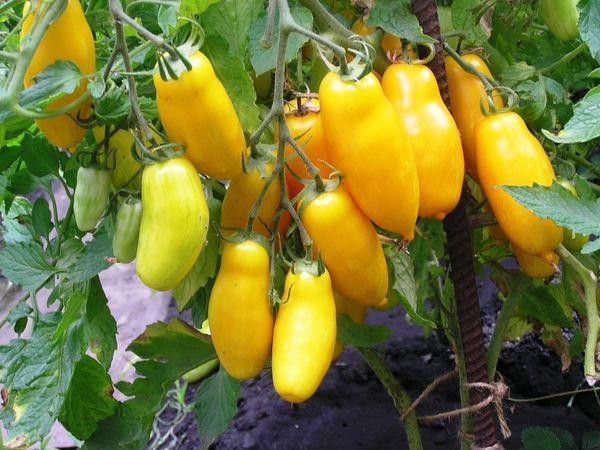
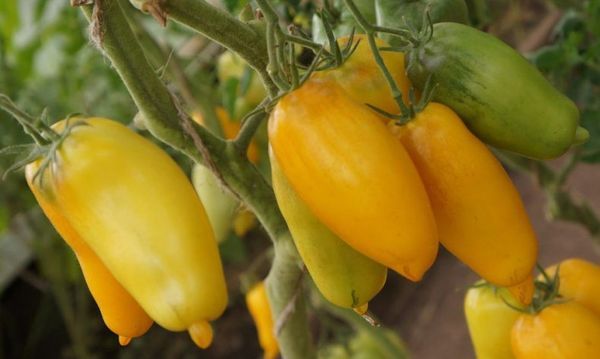
The appearance of the fruits fully reflects their varietal name. They are elongated, slightly curved at the tip, and indeed somewhat resemble bananas. Size varies depending on growing conditions: a tomato grown in the garden weighs 50-80 g and is 8-10 cm long. In greenhouses, they grow larger—100-120 g and reach a length of 10-12 cm.
All the fruits in a cluster are approximately the same size. When fully ripe, they are a rich yellow or orange color; unripe tomatoes are paler, with noticeable longitudinal stripes that fade as they ripen. The flesh is juicy and meaty, with minimal seeds, and the flavor is slightly tart and delicately citrusy. The skin is thick and does not crack, allowing the tomatoes to store and transport well.
Yield of the variety
The ripening period of tomatoes is influenced by the region's climate: in warmer climates, it takes 65-70 days, while in cooler regions, it can reach 80 days. Fruiting occurs evenly, resulting in high yields – 4-6 kg per bush, or about 20 kg per square meter. Considering the small size of the bushes, this is an excellent result. The fruits can be picked whole bunches, which significantly improves their marketability.
-
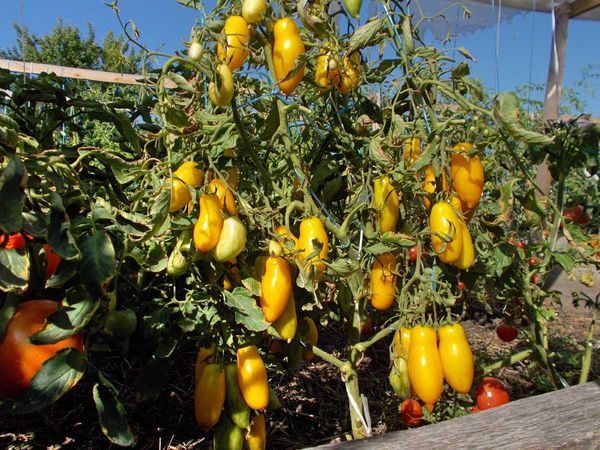
- The weight of a tomato from a garden bed is 50-80 g
-
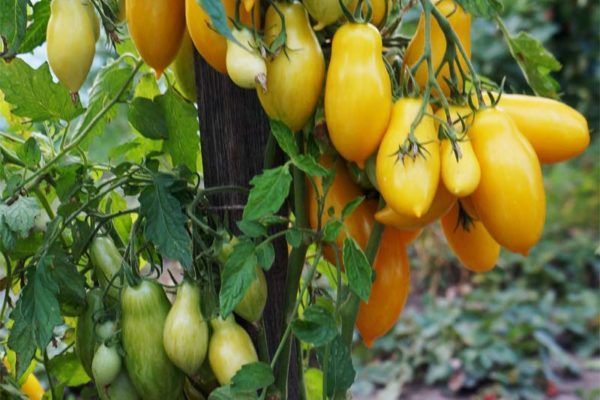
- The ripening period of tomatoes is influenced by the climate of the region.
-
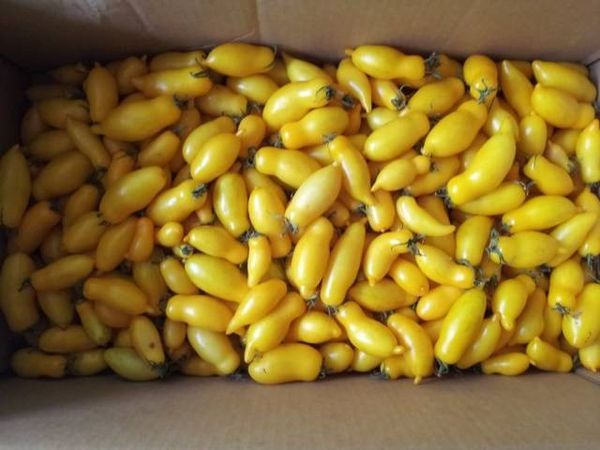
- The variety has a high yield – 4-6 kg per bush
Application of fruits
Tomatoes have a wide variety of uses. They're primarily used in fresh salads and sauces, where the fruits reveal their unique flavor and aroma. They're also added to hot dishes, vegetable stews, casseroles, and pizza. Their fleshy flesh makes them easy to dry and freeze, and their thick skin prevents cracking during canning and pickling.
Advantages and disadvantages of Banana Legs tomato
- high yield rate;
- undemanding to care and environmental conditions;
- ability to adapt to any climate, resistance to frost, heat and diseases;
- good seed germination (97-98%);
- mass ripening of fruits;
- beautiful color and attractive shape of fruits;
- transportability and good product characteristics;
- pleasant aroma and refreshing taste of the pulp;
- the possibility of growing in beds and greenhouses, through seedlings and by direct sowing into the soil.
There are no significant disadvantages, except that not everyone likes the thick skin on the fruit.
Features of planting and growing
A rare feature of these tomatoes is that they can be planted either as seedlings or by sowing seeds directly into the ground. Let's consider both methods in more detail.
Seedling method
Sow seeds for seedlings 60-70 days before the expected planting date. First, soak them in potassium permanganate for half an hour, then dry them and sow them in fertile, pre-moistened soil. A suitable "Seedling" mixture can be purchased at the store or prepared at home using turf soil, a small amount of sand, humus, ash, and 50 grams of crushed chalk.
The seeds are placed in nests of two at a depth of 0.8-1 cm and covered with soil. The container is covered with plastic wrap and the temperature is maintained at 18-20°C. When the sprouts appear, the cover is removed, and the plants are watered and fertilized. When the seedlings have two true leaves, they are pricked out and, after a week, fed with a complex fertilizer (nitrophoska). The plants are transplanted when they reach a height of 15-20 cm and have formed 8-10 leaves. A week before this, they are taken outside to harden off.
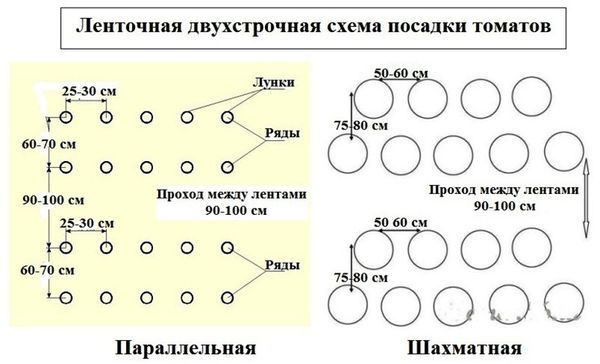
Important! It is recommended to plant no more than 4 bushes per square meter. Planting too densely will negatively impact yield.
Seedless method
Here, everything is simpler. The seeds are planted in well-warmed soil, spacing them 50 cm between plants and 70 cm between rows. Fertilizer (humus, superphosphate, potassium nitrate) is added directly to the holes, mixing it with the soil. Two to three seeds are placed in each hole, 1.5 cm deep, covered with soil, watered, and covered with plastic wrap until seedlings emerge. Subsequently, the strongest seedling is left, and the others are removed.
Care instructions
Water the seedlings as the top layer of soil dries. Use air-warmed water at a rate of 5-6 liters per plant. Ten days after transplanting, fertilize with a herbal infusion or mullein (1:10) with 1 tablespoon of urea added per bucket of solution. Apply the fertilizer under the roots. During the season, you can apply a few foliar applications of boric acid.
The next step is shaping the bushes. The instructions state that this variety doesn't require side shoots, but gardeners report that without this procedure, the fruit production is significantly lower than with 3-4-stemmed plants. Regularly removing any side shoots that appear is also recommended. During fruiting, the bushes require support, as the weight of the clusters can cause the shoots to collapse and break.
Pest and disease control
High resistance to adverse factors and early harvesting help this variety avoid many pests and diseases. However, if cool and damp weather persists for a long time, the harvest may be damaged by late blight. To prevent this, it is recommended to sprinkle mustard powder or ash between the bushes. Affected bushes can be sprayed with whey diluted 50/50 with water, or with milk and iodine (15 drops per bucket) every 2-3 days. To combat insects, plants can be sprayed with bitter herbal decoctions.
Tip: To repel insects and gnats, plant onions or garlic near your tomatoes. Pests also dislike the scent of lavender and marigolds.
Reviews from summer residents
I planted this variety for the first time. The harvest exceeded all expectations; the bush was literally covered with fruit. My wife really liked the taste and the light lemon aroma, which persists even when preserved.
I love this variety and always plant a few for myself. I've noticed that the bushes thrive in sun and space, while in shade and with neighbors, the yield is much poorer.
A delicious tomato, the kids love it. We eat it whole and in salads, but we didn't like it in preserves because of the tough skin and distinctive aroma.
This variety is ideal for lovers of yellow tomatoes who prefer a light and fresh flavor. Of course, it's more popular in southern regions, where it can be grown directly from seedlings, but it also grows well in greenhouses, as it tolerates temperature fluctuations.