
Why tomato leaves curl at the top
Content
Possible causes and help
If tomato seedling leaves are curling, it's cause for concern, as delay could cost you your harvest. This behavior could be caused by disease, nutrient deficiencies or excesses, pest infestations, or excessively high temperatures. There are many possible causes. To determine which is best for your situation, we'll look at the most common ones and discuss what to do in each case.
Feature of the variety
The leaves of some tomato varieties are curled due to selective breeding and genetics. For example, the varieties 'Fatima,' 'Oxheart,' and 'Cherry' have leaflets that curl downward. Furthermore, if all the seedlings have leaves that curl in the same way, there's no need to worry—it's simply a characteristic of this particular tomato variety.
Air temperature
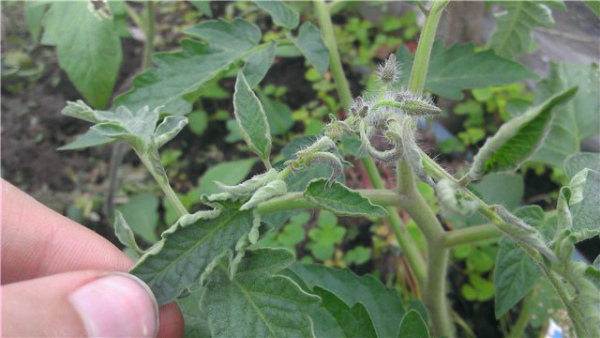
Young plants haven't yet developed tolerance to scorching sunlight, and some varieties are shade-loving, so curled leaves may be a reaction to excessively high temperatures. This is actually a defensive reaction by tomatoes—they're trying to reduce evaporation area to conserve moisture. What should you do in this case? Try to water the beds so that water doesn't splash onto the leaves in full sun, create a shelter, or transplant the tomatoes into the shade.
Low moisture content
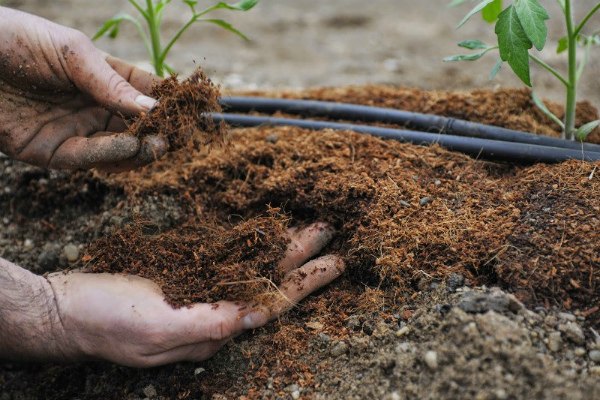
Tomato seedlings' love of moisture is worthy of poems. Therefore, if you notice strange leaf behavior, check whether they're getting enough water or if they're just sitting on dry rations, trying to draw moisture from the soil. This could be the cause. In this case, to stop them from curling, increase the frequency of watering and mulch the soil with grass clippings. This will help the plant retain moisture, and it will also prevent excessive evaporation during dry periods.
Excess moisture
Sometimes too much is worse than nothing. This proverb applies 100% when watering seedlings.If you overwater, the leaves will curl upward. This happens primarily because the tomato roots can't breathe. To prevent this, fill the holes with loose soil and create furrows around the holes to allow drainage.
Pests and diseases
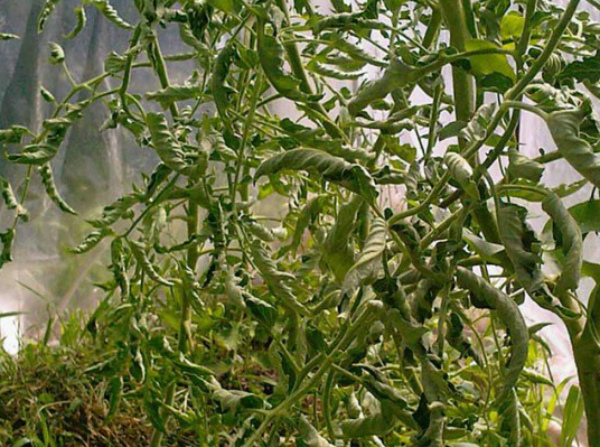
A common cause of diseases that affect tomato leaves is an infestation of harmful insects or fungal diseases. The larger the garden beds, the more likely this kind of problem is to occur. Most insects settle on the undersides of leaves, sucking out vital juices, causing the leaves to curl inward and eventually die.
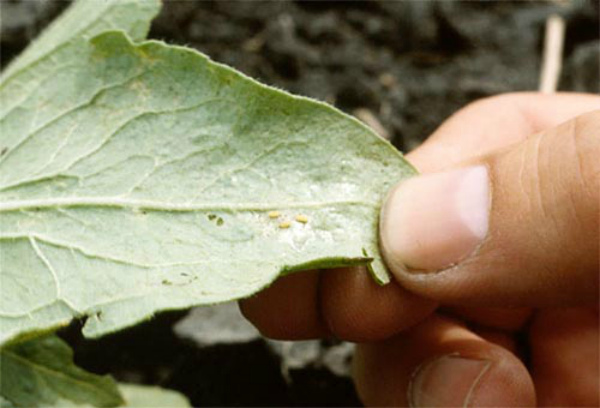
One of the most destructive enemies of tomatoes is the whitefly. This insect, rarely exceeding 1.5 mm in length, is yellow in color and has two pairs of wings. Swarming, whiteflies completely cover a leaf and consume it. The plant becomes covered in a black coating and soon dies. If whiteflies are detected, tomato leaves should be treated with an insecticide immediately.
Another cause of leaf curling is bacterial canker. The main symptom is leaflets curling downward, then quickly turning brown and drying out. Cracks also appear on the underside of the petioles. Affected plants should be removed from the garden bed: trimmed, treated with copper oxychloride, and then destroyed.
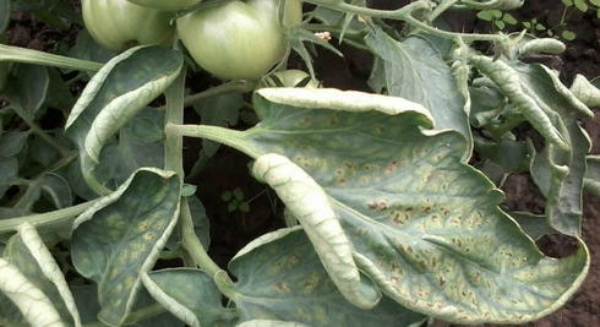
Leaf curl can be caused by the tobacco mosaic virus. The leaves become covered in a mosaic of dark-green and light-green segments, and swellings appear. To treat this disease, remove the affected plants and spray the remaining ones with antifungal agents.
Another fungal disease that can affect tomatoes is fusarium wilt. The lower leaves wilt first, and the disease gradually progresses upward. Additionally, leaf blades may turn yellowish, upper shoots wilt, and a light-colored coating forms on the leaves and a pinkish coating on the roots. Verticillium wilt symptoms are very similar to fusarium, but the leaves curl upward, wilt, and darken. However, with proper care, the plant easily survives the disease and survives until harvest. In both cases, antifungal treatments are necessary.
Brown spot is a disease affecting tomato seedlings in greenhouses. A brown, velvety coating spreads along the lower edges of the leaves. The leaves wilt, and the fungus spreads to neighboring plants. Reduce watering and spray with copper oxychloride.
If you suspect that the wilting of your seedling leaves is due to the harmful effects of diseases or insects, you should make infusions of ash, celandine juice, and onion peels, and then spray the affected plants with them.
Nutrients
If the poor condition of your seedling leaves isn't due to humidity, pests, or disease, you may be experiencing a deficiency or, conversely, an excess of nutrients in the soil, which shouldn't be the case.
A deficiency of beneficial micronutrients is characterized by a dark brown leaf coloration. The leaves curl downward, and the shoots become smaller, turn yellow, and droop. In this case, a comprehensive foliar feeding is necessary to support the plants.
Sometimes, overfertilization can occur. In such cases, the leaves form tubes, become ulcerated, and quickly die. This happens because the plant is unable to absorb all the micronutrients and, due to the excess, attempts to reduce active photosynthesis.
Incorrect pinching
Pinching or removing side shoots should be done carefully and at the right time, otherwise you will end up with withered tubes instead of beautiful leaves on your tomatoes.
If the stepsons have reached a length of 7-8 cm, you can pinch them off; if they are shorter or longer, you will harm the plant.
Try not to remove a large number of parts involved in vegetation at once.
Observe your plants. If you notice any unusual behavior in leaves, stems, or flowers, try to identify and eliminate the causes.
Video: "Tomatoes' Nutritional Deficiencies Cause Leaf Curl"
Find out what nutrients you need to add to prevent tomato plant leaves from curling.