
Titania currant variety - the Swedish queen on your plot
Content
History of the variety
Titania currant is often described as a "Swedish variety with Russian roots." The appropriateness of this metaphor is explained by the variety's origins. Titania was bred in Sweden by pollinating the "Altai dessert" currant with the well-known Swedish variety Kajaanin Musta-Tamas. Officially registered in 1970, this variety only appeared in Russian gardens in the mid-1990s.
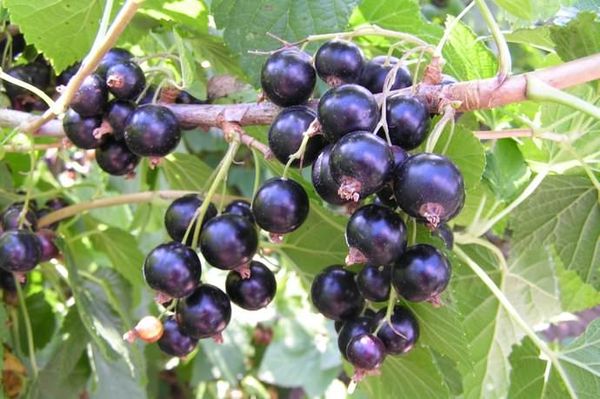
From 1997 to 1999, the Bryansk Research Institute conducted tests of Titania for its adaptability to various climatic conditions, as a result of which the currant demonstrated excellent yield (80 tons/hectare) and high taste characteristics, while surpassing many high-yielding varieties and hybrids of domestic selection.
Such productivity led to Titania being cultivated on an industrial scale since the late 1990s. Today, this variety is often used to develop new promising hybrids, and it remains a leading chokeberry variety in Swedish breeding.
Planting and care
Titania currants aren't particularly demanding when it comes to growing conditions, but their yield largely depends on proper planting and basic care. It's recommended to plant seedlings along the perimeter of the garden plot, rather than in nooks or tree shade—the more sunlight the bush receives, the sweeter and more flavorful the berries will be.
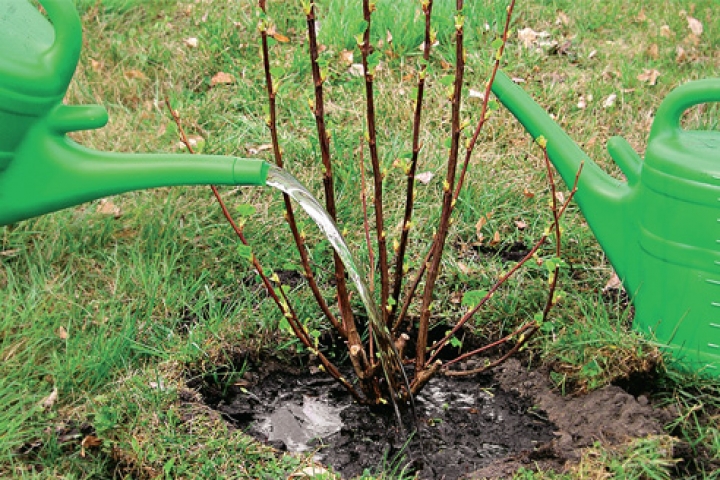
When planting, keep in mind that a mature bush grows up to 1.5 m in diameter, so seedlings should be spaced approximately 1.8-2 m apart and the same distance between rows. When growing berries on a commercial scale, it is recommended to stagger the bushes with at least 1 m between rows – this will save space and facilitate harvesting.
Autumn is considered the best time to plant currants, but since this variety has excellent adaptability and a high survival rate, spring is also possible. The area allocated for growing Titania should be thoroughly dug, completely cleared of debris and plant debris, and supplemented with mineral fertilizers and organic matter. To improve the soil's nutrient content, it's a good idea to add well-rotted manure. Other fertilizers are best applied directly to the planting hole.
Regardless of the seedling's size, planting holes should be wide and spacious—at least 0.5 m in diameter. The depth is adjusted according to the seedling's condition—it should be such that the root collar of the plant is 4-5 cm deep in the soil when planted.
Before planting, add fertilizer to the bottom of the hole. A thin layer of leaf compost mixed with a handful of ash is ideal. For mineral fertilizer, you can add one tablespoon of superphosphate or another complex mixture.
It's recommended to place the seedling in the hole at a slight angle—this promotes rapid root growth and increases survival. After planting, the seedling should be thoroughly watered and pruned, leaving 4-5 developed buds on each shoot. After pruning, the bush will begin to develop side shoots, allowing the plant to begin fruiting earlier. If desired, the area around the trunk can be covered with mulch.
Currants grow and bear fruit in one place for about 15 years, but to maintain productivity throughout this time, they need proper care:
First of all, regularly rejuvenate the bushes through thinning and pruning. During the first three years, the bush requires shaping. Every year, remove excess branches that cause the bush to become too dense, and shorten the tips of strong, healthy shoots by 10-15 cm. By the age of four, the bush should have 15-25 fruiting branches. In subsequent years, spring sanitary pruning is sufficient, removing all damaged branches and any that are six years old.
Throughout the warm season, it's important to monitor the currant bushes: remove weeds, loosen the space between the rows, and water. A clean bed is crucial for plant health, as weeds promote the spread of diseases and pests. Three scheduled waterings are necessary throughout the summer, at a rate of 30 liters of water per bush. In unusually hot conditions, additional watering may be necessary, as drooping currant leaves will indicate this.
Long-term fruiting and a high-quality harvest can only be expected if the plants are adequately nourished. If the bushes are healthy, two scheduled fertilizing sessions are sufficient: in early spring and in the fall, before wintering. In the spring, 30 grams of urea is applied under each bush. The fertilizer is scattered and lightly incorporated into the soil around the trunk. In the fall, while digging between the rows, 40 grams of superphosphate, 20 grams of potassium sulfate, and 5 kg of humus are added under each bush. This organic matter will not only nourish the plant but also keep it warm during the winter.
Despite Titania's high winter hardiness—it can theoretically survive temperatures down to -25°C—in harsh climates, the bushes need to be covered for the winter. If your region has a moderate climate and winter temperatures don't drop below -25°C, a 10-cm-thick mulch of peat or sawdust around the trunk will suffice. In regions with very harsh and snowy winters, shoots should be bent to the ground and securely covered with a breathable material.
Characteristics of taste qualities
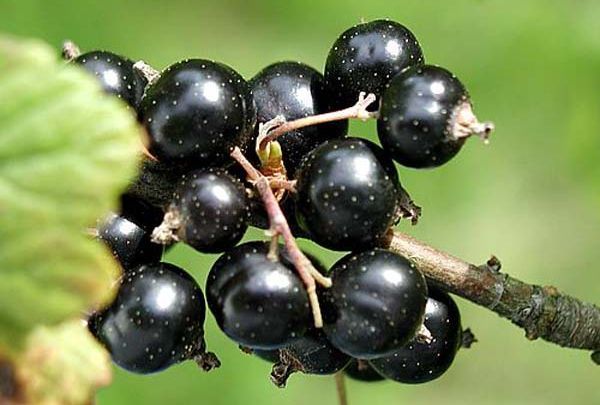
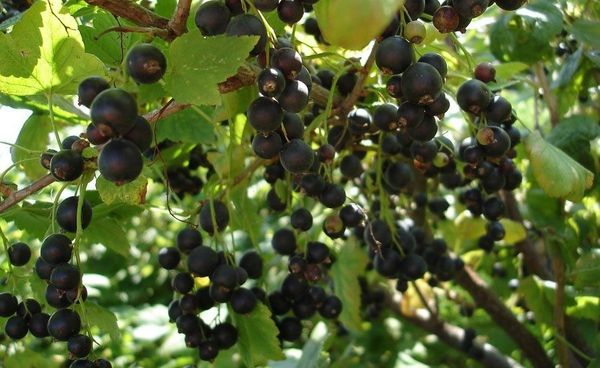
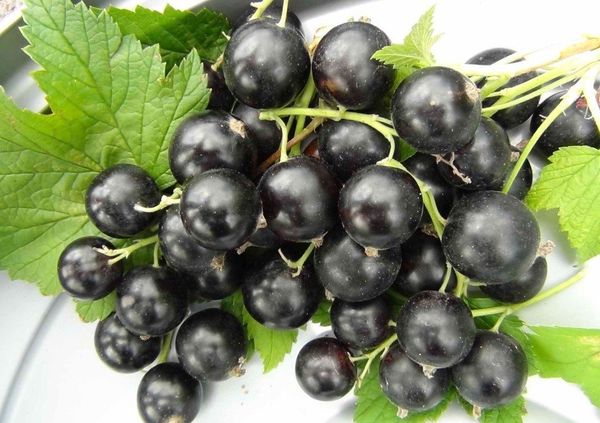
Titania currant berries are quite attractive. They are round and smooth, gathered in long, dense clusters of 20-25 berries. The top berries are larger, reaching 3-4 g in weight, while the bottom berries weigh about 1.5 g. The skin is glossy, an intense black color, very dense but thin. The flesh is green, firm, juicy, and not watery. The flavor is complex, slightly tart, with a distinct wine-like aftertaste. The berry's sugar content is 6.6%, making Titania a dessert variety. On a five-point scale, the currant's taste score is 4.6.
Harvesting and storing berries
Black currant variety Titania begins to bear fruit fully in the third year after planting seedlings in open ground. In terms of ripening time, it is classified as a mid-season variety, but weather and climate conditions significantly influence the ripening process. For example, in southern regions, the first berries ripen as early as late June, while in temperate climates, they don't arrive until mid-July. With proper care, a single mature bush can yield up to 5 kg of berries.
The Titania variety is characterized by a long, undulating ripening period. The full harvest occurs within 3-4 weeks. This allows gardeners to harvest berries over a period of almost a month, in 2-3 stages, and prepare them slowly, as they harvest. This has another advantage: several Titania bushes planted in a plot eliminate the need to plant other later hybrids.
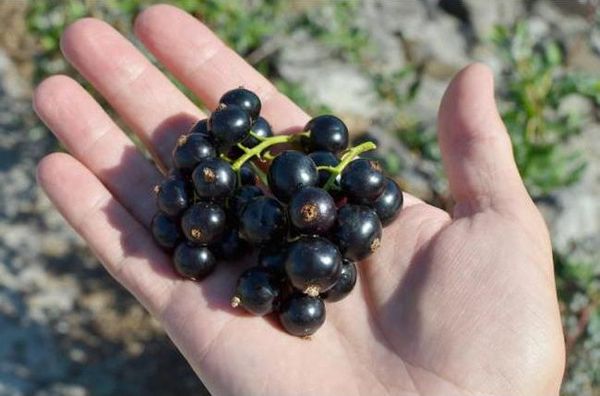
Despite uneven ripening, the berries of this currant do not fall off, making it possible to harvest the entire crop at once. This is very convenient when growing currants on an industrial scale, where the berries are harvested using machinery. It's worth noting that the berries have excellent commercial qualities—they don't bruise or burst, making them easy to transport, and their dry separation ensures long-term storage.
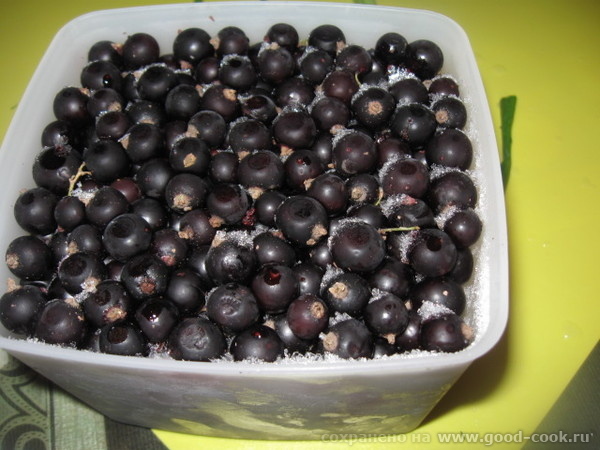
Titania berries are versatile. They can be eaten fresh, used in a variety of desserts and drinks, and used for preserves (jams, jellies, compotes). The berries' thick skin allows them to be frozen and even dried. Fresh harvested berries can be stored for up to two weeks at temperatures between 1 and 4°C (in the refrigerator), but the berries must be dry to do so.
Video: "History and Benefits of the Titania Currant Variety"
This video tells the story of the Titania blackcurrant variety and its beneficial properties.