
What are the qualities that make gardeners love the Yakhontovaya plum?
Content
History and description of the variety
Yakhontovaya is a relatively new hybrid plum variety. This yellow-fruited beauty originated at the Moscow branch of the All-Russian Scientific Research Institute of Plum Breeding (VSTISP), and was directly developed by S. Satarov and Kh. Yenikeyev. The scientists used varieties such as Smolinka and Eurasia 21 as their starting material. The result of this successful cross was named Yakhontovaya. The new variety is ideal for cultivation in temperate climates, particularly in central Russia.
This unusual zoning for the variety is justified by the hybrid's tolerance to low temperatures. Seedlings and mature specimens can survive winter temperatures down to -35°C. The buds and inflorescences are also resistant to recurrent frosts and are not prone to shedding. Furthermore, the Yakhontovaya variety tolerates fluctuations in soil moisture levels well; a slight drought will not cause significant damage. The plum has a complex immunity, meaning the plant is also resistant to most fungal and viral diseases common to stone fruit crops.
This variety is described as a fast-growing, vigorous tree. Under favorable growing conditions, individual specimens can reach over 5 meters in height. The crown is characteristically rounded, compact, and moderately dense. The plum's shoots are straight and brown. The leaf blades are light green, matte, oval, and slightly elongated with serrated edges.
The recommended optimal planting time is spring.
Video "Plum Varieties"
In this video, an expert will talk about the benefits of different plum varieties.
Fruiting characteristics
The crop is an early fruiting variety, which begins to bear fruit as early as 3–4 years after planting in open ground. The variety is famous for its regular and rich harvest, which in particularly good years can reach 70 kg from one tree. However, the Yakhonotovaya plum is predominantly self-sterile. While it is certainly capable of producing fruit on its own, without pollinators, the final harvest will be meager. The following plum varieties make good neighbors:
- Moscow Hungarian;
- Memory of Timiryazev;
- Early ripening red.
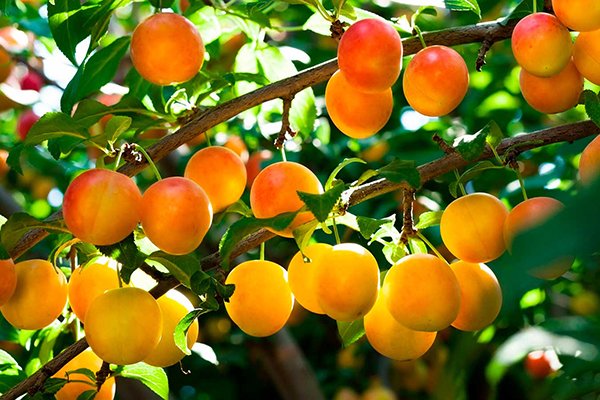
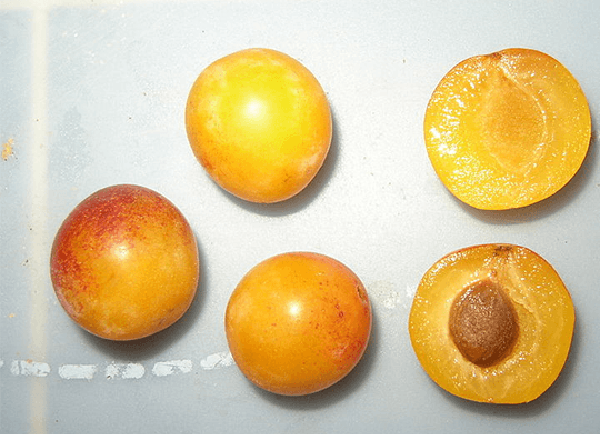
Yakhontovaya is a mid-early variety, allowing you to enjoy ripe plums as early as August. This hybrid gets its name from the warm, sunny color of its fruits. The bright, thin skin is covered with an even layer of wax and a slight speckled blush. The flesh is tender, uniform, greenish-yellow, and contains a small, easily separated stone.
The plums have a sweet and sour flavor with a refreshing aftertaste. The average fruit weight is about 30 g. The variety's versatility allows for both fresh consumption and various processing.
Advantages and disadvantages
Despite its relative youth, this cultivar has already established itself among experienced and novice gardeners alike. Among the outstanding qualities of the yellow-fruited plum that have contributed to its popularity are:
- early fruiting of the plant;
- stability of fruiting;
- good presentation;
- high taste qualities;
- versatility of purpose;
- resistance to frost and drought;
- good adaptation to unstable weather conditions;
- immunity to viruses and fungal infections.
Based on the characteristics of the Yakhontovaya variety, it is clear that the breeders have invested all their professionalism into creating a plant suitable for cultivation in gardens in the central zone.
However, this plum variety is not completely free of drawbacks. The following can cause problems for gardeners:
- need for pollinators;
- large tree sizes.
If desired, the problem of tall growth can be solved by using dwarf plum varieties as rootstock.