
What does a peach plum taste like and how does it bear fruit?
Breeding history
The peach plum doesn't bear fruit every year, requires pollinators, and is only able to produce fruit in a sunny location. This variety can rightfully be called ancient, as the first mentions of this stone fruit tree appear in sources dating back to 1830. It is believed that these trees were originally grown in England and France.
In 1904, renowned Russian breeder Ivan Michurin attempted to develop a more cold-hardy variety of peach plum. To do this, he grew a seedling from the seed of a cultivar called the White Samara, which was pollinated by the American variety Washington.
The first fully ripened specimen yielded its first harvest only in 1921, casting doubt on its early maturity. The new stone fruit variety was given the following names: Red Nectarine and Royal Rouge.
The modern peach plum is actively cultivated in many regions: in Crimea, Chechnya, Ingushetia and Dagestan, as well as in the Stavropol and Krasnodar regions, and in the Rostov region.
Description and characteristics
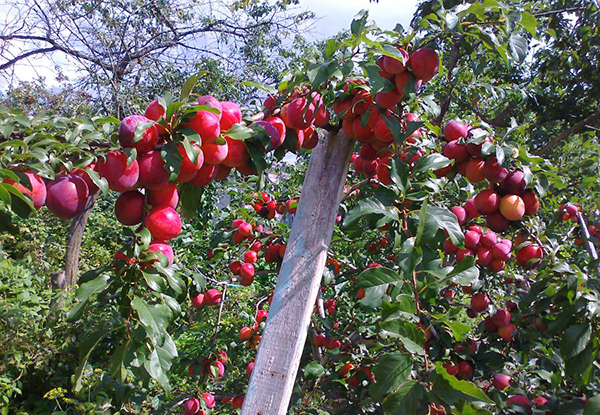
If you follow all the rules for planting seedlings and provide the crop with proper care, you can expect the emergence of medium or tall trees with a well-foliated crown of medium density. The crown is inversely conical or rounded. In the early years, the tree is somewhat compressed, later becoming more spreading. The skeletal branches are thick, the shoots are similarly thick and pubescent, their bark is grayish-brown. The leaves are oval, large, and medium-thick.
The seedlings are fast-growing, with growth slowing as they reach 5–7 years of age. During this period, the first ovaries form on the cluster branches. Initially, fruiting is intermittent, but then becomes more consistent and heavier. The yield from a 15-year-old tree is approximately 50 kg of fruit. Harvesting typically occurs between the second half of July and the second ten days of August (much depends on the growing region and weather conditions).
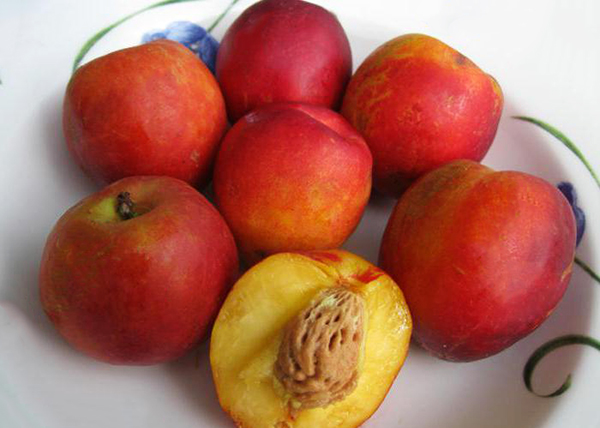
Now we move on to a description of the fruits. They are large – up to 4.5 cm in diameter each, with an average weight of 50 g. They are round or ovoid-oval in shape, slightly flattened at the apex. They are located on short, thin stalks. The fruits are covered with a thick, orange-purple skin with a waxy coating on the surface and numerous subcutaneous spots. The flesh is yellow with a greenish tint. The stone is round-oval and flat, easily separated from the flesh.
Peach plums require pollinators. Suitable plum varieties include Vengerka, Renklod, Lama, Lodva, Kubanskaya Kometa, and similar ones, whose flowers bloom after spring frosts. These varieties should be planted in a nearby plot.
The fruit's flavor is juicy and delicate, with a sweet and sour balance. The plums are very aromatic, with firm, dense flesh. Since the plant often lacks sun in northern regions, this adversely affects the fruit—it becomes rough and tart.
This type of stone fruit is versatile—it makes wonderful jams, preserves, compotes, as well as sauces and pie fillings. Its fruits are highly transportable—they retain their appearance and flavor during transit. Ripe fruits don't keep for long, so they're best eaten fresh or used in beverages and culinary dishes. This crop is resistant to many diseases.
Pros and cons
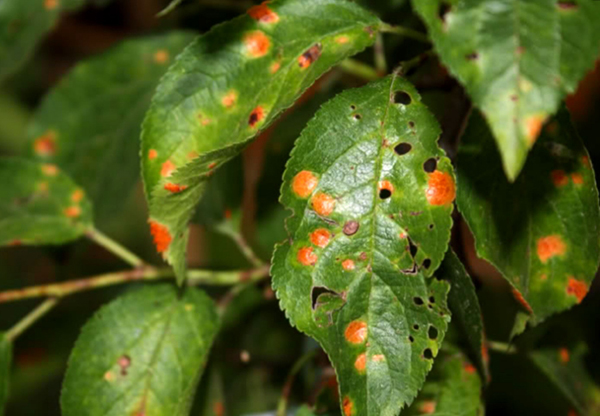
Like any fruit crop, the peach plum has a number of advantages that make it prized by gardeners in our country. These include high yields and attractive, large, and tasty fruits with easily separated pits. The tree also produces a consistent harvest, is early-bearing, and has a relatively low fruit drop rate. This stone fruit variety has strong immunity to polystigmosis and other fungal infections.
The disadvantages of this variety include late fruiting (six years after planting), low winter hardiness, and self-sterility (requiring pollinators in the garden). Furthermore, the variety does not bear fruit every year.
Despite some shortcomings, gardeners love to grow this plant in their plots, and their efforts are rewarded with the appearance of large, sweet and juicy fruits with a pleasant peach aroma.
Video: Plum Tree Care
In this video, experts will talk about how to increase plum yields.