
What is the difference between mulberry and blackberry?
Content
What type do they belong to?
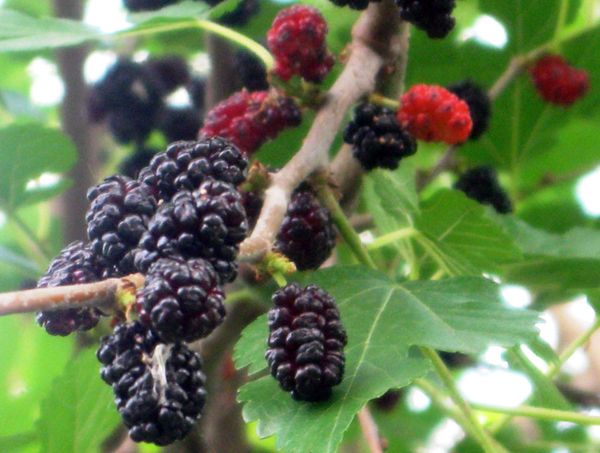
The main difference between mulberry and blackberry lies in the botanical descriptions.
The mulberry (or mulberry) is a deciduous tree belonging to the Moraceae family. The genus Mulberry comprises 17 species that prefer warm temperate or subtropical climates. Therefore, they grow in southern North America and Eurasia, as well as northern Africa. Wild trees live for at least 200 years (sometimes even 500 years), growing to heights of 10–15 meters. Gardeners cultivate two types of mulberry: white and black. They are differentiated not only by the color of their berries but also by the color of their wood.
In ancient China, silkworms, which feed on mulberry leaves, were bred to produce silk. White mulberries were grown as bushes to facilitate the moth's care. However, this was rather an exception.
Blackberries belong to the Rubus genus of the Rosaceae family. This subshrub grows in the forest and forest-steppe zones of Eurasia, and can be found in river floodplains, coniferous, and mixed forests. Their distribution range is somewhat north of that of mulberries, so the two plants only occur when planted in the same garden plot, which is what happens in southern Russia, Ukraine, and Moldova.
Video: How to Properly Care for Blackberries
This video will show you how to plant blackberries and care for them.
How they grow
The difference between mulberries and blackberries becomes obvious when you see the plants in your garden.
A typical mature mulberry tree produces a beautiful, large crown, valuable wood, and abundant fruit. A young tree grows very quickly, but after a few years, growth slows, gradually thickening the trunk with smooth bark. The wood is beautiful, strong, and heavy, used in arts and crafts, construction, and cooperage, and in Central Asia, it is used to make musical instruments.
A lush, spreading crown is formed by strong, widely spaced branches covered with simple, serrated-edged leaves. The tree blooms in the spring with small flowers, unnoticeable among the budding foliage, gathered in small inflorescences that later develop into edible fruit.
Essentially, what we call a berry is a conglomerate of very small seeds fused together, covered in a nutritious (sweet and healthy) shell. The fruits ripen in early summer and can be enjoyed for up to five weeks.
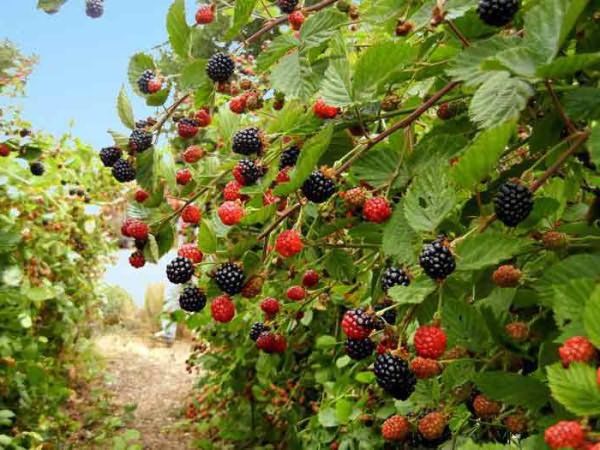
The distinctive feature of blackberries is immediately apparent: they are a very picturesque thorny shrub. Flexible shoots grow upward or trail along the ground, intertwining at forest edges to form impenetrable thickets. In summer cottages, they are often planted along the perimeter of a garden, but their growth is strictly controlled. To maintain easy maintenance and prevent the fruit from becoming small, the bush is pruned heavily annually. The branches are covered with sharp spines and dark green leaves, consisting of three or even five parts.
Blackberries begin to bloom in mid-June and continue to bloom throughout the summer.
What does it taste like?
Although similar at first glance, the fruits differ greatly in taste. Mulberries produce delicate, very sweet fruits that contain high amounts of sugars, polyunsaturated and monounsaturated fats, protein, dietary fiber, vitamins B, A, D, and K, and many other essential nutrients. The berries and leaves are often used in folk medicine. Young leaves contain a lot of ascorbic acid.
Blackberries have a richer flavor because, in addition to vitamins (including vitamin C) and macronutrients, they also contain salicylic, citric, tartaric, and malic acids. They are firmer, but have a sweet and sour taste and often have a pleasant aroma. The berries are eaten fresh, frozen, and used to make liqueurs, wines, and various desserts. The berries and leaves are also used in folk medicine.
Are there any similarities?
The mulberry tree and the blackberry bush produce similar fruits—drupes. This is where their main similarity lies. Ripe berries of common blackberry varieties resemble raspberries in shape and are black in color, either glossy or matte. Mulberries also produce black berries ranging from 1.5 to 5.5 cm in length (depending on the variety). However, besides their flavor, they also differ in the strength of their skins. Blackberries store well, making them easy to transport.
Mexico and the US state of Oregon produce vast quantities of blackberries, the berries of which are sold throughout the US and Europe. Modern varieties with white and bright yellow fruit are available, and new hybrids of blackberries and raspberries are gaining popularity.
Mulberries won't be so widely distributed for one reason: they can't be stored for more than a few hours. They can only be enjoyed where they grow. And yet, it's fresh berries that provide the most nutritional benefits, not all the various products made from them (liqueurs, wines, compotes, juices, jams, pastilles, marmalade).