
Growing and Benefits of Daikon Radish
Content
The origin of white radish
Daikon radish has a history spanning over a thousand years. Its origin is considered to be Japan, as Japanese breeders developed this crop through natural hybridization with the Chinese radish "loba," which is why the white root is sometimes called "Chinese radish." Today, daikon, or Chinese radish, is a staple in most East Asian countries, with over 400 varieties and hybrids.
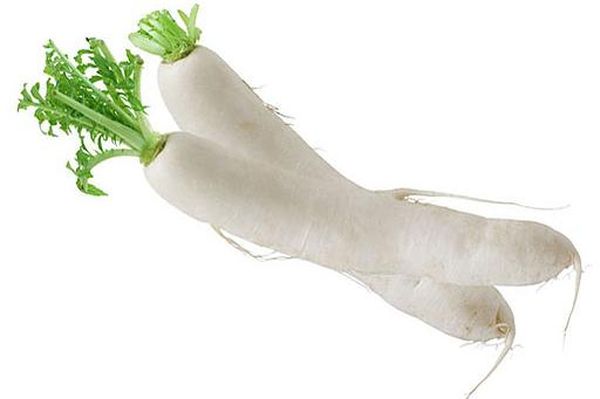
Modern daikon varieties are divided into seven main types, depending on the size, shape, and depth of the roots' placement in the soil. Daikon differs from regular radishes in its juiciness and milder flavor, thanks to the absence of mustard oils in the pulp.
The crop is grown on an industrial scale in almost all countries of East and Southeast Asia, and to a lesser extent in Brazil and the USA. This type of radish has also attracted considerable interest from our breeders, resulting in the development of new hybrid forms adapted to the local climate.
Beneficial properties
In its native East Asia, Japanese radish is considered a highly valuable food product and is an integral part of most dishes. It is pickled, salted, eaten fresh, and used in salads, side dishes, hot appetizers, and even soups. The popularity of this white root stems not only from its exceptionally mild flavor but also from its wealth of beneficial nutrients and properties.
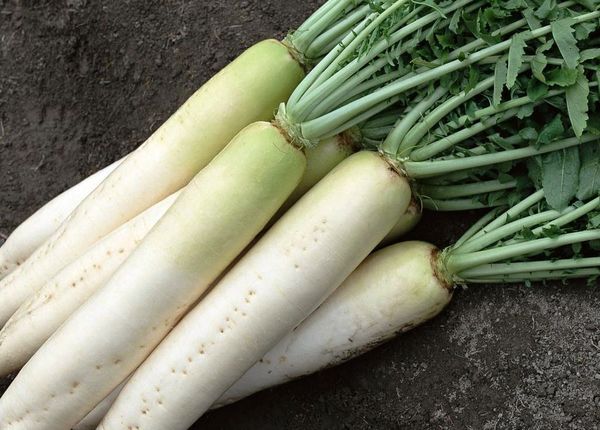
There are virtually no contraindications to daikon consumption, with the exception of peptic ulcers and acute gastritis. Daikon is recommended for people of all ages, including those who cannot eat spicy vegetables (radishes and horseradish) due to the presence of mustard oils, such as those with heart disease or gastrointestinal problems. Its low calorie content (21 kcal/100 g) makes it suitable for diabetics and as a staple in low-calorie diets.
When considering the health benefits of white radish, its value lies in its high content of vitamins C and B, as well as protein, pectin, fiber, and unique enzymes that promote digestion. Like radish, daikon contains a lot of calcium, magnesium, and potassium salts, which help remove excess fluid from the body. It's also worth noting the root vegetable's high antiseptic and antibacterial properties, which help promote rapid recovery from colds and other infectious illnesses.
In Eastern folk medicine, daikon is considered a prime remedy for boosting immunity, and strong immunity is known to be the key to good health and longevity. Regular consumption of the root has a beneficial effect on the kidneys, liver, and blood vessels, normalizes digestion and gallbladder function, and even neutralizes the effects of radiation. Maintaining excellent health with daikon is quite simple, as thanks to its long shelf life, this healthy root vegetable can be enjoyed year-round.
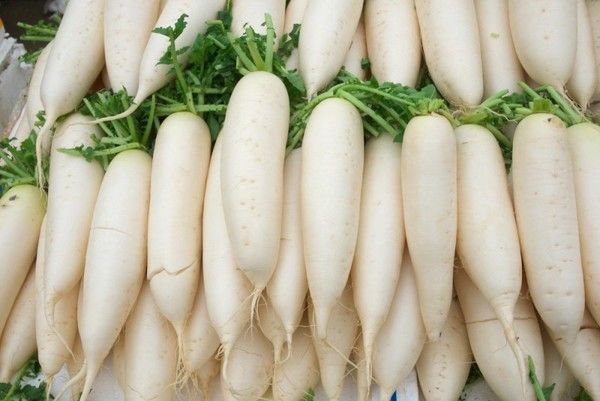
Growing a giant vegetable
Many gardeners note that they don't always get a good daikon harvest, as this exotic East Asian vegetable doesn't adapt easily to our climate. Certainly, the best results are achieved by growing local varieties bred domestically, of which there are now several dozen, but choosing the right variety isn't the only factor for a good harvest. It's equally important to determine the planting time, select a suitable site, prepare the seeds and soil, and then ensure proper care for the plants.
Landing
In our climate, daikon can be grown in two ways: from seeds and from seedlings. Seedlings are more suitable for early varieties planted in the spring, when there is a risk of frost. Autumn-season daikon varieties are easier to plant from seeds in open ground in the second half of summer.
The biggest problem facing domestic vegetable growers is premature flowering, before the roots have formed and matured. This occurs because daikon, like radishes, requires cool conditions (18–20°C) and 10–12 hours of daylight to thrive. However, since spring arrives quickly in temperate climates, a sharp rise in temperature immediately negatively impacts root growth.
In this case, seedlings allow for a much earlier harvest, before the summer heat sets in, thus avoiding this problem. If seeding is chosen, sowing should be done very early, as soon as the snow melts. For a fall harvest, daikon is sown in mid-August. At this time, soil temperatures are not as high as in early or mid-summer, so root ripening problems generally do not arise.
Daikon is considered an easy-to-grow crop. It can grow in any soil, but loose, fertile loamy and sandy loam soil with a neutral pH is considered best. Heavy clay soil will cause the vegetables to grow small, crooked, and lacking in juiciness. Given the considerable length of the roots, the soil should be dug deeply, to a depth of 30-40 cm.
Japanese radish thrives on organic matter, particularly humus. This can be achieved by sowing green manure. If this isn't possible, add a sufficient amount of mineral and organic fertilizers during tilling to last until the end of the growing season: potassium sulfate (20 g/1 m²), superphosphate (40–50 g), ash (1 cup), and 0.5 buckets of compost and humus.
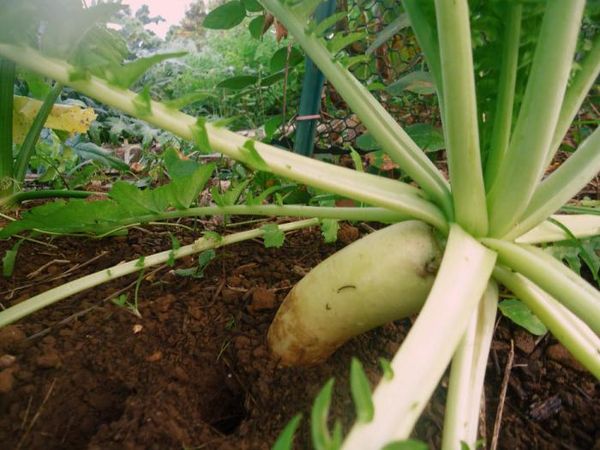
To ensure a good harvest, it's important to follow crop rotation principles and avoid planting the same crop in the same bed two years in a row. Nightshade crops, cucumbers, and greens are considered the best predecessors for daikon, while any vegetables from the cruciferous family are highly undesirable.
Regardless of the planting method (seeds or seedlings), plants should be placed according to the following diagram:
- 30x50 (30 cm between plants, 50 cm between rows) for round and large root crops;
- 20x40 for long and small vegetables.
Planting is done in pre-dug holes or long furrows. When planting from seed, the seeds are placed in clusters of 2-3. After planting, the bed is watered and covered with a thin layer of peat mulch.
Watering and fertilizing
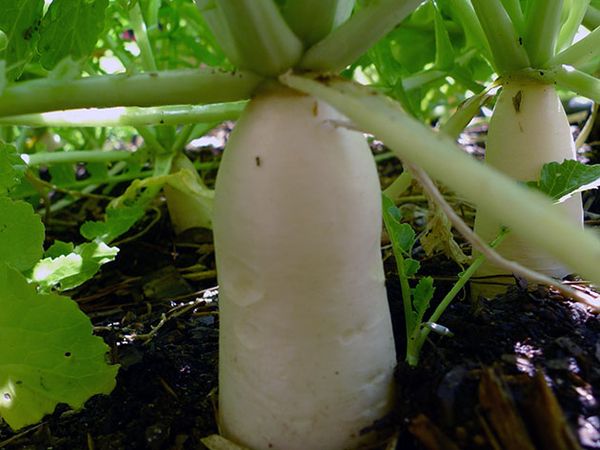
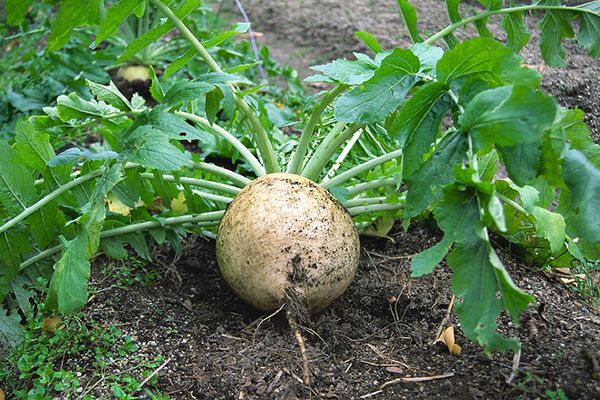
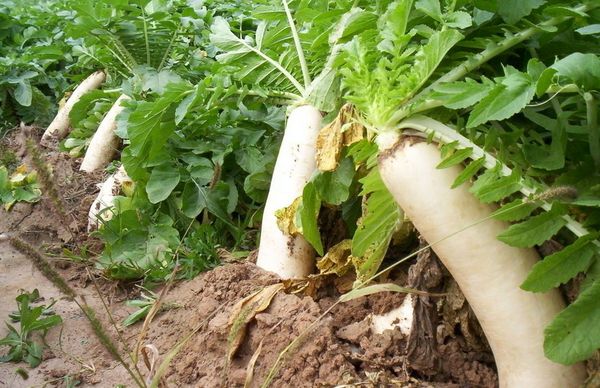
Basic daikon care includes regular watering, loosening the soil, hilling, and fertilizing. Most daikon varieties are typically planted partially in the soil—about two-thirds deep—and if you want tasty, sun-protected daikon, the plants need to be hilled several times throughout the season.
The long roots grow deep in the soil, and to ensure they don't suffer from a lack of moisture or oxygen, the soil in the garden bed must be deeply loosened, weeded, and watered regularly. Daikon is quite demanding in terms of moisture, but absolutely cannot tolerate overwatering. In waterlogged soil, the roots don't develop and are often susceptible to bacterial rot, while insufficient moisture causes the flesh to become coarse and more bitter.
Watering should be generous but not too frequent—the soil in the garden bed should always be slightly moist. It's important to understand that round root vegetables close to the surface require more frequent, but not abundant, watering. Plants with long, deep-rooted plants, on the other hand, require more intensive, but less frequent, watering. This suggests that watering frequency and water consumption depend on the variety being planted.
The need for additional feeding also depends on the crop variety. Early daikon varieties generally don't require additional feeding, as the fertilizer applied at planting is sufficient for their short (45-60 days) growing season. However, plants planted in the second half of summer should be fertilized at least twice per season:
- the first time, when 4-5 true leaves are formed (azofoska 3 spoons/10 l of water);
- the second time - during the formation of root crops (superphosphate 1 tablespoon, potassium salt 2 tablespoons/10 l of water).
You can use a ready-made Kemira complex fertilizer or an ash solution for fertilizing. Daikon responds very well to ash, so it can be applied not only as a solution but also simply sprinkled on the bed, mixed with a small amount of compost.
Pests
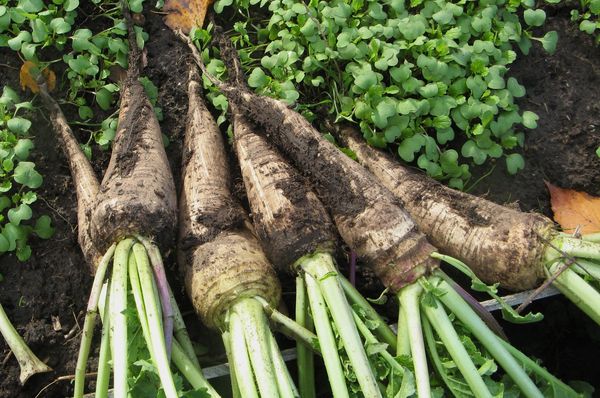
Daikon has few pests. These are primarily the same insects that harm all Brassicaceae plants, particularly radishes and turnips: flea beetles, cabbage flies, slugs, and cutworms. Flea beetles are considered the most dangerous, as these small insects feed on young leaves and can destroy an entire garden bed immediately after the seedlings emerge. The most troublesome pest of daikon is the cabbage fly. Its larvae bore into the roots, rendering them unfit for consumption.
To combat these pests, folk remedies such as ash and ground hot pepper, scattered between the rows, are often used. Covering the beds with a thick material immediately after sowing the seeds can help delay the onset of pest infestations and give the plants a chance to establish themselves. Good results can also be achieved with preventative measures: crop rotation, pre-planting disinfectant treatment of the soil and seeds, and prompt removal of plant debris after harvest.
Video: "Cultivation Techniques for Daikon"
This video will tell you what kind of vegetable Daikon is and how to grow it properly.