
How to use spunbond to cover roses for the winter
Content
Why are roses covered?
Most rose varieties are the result of repeated crossings of several cultivars. Each variety has a number of characteristics that determine the nuances of cultivation, care, and propagation. Heat tolerance is a common characteristic among all varieties. This is why roses are planted primarily in sunny areas of the garden and covered with special materials in the fall. However, even among these delicate and fragile flowers, there are resilient specimens. These include:
- park;
- Claire Austin;
- Pat Austin;
- Cordes;
- Constance Fry.
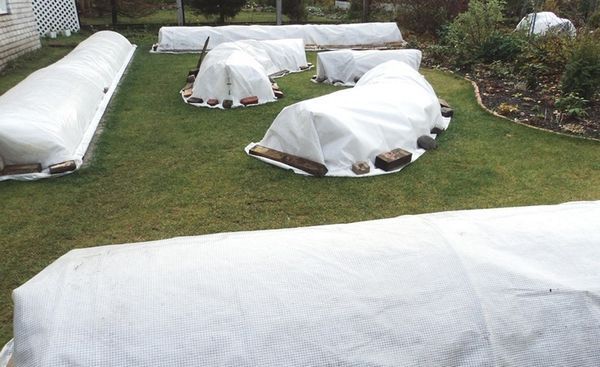
These plants survive winters well without any cover.
The most fragile heat-loving roses are:
- Banks;
- Vihuriana;
- Multiflora;
- Lambert;
- Climbing.
Delicate rose varieties prefer sunny locations and do not tolerate drafts. Furthermore, during periods of high sun exposure, the bushes should be shaded to prevent foliage burn.
Video: "Covering Roses with Lutrasil"
This video will show you how to cover roses with lutrasil for the winter.
What's good about spunbond?
Spunbond or lutrasil is a product of molten polymer. This is a fairly durable non-woven material that is popular among gardeners. Agrofibre is used when it is necessary to accelerate seedling emergence by warming the soil, protect the upper soil layers from drying out, or cover heat-loving crops for the winter.
Technical properties of non-woven material:
- Non-toxic to plants. Covering ornamental and fruit crops with spunbond for the winter is completely safe.
- Inert to chemicals. Treatment of plants with antifungal compounds, as well as weed and insect repellents, does not affect the quality of lutrasil.
- Resistant to bacteria that cause rot and mold.
- Resistance to critical temperature drops (down to -50 °C).
- Durability. The strength of the non-woven material allows it to be used for several years.
- Lightweight. The plant will thrive under cover, even in heavy snowfalls.
- Thermal insulation. The material retains heat well. This characteristic varies depending on the density of the nonwoven.
- Uniformity. The structure of the agrofibre ensures uniform distribution of heat and moisture underneath.
- Air permeability. Its degree depends on the density of the insulation. In any case, a plant covered with lutrasil is protected from damping off and rotting.
- Light Transmittance. White spunbond allows light to pass through perfectly. A shelter created using this material can be considered a kind of greenhouse, providing plants with all the necessary resources for life: moisture, warmth, and light.
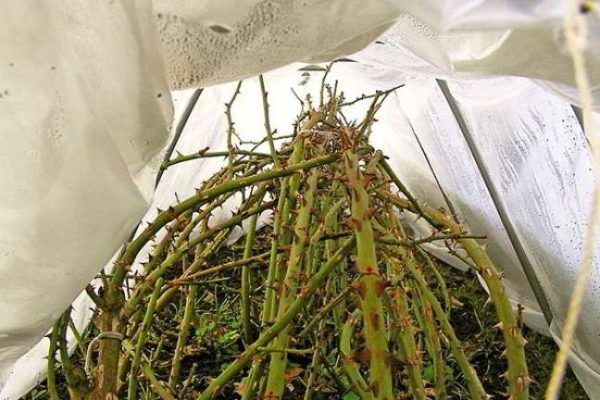
Thus, spunbond covering material is an alternative to polyethylene, which is often used as insulation. Agrofibre creates a favorable microclimate for overwintering roses: the right light regime, moderate humidity, and good air circulation. The non-woven material protects delicate plants from wind and temperature fluctuations. Furthermore, the covering material protects the flowers from rodents and insects.
Types of material and application
Spunbond is classified as greenhouse and cover material. The material comes in several types:
- Black. Protects against severe frosts. It is used to control weeds and when it is necessary to prevent plant contact with the soil.
- White. Allows light, moisture, and air to pass through, creating a favorable microclimate in the greenhouse.
- Two-color. Used as a mulch. The black and yellow non-woven material repels some rodents and insects.
- Foil-coated. Reflective.
The method for insulating with agrofibre depends on the flower variety. Shrub roses are insulated using a frame and then covered with non-woven fabric. Climbing plants are wrapped in the material without removing their supports, and the ends are stapled. Standard plants are wrapped in lutrasil or formed into a cover, which is carefully placed over the plant and secured with twine.
Rules and techniques of use
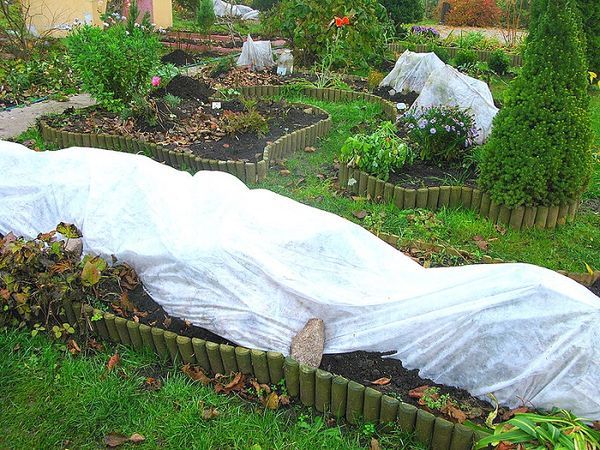
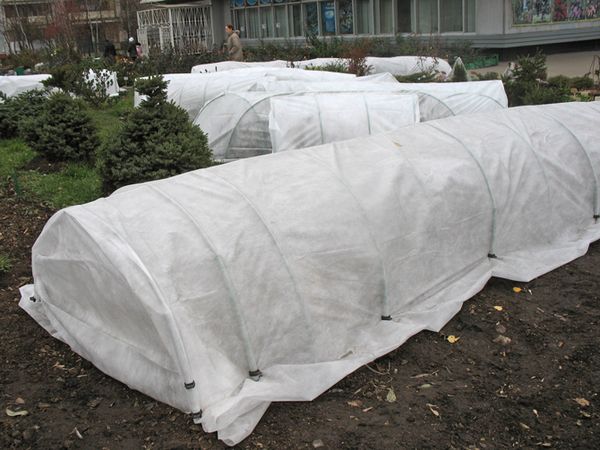
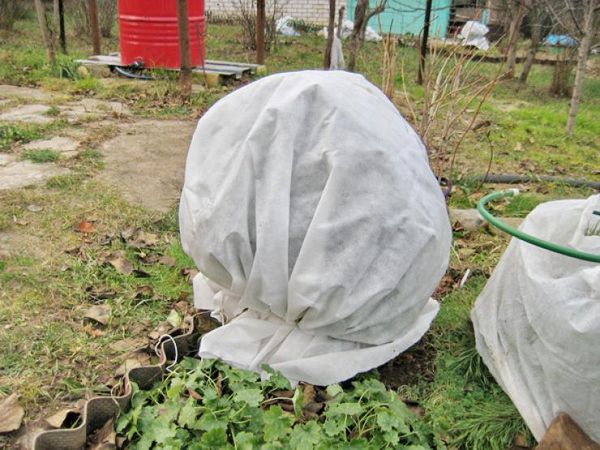
Before wintering, this garden beauty needs to be prepared. To do this, prune old, damaged, or underdeveloped branches. The root zone is cleared of old mulch and weeds.
The material is a special fabric that doesn't hold its shape at all. Therefore, the first step in insulating garden pets is constructing a frame. It's made of wood or repurposed wooden crates. The roses are first covered with hay or pine branches. The final step is stretching the spunbond over the arches.
Spunbond is considered an excellent alternative to polyethylene. The material is used to insulate fruit crops such as grapes, garlic, gooseberries, and strawberries.
It provides plants with essential resources and protects them from garden pests. Agrofibre not only protects crops from frost but also positively impacts future harvests.