
How to plant a peach tree in spring and autumn
Content
When is the best time to plant a peach tree?
Peach trees can be planted in spring or fall, depending on the climate of the region where they will be growing. Both options have their advantages and disadvantages. When planting in spring, there's always a risk that the young tree will be damaged by heat or pests.
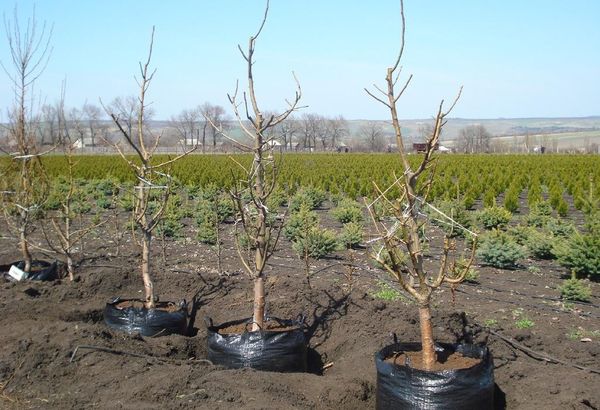
However, given the crop's low frost resistance, spring planting is recommended in risky farming zones. In regions where winter is mild and comes later (the south and surrounding areas), it is better to plant peach trees in the fall, about 2 months before the first frost. During this time, the tree will have time to take root and avoid freezing in winter. Furthermore, the winter dormancy period will allow it to strengthen, and with the arrival of warmer weather, it will begin to grow more vigorously.
Which variety to choose?
When choosing a variety, always choose those that are zoned for a specific region. These characteristics can be obtained from the State Register of Varieties. It's also a good idea to inquire about new breeding innovations. New varieties adapted to cold climates are regularly developed. It's definitely not a good idea to plant varieties bred for other climate zones, much less countries.
Condition and selection of rootstock and seedling
Choosing the right rootstock and peach sapling simplifies planting and subsequent care. The rootstock determines almost everything: viability, longevity, yield, disease resistance, and even tree size. To ensure the scion retains all these qualities, it's essential to choose vegetative rootstocks (those obtained from cuttings).
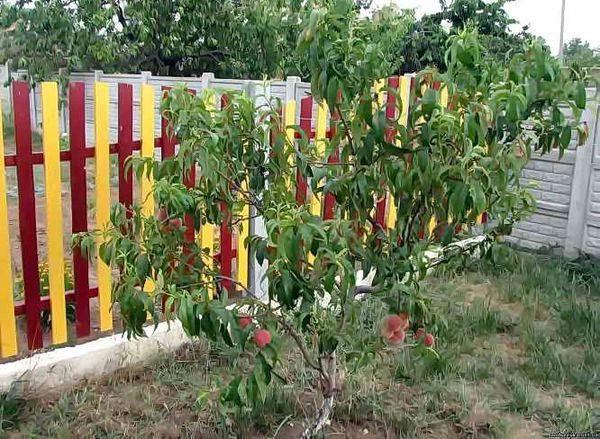
You should also pay attention to criteria such as frost resistance and compatibility with the scion. Peach trees thrive best with apricots, cherry plums, and almonds. When choosing a sapling, it's safest to purchase two-year-old trees—they take root more successfully.
The quality of the seedling itself can be judged by the following criteria:
- root system - in a healthy plant it is fibrous, well-branched and not dry;
- condition of the bark – the surface of the shoots is smooth, glossy, without traces of gum flow;
- the grafting site should be 6–8 cm above the root collar;
- height and size – at the age of 2 years, a peach seedling usually has a height of 1.2–1.5 m, 3–4 well-branched shoots, and a trunk thickness of at least 2 cm.
Preparing the landing site
Peach is a very heat-loving tree, so choose a sunny and wind-free location, preferably on the south side of the plot. Since the tree absolutely does not tolerate overwatering and cold air accumulation, peach trees are best planted on gentle slopes or hills. It's also important to ensure adequate spacing between trees.
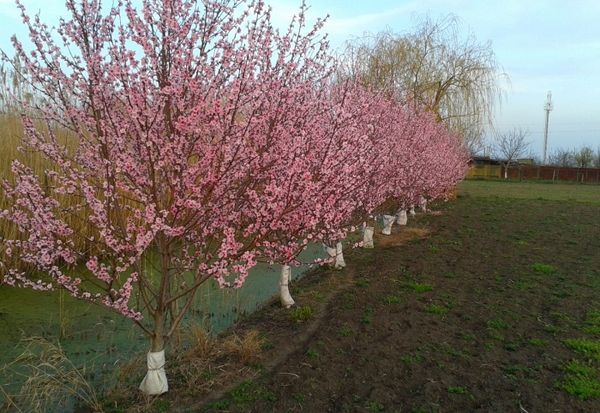
There should be no tall plants, plantings, or buildings within a 3-meter radius. Ideally, peach trees should be planted away from mature fruit-bearing trees, as they can rob young seedlings of nutrients. Planting holes should be prepared in advance: for spring planting, in the fall; for fall planting, at least 2–3 weeks in advance. The hole's depth depends on the size of the roots; for an annual plant, 50–70 cm in width and depth is generally sufficient.
A sturdy stake should be driven into the center of the planting hole. It should extend approximately 0.5 m above the ground—the tree will be tied to it. To ensure the plant doesn't suffer from nutrient deficiencies during the first and most crucial stage of its growth, add fertilizer to the hole. To do this, add 1–2 buckets of compost or humus to the bottom, then mix some of the soil with ash (200–300 g) and superphosphate (70–100 g), and then return it to the hole to form a mound.
Planting methods and step-by-step instructions
Nectarine and peach seedlings are commonly planted in two ways: "in slurry" (a liquid mixture of soil and fertilizer) and "in a cone" (a mound of soil mixed with fertilizer). The first method is convenient because it can be planted alone, without assistance, as the viscous soil holds the seedling firmly in place.
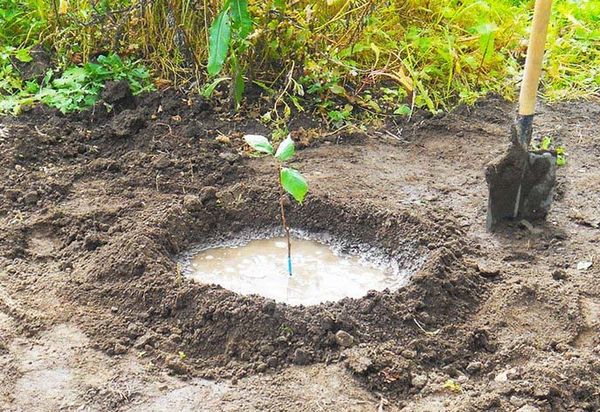
The algorithm for such landing is as follows:
- Fertilizers (humus, superphosphate, ash) are poured into the hole, after which a bucket of water is poured in.
- As soon as the water is half absorbed, add 1 bucket of fertile soil and mix everything.
- The root of the seedling is immersed in the resulting liquid mass.
- Next, the hole is slowly filled with soil, periodically pulling the tree upward by the trunk - this is done so that the roots are positioned at the correct angle (approximately 45°).
- When the hole is completely filled, the position of the root collar is checked, then another watering and mulching of the trunk area is carried out.
The placement of the root collar on peach trees is still a matter of debate. Some gardeners believe that planting the collar deeper increases the tree's frost resistance, which is crucial for this crop. However, this increases the risk that the grafted plant will root itself, losing all the beneficial properties of the rootstock. Therefore, in southern and temperate climates, it is recommended to position the collar a few centimeters above the soil surface.
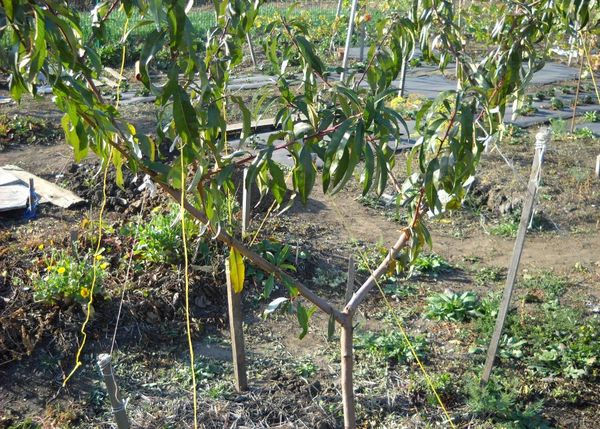
Now let's look at how to properly plant a peach tree "on a cone":
- Pour two buckets of water into the hole. While the water is soaking in, prepare a soil mixture of soil and fertilizer in the quantities described above.
- When the water is absorbed, prepared soil is poured into the hole in a mound.
- The seedling is placed on a hill, and its roots are straightened so that the angle of inclination is 45°.
- The hole is gradually filled with earth and lightly compacted.
- Then the seedling is watered, and when the moisture is absorbed, the trunk area is mulched.
It is important to ensure that the mulch does not come into contact with the thin bark of the young tree.
Further care
Until the peach seedlings take root, it is necessary to monitor the soil moisture.
Avoid drought or overwatering, as both can damage the root system. Fruit-bearing trees should be watered less frequently—in hot weather, once every 10–15 days, at a rate of 2–3 buckets per tree. If there is no precipitation, watering is essential a week before flowering and then during fruit ripening.
Trees are fed starting in their third year. Fertilizer is applied 2-3 times during the growing season. Organic fertilizers include liquid cow manure (1:10) or manure (1:20). During fruiting, watering with an ash solution is recommended. Organic fertilizers can be replaced with mineral ones: superphosphate, saltpeter, and potassium chloride – 2-3 tablespoons each per bucket of water. Approximate consumption is 25-30 liters per tree.
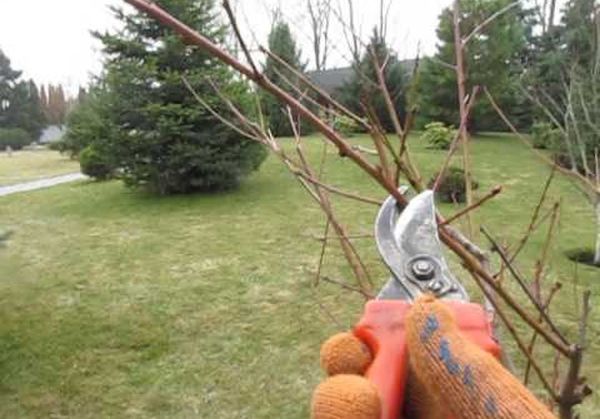
Crown formation is the most crucial stage in peach tree cultivation. To ensure full fruiting, annual pruning and shoot shortening are necessary. The first time, this is done immediately after planting. Young trees must be protected for the winter.
Video: Planting a Peach Tree
This video will show you how to properly plant a peach tree in the fall.