
How to properly lay and care for rolled lawn
Content
Advantages of rolled lawn
Contrary to popular belief, lawns have been around for quite some time. The first mentions of the surface date back to the 14th century. And as early as the following century, grass began to be actively used in landscape design. Today, there are two types of lawns: seeded and rolled. Seeded lawns are cheaper and more durable, but they will only become a fully functional lawn after several years.
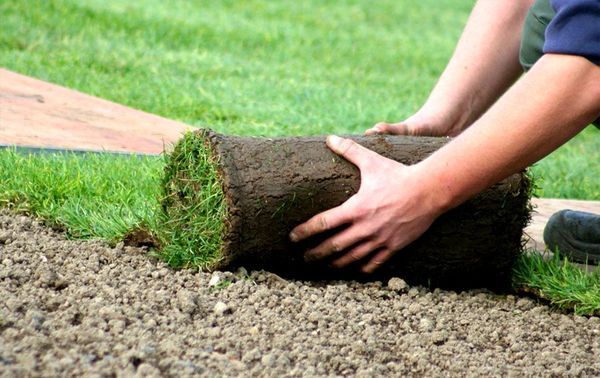
Roll coating has its advantages:
- High resistance to adverse weather conditions: drought, frost, etc.
- The grass in a rolled lawn takes root in a new place faster and easier.
- Saves time: unlike the seeded option, you get full coverage almost immediately.
- There is no need to worry about the right time for sowing; it can be done even in late autumn.
- The covering will decorate the chosen space immediately after installation.
- Simplified maintenance: the roll covering prevents the growth and development of weeds, making it much easier to maintain.
- The base (grass) of the roll covering has excellent immunity to common plant diseases.
- Trusted manufacturers (such as Gorgazon) guarantee the quality of the turf and grass used in rolled lawns. This ensures long-lasting and reliable performance.
Video: "Rolled Lawn Maintenance"
In this video you will learn how to properly care for a rolled lawn.
Flaws
It is also fair to note that roll coating has significant disadvantages that can play a decisive role when choosing:
- The relatively high cost of turf, leading many to opt for seeded turf, is a popular choice. The average price of rolled turf per square meter starts at 180 rubles.
- There are many companies and manufacturers on the turf market. This significantly increases the risk of purchasing a low-quality product, especially when trying to save money. A low-quality material may fail to take root or lose its appearance in just one season, leaving you with wasted money.
- The rolls are quite large and heavy, so it's unlikely you'll be able to handle the surface alone. Hiring a dedicated team will further increase your lawn maintenance costs.
- The service life of the rolled coating is significantly shorter than that of the seeded analogue.
- It is possible that the lawn is rotting due to the appearance of felt under the grass or turf.
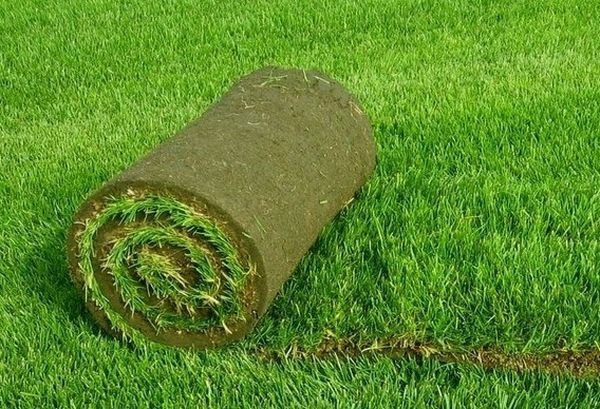
In our opinion, rolled turf is the best option for those who can afford significant material costs (purchasing a high-quality product, hiring a specialized installation team) and who want to achieve the desired result in a short time.
Lawn installation instructions
The process of laying the covering can be divided into two stages: preparatory work and the actual laying.
The preparatory stage consists of the following actions:
- Calculation of the required amount of coating (rolls): for this, the area to be covered (m²) is multiplied by 1.67;
- work on the area to be covered: removal of garbage and foreign objects, weeding and treatment with herbicides to destroy weeds, on clay soils - laying a drainage layer (sand and gravel cushion);
- if necessary, create fertile soil or, if available, loosen it by 10–15 cm;
- leveling the area, creating a slight slope for natural drainage of excess liquid;
- compacting the soil under the rolls using a special hand roller;
- Moistening and light fertilizing of the soil: nitrogen-containing fertilizers are used in the spring, and potassium-phosphorus complexes in the fall.
The actual installation is carried out according to the following scheme:
- Laying should begin from the edge where the rolls are folded; this will prevent additional manipulation and damage to the integrity of the rolls.
- The roll is placed precisely on the corner of the site and spread out in a straight line, as evenly as possible, without bending, twisting or curling the grass.
- The covering must be laid in such a way that the joints of the rows do not coincide - this helps the base (turf or grass) take root more evenly.
- The rolls are laid end-to-end, without overlapping, similar to the way vinyl wallpaper is laid. Discrepancies of more than 1 cm are unacceptable.
- The edges of turf grass are the slowest to take root, so it's not recommended to lay them in sections smaller than 1.5 meters. Smaller clumps are best placed in the middle.
- After laying, each row should be carefully pressed down with a smooth board and the surface should be checked by hand for any unevenness. If any are found, remove or add soil underneath the flooring.
- Lay the surface so that you don't step on existing turf. If laying the surface in any other way isn't possible, lay down a board and then sit on it.
-
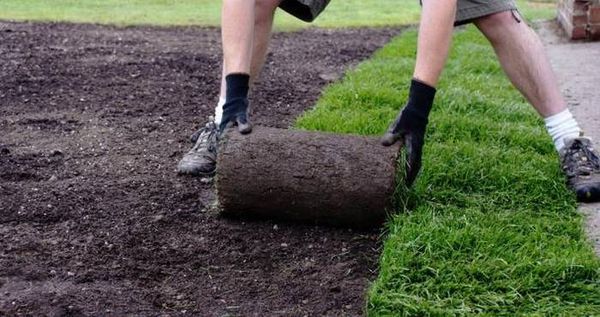
- Laying rolled lawn
-
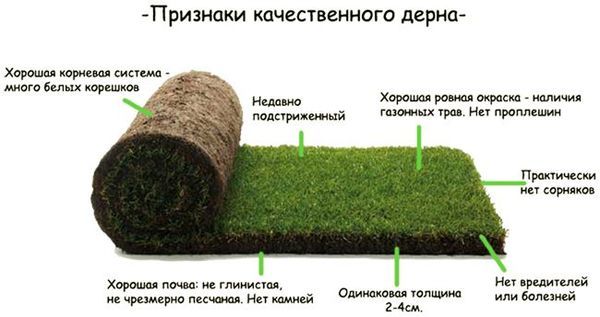
- Signs of high-quality turf
-
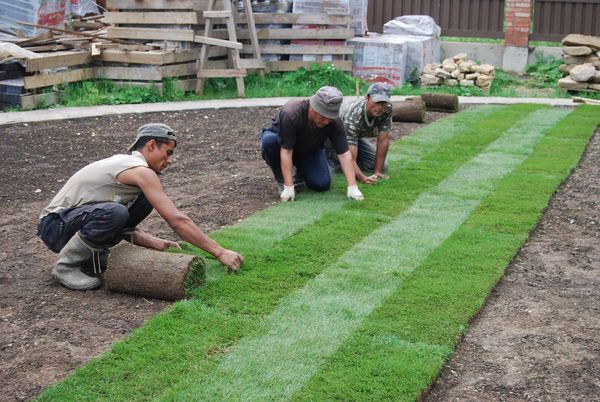
- The rolls are laid without overlapping
Further care
After laying the rolls, water the lawn daily for 15 days. You can water it with a hose, but if possible, it's better to use an automatic sprinkler system. It's important to keep in mind that walking on the surface for the first month is prohibited, as it may leave indentations. As a last resort, you can use a mat, but it should also be removed immediately.
Maintenance of a rolled lawn consists of the following activities:
- get rid of weeds in a timely manner;
- carry out the first haircut in about a month, but mow only the tops of the cover;
- Mowing should be done as needed, but it is essential to remove all mown material from the surface; the height of the grass before wintering should be at least 4 cm;
- water the lawn as the top layer dries, approximately once every 10 days, provided there is no precipitation;
- Before wintering, the surface is cleared of debris, moistened and fertilized; it is desirable that the lawn be covered with snow.
In terms of necessary maintenance and material costs, rolled turf is less cost-effective than seeded turf or simply growing regular grass. However, it's also impossible to give regular grass a well-groomed green look from winter to winter.