
What is industrial hemp and what is it made from?
Content
What type of hemp is called "industrial"?
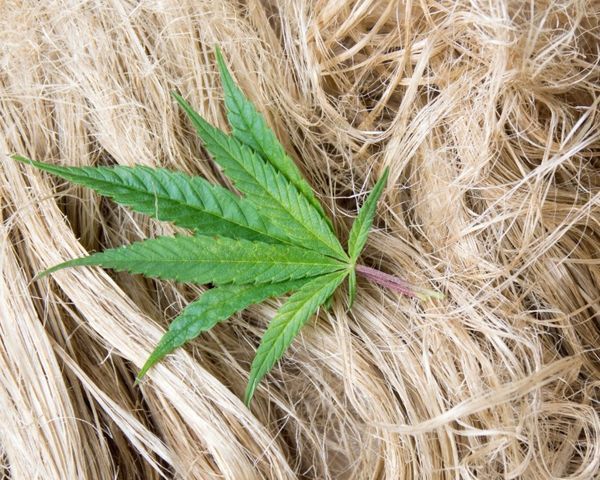
Industrial-scale hemp cultivation relies solely on the industrial variety. This is an annual herbaceous plant of the Cannabis family. Unlike other species, it contains only 0.08% tetrahydrocannabinol, and its stems and seeds are the most valuable. The plant grows to a height of 0.8 to 4 meters. The shoots are erect, branched, 0.2-3 cm in diameter, covered with pointed, elongated leaves, clustered in groups of 5-7, with serrated edges.
The appearance of the grass depends on its sex. Male plants are taller, less foliated, and bloom with yellow paniculate inflorescences with a light green tint. The fibers are elastic and soft. Female plants are characterized by dense foliage, a distinct aroma, and complex spike-shaped inflorescences. The stem structure is denser, more elastic, and tough.
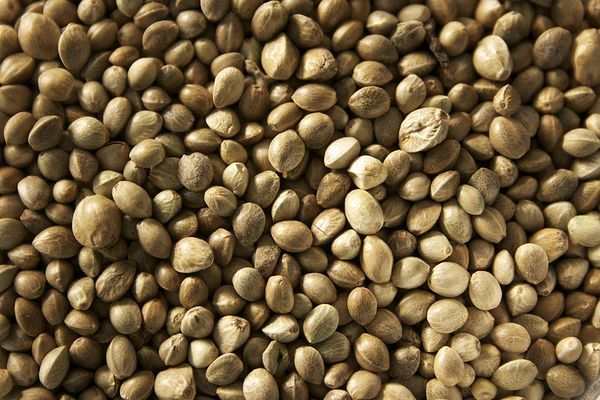
After flowering, the cannabis plant produces fruit. These appear as small, oval-shaped, bluish-green nuts.
Video "Marijuana as a Medical Drug"
In this video, an expert will explain how cannabis is used in medicine.
The main qualities of industrial hemp
Industrial cannabis is characterized by a diverse chemical composition. It includes over 400 compounds, of which only a small proportion are cannabinoids. However, sometimes psychotropic substances may be completely absent. Hemp also contains:
- proteins;
- carbohydrates;
- alkaloids;
- terpenes;
- phenols;
- various beneficial acids;
- steroids;
- vitamins (A, B, D, E, K);
- microelements (Fe, Ca, K, Mn, Mg, S, P, Zn);
- tannins;
- chlorophyll;
- carotene;
- glycerols.
Thanks to such a rich composition, industrial hemp has a lot of useful qualities:
- antibacterial;
- anti-inflammatory;
- painkillers;
- antibiotics;
- antitumor.
Areas of application
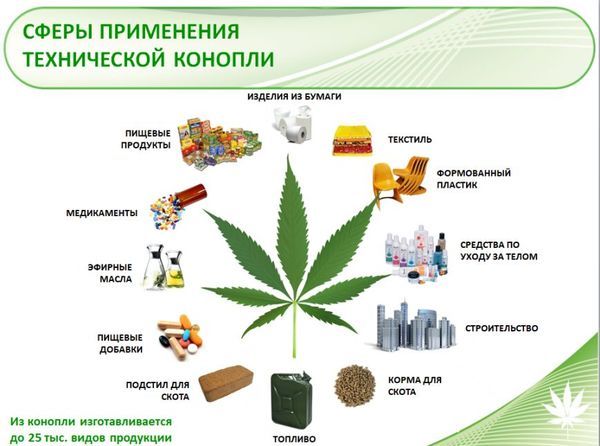
The industrialization of culture began to emerge with the advent of the 20th century. Over the decades, breeders developed numerous varieties of industrial hemp, which later expanded into various spheres of our lives, from medicine to the textile industry.
-
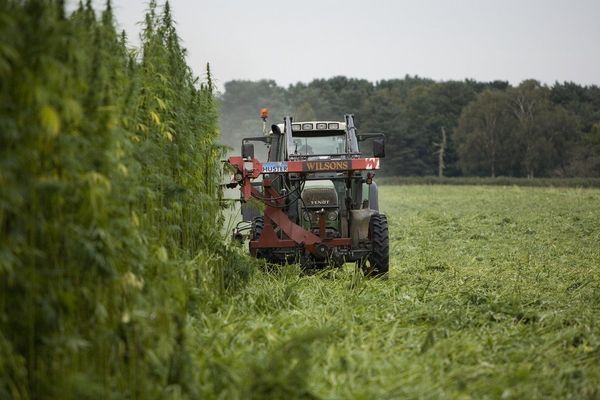
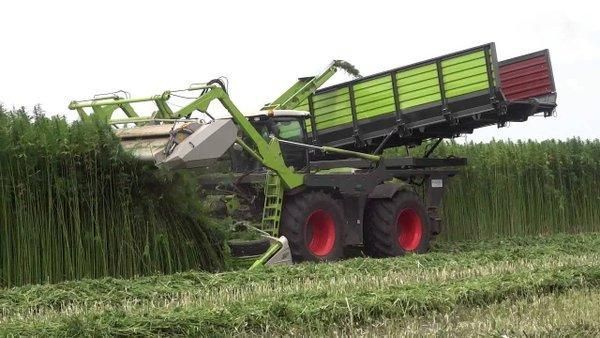
- Industrial production of industrial hemp
-
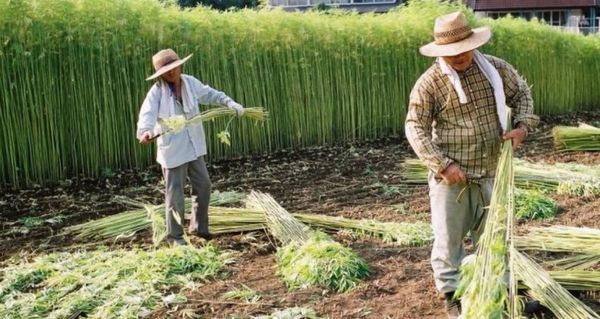
- Harvesting industrial hemp
-
- Hemp is used in everything from medicine to the textile industry.
In medicine and cosmetology
Industrial production of the plant allows it to be included in hygiene and cosmetic products, as well as medical preparations.
Despite its not fully studied chemical composition, the herbal plant is highly valued by cosmetologists and doctors.
Possessing antioxidant properties, industrial hemp slows down the aging process, accelerates cell regeneration, and improves metabolism. It is also used to prevent the following diseases:
- oncology;
- asthma;
- chronic bronchitis;
- rickets;
- diseases of the cardiovascular system and gastrointestinal tract.
In everyday life
Thanks to its elastic yet durable fibrous structure, industrial fiber is used in the production of building materials. For example, it is used to make:
- panels for house finishing;
- foam plastic;
- concrete;
- varnishes and paints.
Recently, dried plants have been used in wall construction, façade reinforcement and insulation, and flooring. A program to use hemp cake in house construction began 10 years ago in England, and the practice has since been successfully adopted by Europeans.
In the food industry
Hemp seeds contain 99.9% healthy fats, which are easily absorbed by the body. They are recommended for inclusion in the diet of people who:
- lead an active lifestyle;
- watch their weight or are on a diet;
- vegetarians;
- athletes.
The seeds are consumed as a stand-alone product or as a pulp. Hemp oil is cold-pressed and contains no carcinogenic substances.
In the weaving industry
Fibers extracted from industrial hemp stems are widely used in the light industry. Fabrics made from them are used to produce:
- underwear;
- clothes;
- shoes;
- various accessories.
In production
Recently, industrial hemp has become increasingly popular in furniture manufacturing. For example, recycled hemp is used as a filler for particleboard. It is also used to make durable, environmentally friendly adhesives.
Farmers are increasingly adding oilcake, the residue left over from oil extraction, to cattle diets. Thanks to its rich chemical composition, this feed supplement helps replenish the animals' nutritional needs.
Pulp industry
The pulp industry has increasingly switched from wood to industrial hemp. This shift is driven by the critical state of forests and the high rate of deforestation. Furthermore, hemp-based paper offers several significant advantages:
- higher quality;
- fortress;
- low price.
Producing cellulose from grass-based crops is more cost-effective, allowing for four times greater production volumes than using wood. Innovative technologies also allow for more efficient removal of silicates from the raw material, elevating the finished product to a new level of quality. Besides its environmental friendliness, another advantage over wood-based pulp is its short maturation period of just four months.
Alternative energy
The potential for using industrial hemp as an alternative energy source was known as early as Henry Ford's time. He was the first to invent a car that ran on hemp fuel. The American industrialist grew his own plantations, a fact he was very proud of.
To this day, dried grass is used to make pellets and other heat sources. The finished product has excellent heat transfer and can therefore be an effective substitute for softwood.
Contrary to popular belief, industrial hemp is completely harmless to the body. On the contrary, it is an environmentally friendly raw material used to produce a variety of products. For example, the crop could be a good organic alternative to plastic, gasoline, or twisted products.