
How to braid onion hair and why do it?
Content
Selecting a variety
When wondering how to weave onions, it should be noted that not all varieties can be stored in this way.
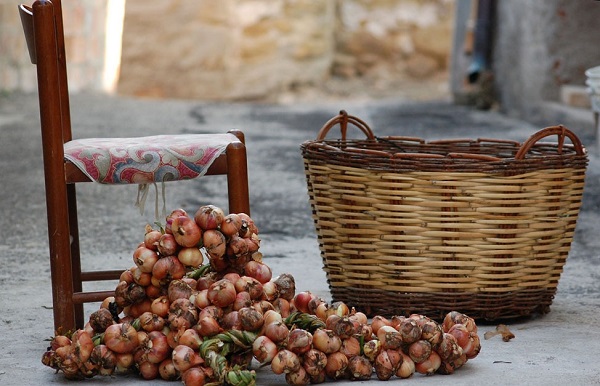
To braid this vegetable, you'll need varieties with long, thick tops. These are best stored in bundles. Onions are best for braiding.
Hot, early-ripening varieties (Aleko), sweet onion varieties, shallots (Kuznechik, Sprint, Mezhsezonye), and many others are suitable. The main thing is that the varieties have good stems for tying.
Video: Onion Storage Technology
This video explains in detail how to best store onions in winter.
Weaving pattern
Hobby gardeners often resort to the simplest method of storing onions at home. Typically, they use wicker baskets, wooden crates, or cardboard boxes to store the bulbs, then store the containers in basements and cellars. However, tightly packed containers make it difficult to ensure adequate ventilation to prevent them from rotting. Therefore, traditional storage methods such as braiding onions can be used.
Only plants with dried stems are used for weaving. If gardeners plan to store their harvest this way, the stems should not be cut off after harvesting.
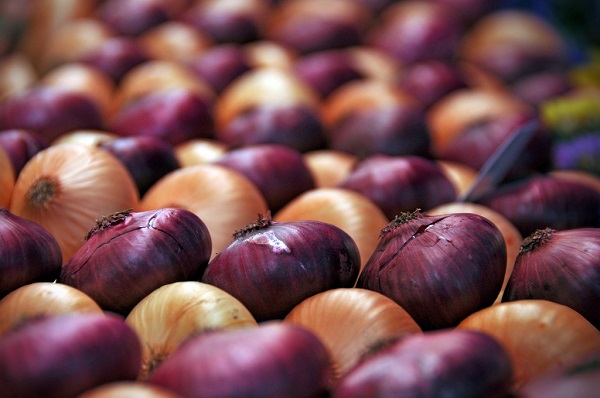
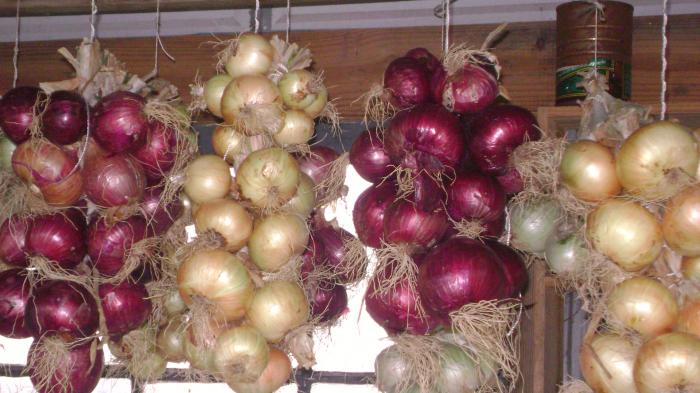
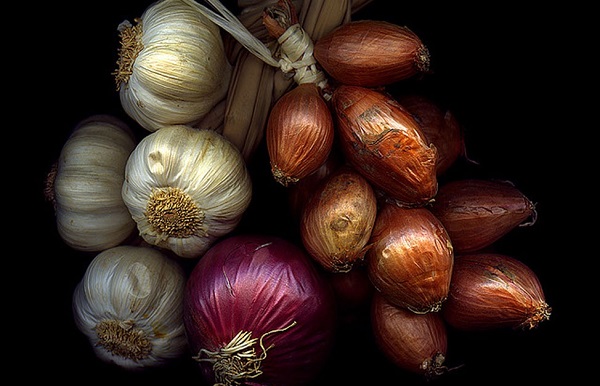
First of all, you should know how to properly harvest the onion crop so that in the future you can make large woven bundles of onions.
The harvest should be in late summer or early fall. The harvest time depends on weather conditions and the vegetable variety. For two weeks, take the onions out to a dry, sunny spot every day to dry. In the evening, bring them under cover to prevent them from becoming damp again when the dew falls in the morning. Proper drying will prevent rotting when the onions are stored indoors.
As the vegetables dry, their tops become significantly harder. Without sap and moisture, the plant fibers become very strong, capable of withstanding high tensile stress. This allows the tops to support a greater weight, as they are woven together from a large mass of bulbs. Signs that the vegetable is ready for storage include the development of a yellow outer husk and dry tops.
Before braiding onions, select whole onions free of damage, rot, mold, or other signs of poor quality. If a few such onions are found in a bundle, they could lead to spoilage of a larger harvest during storage, as this may not be immediately noticeable.
Only perfectly dry tails can be braided, as they will not break under heavy loads and twisting of the fibers.
It's best to braid together fruits of approximately the same size and variety. Before braiding, remove any clumps of soil, and trim the roots without damaging the bulb.
Braiding a bow isn't difficult. Beginners will need more time, but the technique is quite simple. With a little practice, you'll develop speed, and eventually it'll become almost automatic.
One of the weaving patterns may use rope as a base. Since the structure can be quite heavy when knitted, it's important to provide a sturdy base, otherwise the whole thing may fall apart at the end, requiring redoing.
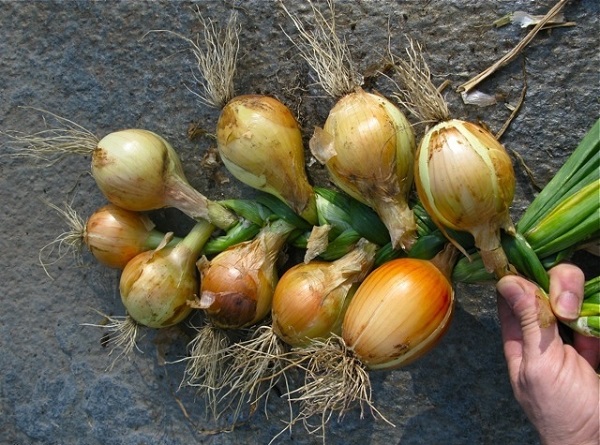
Next, find the onion with the longest stem. Secure it to the string so that you have three branches – two ends of the string and one onion stem. Begin braiding a regular braid. After each new braid, add one onion on each side. It's best to braid the tops as closely as possible to ensure a secure attachment. Continue braiding until the strings are about 20 centimeters long. Then, tie the string tightly around the onion, making a loop so you can easily hang the finished bundle on a hook.
There's another method for tying. Remove excess husks and trim the tops. Form a ring of rope about 75 centimeters long. Then, for ease of handling, secure it to a hook. Attach a pair of bulbs to the beginning of the ring, tied together. Then take a second pair of the same type and secure them crosswise to the first. Then, take one plant at a time, wrapping its tops around the twine.
This way, the attached pairs are tied together from above. The resulting stem should remain between the bulb heads; the ends should not be touched, as they can be trimmed off after the braiding is complete.
The fruits should be evenly spaced to ensure a smooth weave. After weaving a bundle of about 10 kilograms, make a small loop (up to 10 centimeters) to hang the harvest. Once finished, trim off any excess tops to keep them out of the way. Garlic can be braided in a similar manner.
Video “Braiding the bow”
The video shows how to store onions in braids.