
One of the best-yielding potato varieties, Red Scarlet
Content
Description
The Red Scarlet potato variety was recently developed by breeders, but has already proven itself to be excellent compared to its relatives in many countries.
Some believe the potato was named after the characters in "Gone with the Wind." After all, it perfectly combines the noble qualities of Red and Scarlett. Another theory holds that the variety got its name from the appearance and color of the fruit. After all, "red" means "red," and "scarlett" means bright scarlet.
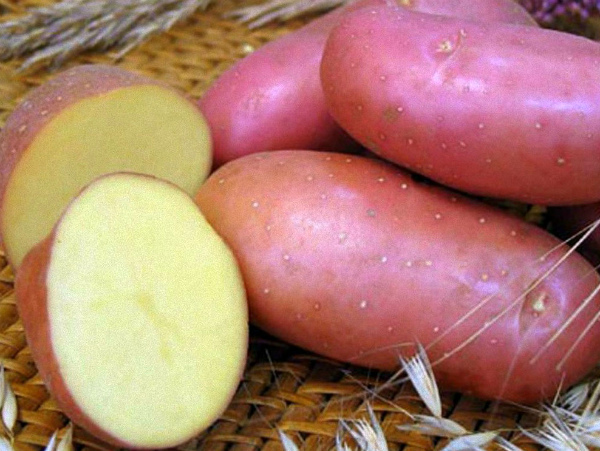
The variety description identifies the root vegetable as follows: long tubers, regular in shape, oval-shaped, with shallow "eyes" that are dark or yellowish; the potato skin is thin and smooth to the touch, pinkish-crimson in color. The sprouts of this potato variety can be purple or reddish in color. Raw tubers are either white or light yellow. According to reviews, the potatoes darken when cut before cooking, but retain their natural color during cooking.
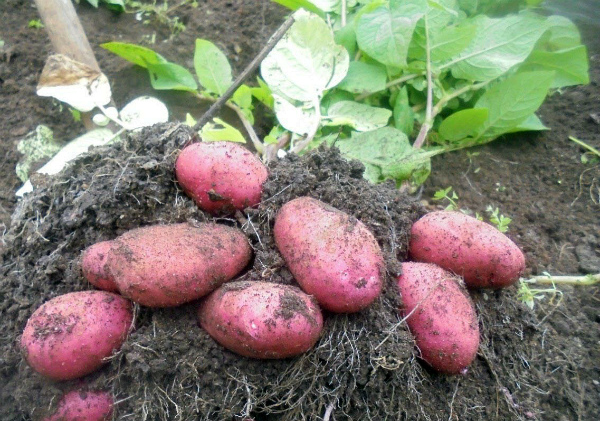
The vegetable's description also states that the tubers weigh between 50 and 120 grams. However, larger specimens, up to 150 grams, are also common. One bush can produce 15–20 root vegetables. They grow simultaneously and, therefore, are almost uniform in size.
Scarlett potatoes contain a large amount of starch – up to 17%.
The plant's bush is described as low, upright, with moderately thick stems. Potato tops form quickly. The inflorescences are either lilac or pinkish-purple. The leaves are medium-sized, dark green, with wavy edges.
Characteristic
The potato's characteristics make this variety one of the best. Southern and central regions are best suited for growing this potato. The vegetable thrives in humid, cool conditions. If the climate is arid and the soil is warm, it's important to form large tubers and maintain constant soil moisture.
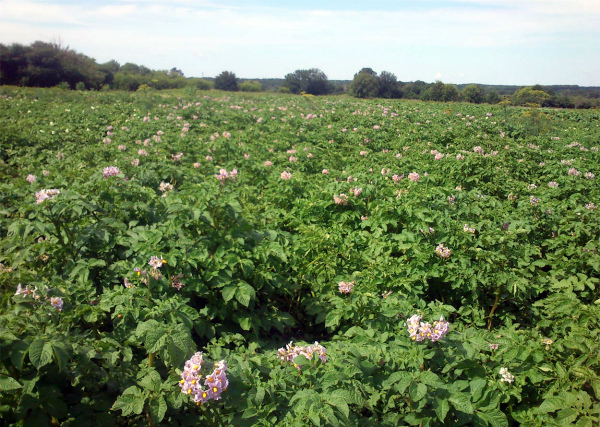
When planting, seeds are very dependent on calcium. Therefore, it's essential to add a generous amount of this macronutrient to the soil. Vegetable yields directly depend on growing conditions and location. Up to 45 tons of yield can be harvested per hectare, and sometimes even up to 60 tons.
Potatoes are delicious and rich in various minerals and vitamins. They ripen fairly quickly, within 70 days of planting.
The plant is also drought-resistant. The roots are easy to transport and do not darken when damaged. The variety description includes information on the taste of the root vegetable, both boiled and fried.
This vegetable can be used to make delicious French fries, as the slices of this variety do not change shape when cooked.
Diseases
As the description of this vegetable indicates, it has good immunity and is virtually immune to diseases such as potato nematode, cancer, and virus A. These diseases are very dangerous for the plant.
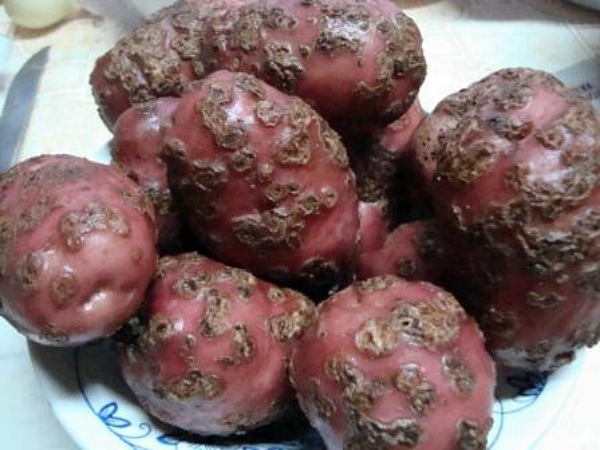
For example, canker causes a white coating to appear on the fruit, which darkens and enlarges over time. Specific growths appear on the green parts of the plant. If such symptoms are detected, infected bushes should be removed immediately. Prevention of this disease involves treating the plant with Fundazol before planting.
This variety is moderately susceptible to scab or late blight of the green parts of the plant. Late blight is a fungus that attacks the crop in a complex manner, causing internal rot. The disease spreads rapidly in warm, humid conditions. Late blight can be controlled by treating the vegetable with boric acid or copper sulfate before planting. However, the crop is virtually immune to tuber blight.
Potatoes are susceptible to attacks by the Colorado potato beetle and the mole cricket, and this variety's description is no different from others. The mole cricket can be controlled with a solution of vinegar and water in the following proportion: 3 tablespoons of vinegar per bucket of water. Pour half a liter of the prepared solution into the burrows. Colorado potato beetles can be controlled by hand-picking them from the bushes or by treating the plants with special chemical solutions. However, this treatment must be carried out at least 20 days before harvest.
Features of agricultural technology
Red Scarlet originates from Holland. There's a specific cultivation technique used in that country. When planting, it's important to leave sufficient space between plants. Only then can you obtain a large harvest.
Before planting, it's essential to sprout the vegetable. Select medium-sized root vegetables and keep them in a warm place until sprouts 5 mm long emerge.
The crop should be planted only in warm soil before frost sets in. This is usually in late April or early May. Dig small holes up to 15 cm deep, spaced 70 cm apart. Place the fruits in the holes, sprout-side up. The next row of holes should be spaced 140 cm from the first. After planting, the soil should be leveled and loosened. Additionally, during care, the plants should be hilled, watered adequately, and protected from pests.
A week before harvest, the green part of the plant is removed from the plot. This will strengthen the skin of the vegetables and prevent damage during transportation and digging.
If you plant the crop at the end of May, you can harvest it as early as August.
Despite the good immunity of the variety, the plants need to be treated with chemicals.
Red Scarlet is a unique variety with many positive attributes. Therefore, it is recommended for both domestic and industrial cultivation.
Video: Digging Red Scarlet Potatoes