
Description and cultivation of the Yakovlevskaya hybrid pear variety
Content
Description and main characteristics
The description suggests that trees of this variety are distinguished by their ornamental qualities. They grow up to 10 meters tall, with a crown gradually taking on a pyramidal shape with a wide base. Strong, straight branches, dark red or chocolate-brown in color, are covered with elongated, medium-sized emerald leaves. The glossy leaflets have a pointed tip and serrated sides. Over the course of a year, shoots grow 15 cm laterally and up to 25 cm upwards; the crown tends to become dense, requiring annual pruning.
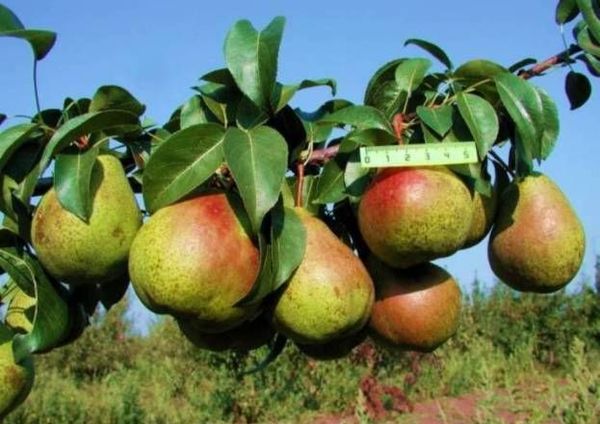
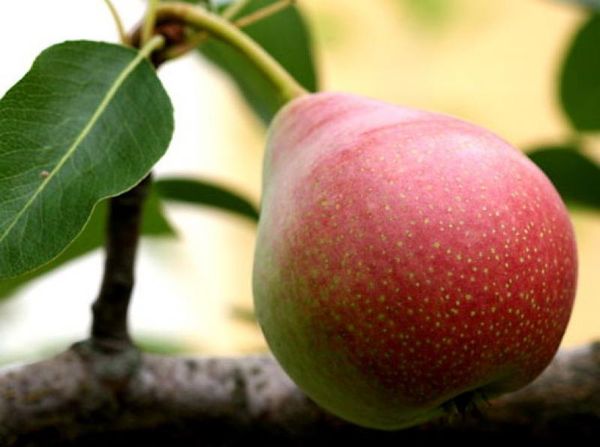
The pear tree blooms in May, its rather large white (or pinkish) flowers hidden among the vibrant foliage. The fruit reaches harvesting maturity in the second half of September – by this time, the fruits are firm and green with a red blush on one side, covering about a third of the surface. They have a slightly elongated, but overall perfect, pear shape. Weight varies from 120g to 215g. The skin is of medium density, covered with a light waxy coating.
After a couple of weeks, consumer maturity sets in: the fruits turn yellow-green, the blush darkens, the aroma intensifies, and the flavor develops a honey-like sweetness with a slight tartness thanks to the high ascorbic acid content. The flesh is creamy, juicy, and soft, with some granules. In a cool place, the fruits can be stored until spring. They are eaten fresh, used in desserts, and used to make winter preserves.
The Yakovlevskaya late pear begins bearing fruit after reaching five years of age. It produces regular, large yields, tolerates temperatures down to -30°C in mid-season, is resistant to scab and entomosporiosis, and is easy to care for. The variety's characteristics note that it is self-fertile, but nearby pear trees (or even other fruit trees) with a similar flowering period can significantly increase the yield.
Features of cultivation
For planting, select a one- or two-year-old seedling with a healthy, well-developed root system, a straight, clean trunk, and several shoots. Choose a site for the new tree in a sunny part of the garden, preferably protected from north winds, with deep groundwater. Any soil will do, as long as it contains nutrients and is not too acidic.
Planting is done in the spring or fall, 3-4 weeks before the onset of frost. The site must be prepared: digging it, removing the roots of perennials, and applying fertilizer. Some prefer to dig a large hole (up to 1 m deep), fill it with humus, compost, and mineral fertilizer, mixing it with the soil, and plant the tree after 3 weeks.
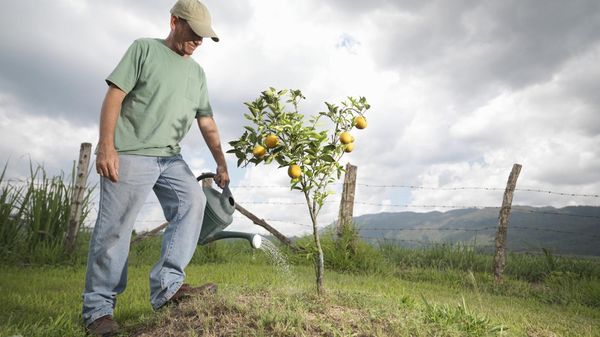
Saplings are watered weekly, young trees monthly, and mature trees with strong, deep-growing roots can find water on their own and tolerate periods of drought well. Young trees are fed with organic matter, with nitrogen fertilizers applied until mid-summer; mature trees are fertilized every few years: nitrogen in the spring, and potassium and phosphorus in the fall.
It's important to prune the tree's crown properly every year: if it becomes too dense, the fruit will begin to shrink. Shoots grow quickly and abundantly, so they need to be trimmed back annually, removing not only damaged shoots but also those that shade neighboring trees and prevent air and light from freely penetrating the crown.
The pear tree has good resistance to most diseases and is rarely attacked by pests, but as a preventative measure, experienced gardeners treat the tree with Bordeaux mixture once every 2–3 years (in the spring, before the buds open).
Young trees need to be covered for the winter, protecting them from frost and rodents, while mature trees can tolerate the cold well, but it is advisable to cover the trunk near the ground with spruce branches to protect it from rodents.
Video: "Where a Pear Tree Should Grow"
This video will tell you where pear trees should grow for best yield and flavor.