
Why plant the Victoria summer pear tree?
Content
History and description
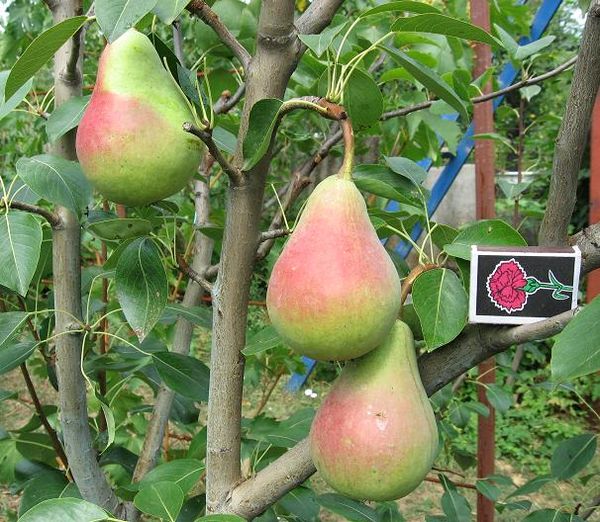
The pear is not only delicious but also beneficial for the human body. It contains organic acids, tannins, and essential oils, as well as numerous trace elements and vitamins. The pear variety known today with the truly feminine name Victoria is a cultivar that yields fruit ripening in the summer.
The variety was developed by specialists from the Ukrainian Institute of Irrigated Horticulture of the Ukrainian Academy of Agricultural Sciences, located in Melitopol. The Victoria pear was developed by breeders E. Avramenko, I. Boyko, G. Kulikov, P. Grozditsky, and I. Maksimova, who successfully crossed the Bere Bosk and Tolstobezhka pears.
The variety, named Victoria, was submitted for state testing in 1974. Almost 20 years later, in 1993, it was approved for cultivation in the North Caucasus Federal District of Russia. Today, it is a typical pear variety grown in the Moscow region. The variety is suitable for cultivation in the steppe and forest-steppe zones, as well as in southern Ukraine.
The fruit setting rate of pears is high. The fruits reach harvest maturity between August 20 and 30, and the fruits hold well on the branches. This type of pear is often considered an early autumn variety rather than a summer one, due to the excellent shelf life of the harvested crop. Picked pears retain their appearance and flavor for one month, and refrigerated pears can last up to four months.
The fruit is highly transportable. The cultivar is self-sterile and tends to produce seedless fruits. To increase yields, it is recommended to plant pollinator trees nearby: Williams red, Bere Dumont, Nikolai Kruger, and Triumph of Vienna.
With proper care, a mature tree can yield up to 200 kg per season. The trees have strong immunity to moniliosis, powdery mildew, and scab pathogens, and are frost-resistant, drought-resistant, and heat-resistant.
Video: "Pear Tree Planting Instructions"
This video will show you how to properly plant a pear tree.
Characteristics of the tree and fruits
Let's move on to the external description of the culture and its fruits.
This pear tree is classified as a medium-sized tree. The crown is conical, with a slightly flattened tip. Experts have dubbed this shape "rounded-pyramidal." Branch density is moderate, and fruiting occurs on the ring-shaped branches. The growing and flowering seasons are late, so the flowers are not damaged by spring frosts.
The average fruit weight varies between 150–250 g, with individual specimens reaching 300 g.
Pears are broadly pear-shaped. Their skin is smooth and medium-thick, sometimes slightly rusty. When fully ripe, the fruit is yellowish-green with a characteristic pinkish-purple blush. Numerous spots are clearly visible beneath the skin. The stalks are medium-thick, long, and curved.
The fruit contains approximately 13% dry matter, 7.8% sugars, 0.4% titratable acids, 5.8 mg/100 g ascorbic acid, and 38 mg/100 g P-active catechins (relevant for pears harvested in Kuban orchards). The flesh is white, very juicy, tender, and buttery. The fruit has a sweet and sour taste and a pleasant aroma.
Gardeners' experience has shown that when the weather is cool in the summer and fall, pears lack the characteristic tartness and aren't as sweet as usual. The fruit is intended for table use, and is most often eaten fresh, allowing you to enjoy its excellent flavor, pulp free of calcified particles, and unforgettable aroma.
Pros and cons
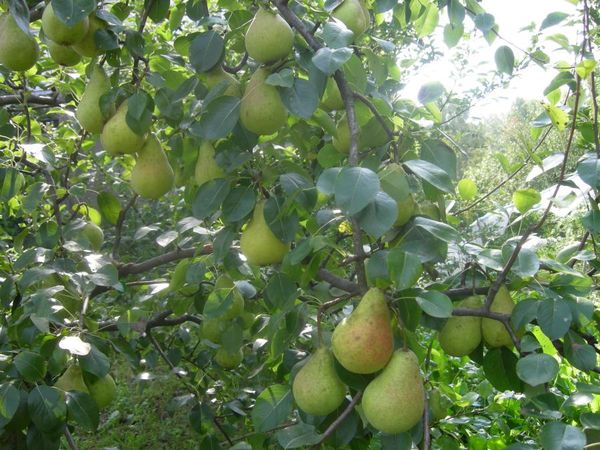
Trees of this species are often found in the gardens of our compatriots because they offer a number of undeniable advantages. These include large, fragrant fruits with excellent flavor and a presentable appearance. Gardeners are also pleased with the abundant and regular fruiting, the trees' high winter hardiness and drought tolerance, and their strong immunity to major diseases and pests.
No obvious disadvantages have been observed so far. Despite good tolerance to low temperatures, it's best to provide protective cover for the seedlings during the first year. In the sparse summer and autumn heat, the fruits may not develop their pleasant tartness and characteristic sweetness.