
Peculiarities of growing the unique Ussuri pear
Content
History of appearance
The Russian botanist Karl Maksimovich first described the Ussuri pear in the middle of the 19th century. He discovered a strikingly beautiful wild tree with delicious fruit that could grow and bear fruit despite severe winter frosts. Ivan Michurin proved that this pear could be used to develop new varieties that would combine the hardiness of the Siberian pear with the qualities of more southern fruits. He created the now-famous varieties Bere Oktyabrya, Bere Zimnyaya, and Tolstobezhka. Michurin's followers continued his work: the Far Eastern varieties Tema, Polya, Olga, and Lida, as well as the Altai varieties Zoya and Pervenets Altaya, were developed from the Ussuri pear.
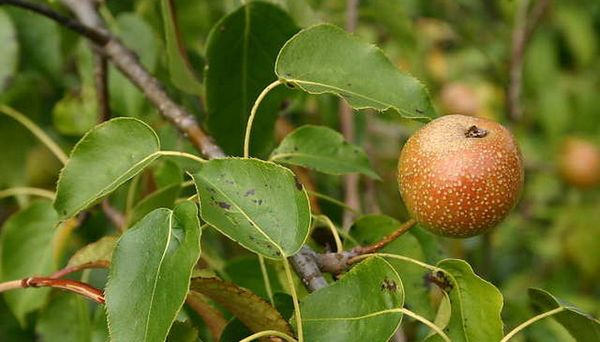
The pear is successfully used as a rootstock for growing crops in cold climates. However, it also thrives in more southern regions, and the fruit of this wild tree is tastier and larger without any grafting. This is true, of course, if it grows in fertile soil and receives plenty of sunlight.
Description of the variety
The tree grows up to 10–15 m in height, the crown is dense, wide, can be broadly pyramidal, rounded, spreading, and is well regulated by pruning. The thorny shoots are yellowish-brown or brownish with a reddish or grayish tint and are hairless. The leaves are elongated with a characteristic ciliate-serrate margin, glossy green above and matte and much lighter below.
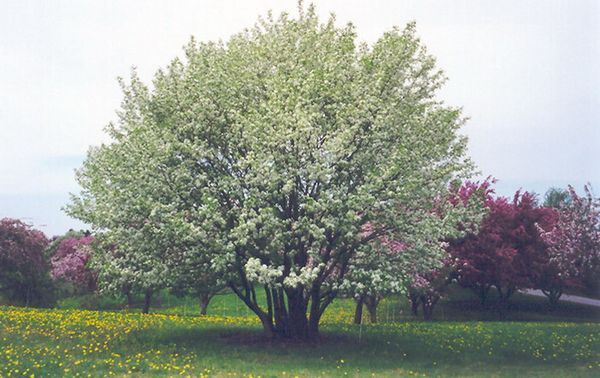
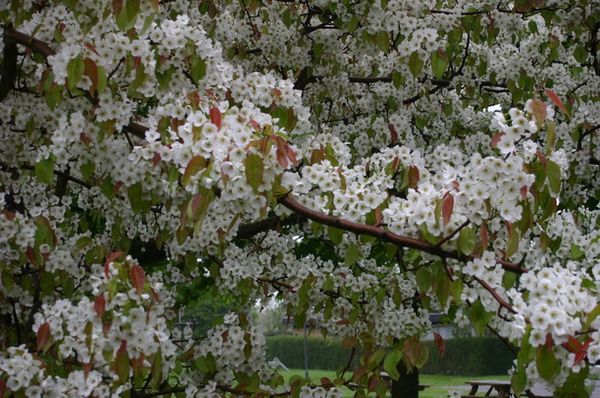
The tree is very decorative: the leaves are red in spring, turn their traditional green in summer, and turn a striking yellow in autumn. But the pear tree is most impressive during flowering – it is covered in large (up to 4 cm in diameter) saucer-shaped flowers gathered in large inflorescences, and a very pleasant, sweet aroma wafts around.
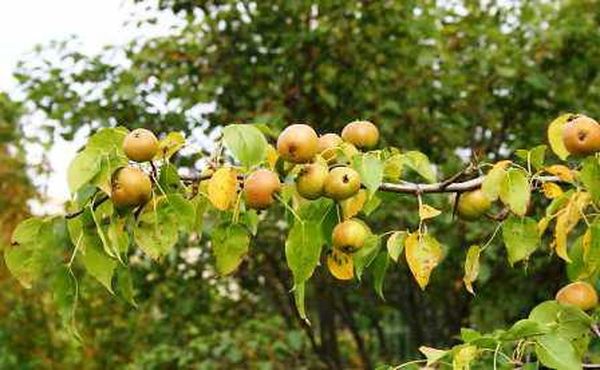
The fruits ripen in August-September. They are typically small—3 to 5 cm in diameter, slightly elongated. Their color depends on the soil and climate—green, greenish-yellow, or yellow with a red flank. Subcutaneous spots are clearly visible. The flesh is white or creamy, sweet and sour, tart, with hard spots that almost disappear after ripening.
The pear is frost-resistant, easily tolerates periods of drought, is undemanding to soil, is not self-fertile, and begins to bear fruit after 10 years of age in the presence of pollinator trees nearby.
The most astonishing thing about this pear is its remarkable variability. If you buy two identical seedlings and plant them in different locations, within a few years the trees will look like representatives of different varieties. Their fruits can vary in weight (up to 100 g), shape, color, and flavor. This explains why this wild pear is often planted in summer cottages, and its fruits are used for many years in compotes, kvass, and jams. They are rarely eaten fresh.
Landing rules
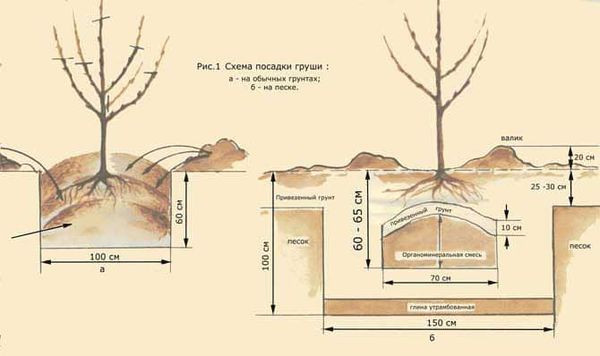
Plant in spring or fall. Prepare the hole at least three weeks in advance; it's best to do it in the fall for spring planting. Choose a sunny but wind-protected location with deep groundwater.
The Ussuri pear is undemanding and will thrive in any soil, but if we're interested in the quality of its fruit (and it's often planted in cities as an ornamental), we need to prepare breathable, fertile soil with a pH of 6-6.5. Its roots are wide and fibrous, so it's best to dig a wider and deeper hole, especially if we need to amend the soil structure and fertilize it.
A drainage layer is created at the bottom, then a mixture of turf and leaf mold is added, along with humus, compost, wood ash, lime (if needed to reduce acidity), and mineral fertilizers. A sturdy stake is driven into the center of the hole, then the seedling is placed, the roots are spread out, carefully covered completely with soil, tied to the stake, and watered thoroughly. The soil that has settled after watering is added so that the root collar is 3 cm above ground level. Then the area is mulched with grass, hay, or leaves.
Tree care
A young tree needs plenty of moisture; after a year, it should be watered once a month if there is no rain. Moisture should be maintained during flowering and fruit set, and then, ideally, a moisture-reducing irrigation should be performed in the fall.
Fertilizers are applied depending on soil conditions. Typically, nitrogen fertilizers are applied in the spring, potassium-phosphorus fertilizers in the fall, and organic matter is added every 3-4 years.
The tree trunk area should be kept clean, loosened occasionally, and mulched to retain moisture and protect against pests. Fallen leaves and fruit should not be left under the tree.
The crown should be pruned in the spring. First, it is shaped, and then excess shoots are removed annually to prevent the tree from becoming overgrown.
Despite their remarkable frost resistance, the trunks of young trees are always covered for the winter, wrapped in burlap and spruce branches. They are earthed up high and mulched with a thick layer of hay or compost.
It's advisable to treat the tree with a colloidal sulfur solution in the spring to protect it from gall mites. Karbofos or Nitrafen will protect against pear psyllids. Bordeaux mixture or copper sulfate will prevent rust infestations.
Video: "Fertilizing Fruit Trees"
This video will show you how to properly fertilize fruit trees.