
All about successfully growing the productive Lada pear variety
Content
History and description of the Lada pear
A new frost-resistant variety was developed by academics Chizhov and Potapov in 1955. The scientists crossed the Belgian variety "Lesnaya Krasavitsa" with the "Olga" variety, popular in the Russian Far East. The former is prized for its flavor and yield and serves as the basis for many other varieties. The latter is distinguished by its resistance to frost and disease. After extensive testing, "Lada" was added to the State Register. The variety proved particularly popular with gardeners in the Moscow region.
Botanical portrait
To ensure that the tree develops a properly even crown, a strong stake protruding 60 cm above ground level is placed near the seedling when planting.
A mature tree grows up to 3 m. The initially funnel-shaped crown eventually changes to a pyramidal or conical shape. The bark on the trunk is dark gray, while the branches are gray. The brown shoots are slightly curved. The foliage is medium-thick and dark green. The leaf is elongated-oval, serrated along the edges, and bends along the main vein.
The flowers are white and cup-shaped. The petals are moderately dense. Each inflorescence contains 5-7 flowers. This variety is distinguished by its mixed fruiting pattern—ovaries form on branches of any type.
Video: "Pear Tree Planting Guidelines"
This video will show you how to properly plant a pear tree in your garden.
Ripening and fruiting periods
Lada is an early-ripening variety. Ripe fruits are harvested at different times depending on the region: in the Samara region – from late July, in the Moscow region – in August, and in the Leningrad region – after August 10th.
Lada is distinguished by its early fruiting. Fruiting begins 3-4 years after bud grafting in the nursery. The variety bears fruit every year.
Lada is self-fertile, but pollinators are needed for a good harvest. Its pollinating varieties include Lel, Ragneda, Chizhovskaya, and Kosmicheskaya. Apple trees are closely related to pears, so these species can be planted together. It's important that the varieties have the same flowering seasons, sunny weather during the pollination period, and a sufficient supply of pollinating insects.
Yield and fruit characteristics
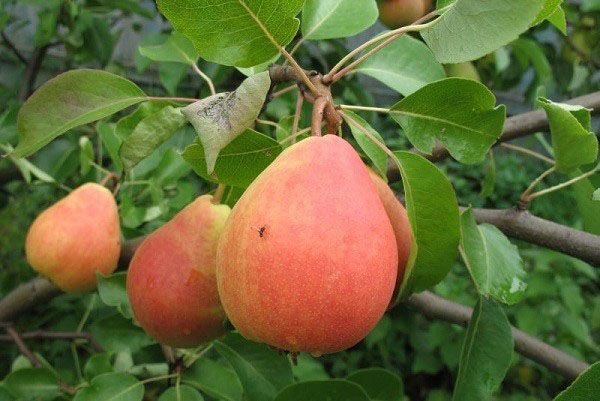
The high yield allows for up to 50 kg of fruit to be harvested from a single tree. The fruits are broadly ribbed, medium-sized, weighing up to 110 g. The skin is thin, light yellow, with a blush on the sunny side. A slight rustiness appears near the stalk. The spots under the skin are barely visible. Each fruit contains up to 5 small, brown seeds.
The flesh of a ripe pear is yellow-white, fine-grained, and medium-firm. The aroma is subtle, and the flavor is sweet and tart. According to tasters, Lada received a score of 4.1-4.4.
-
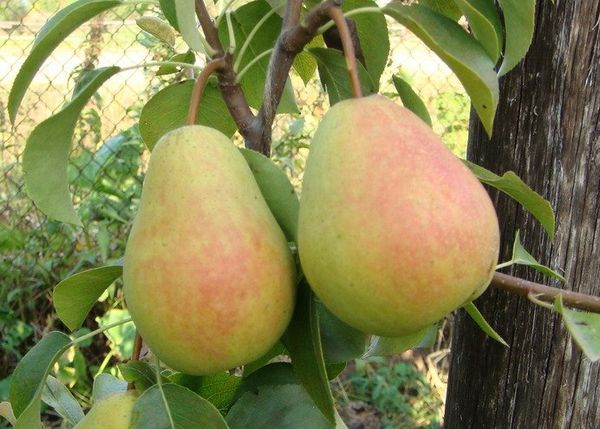
- The fruits of this variety are not large, weighing up to 110 g.
-
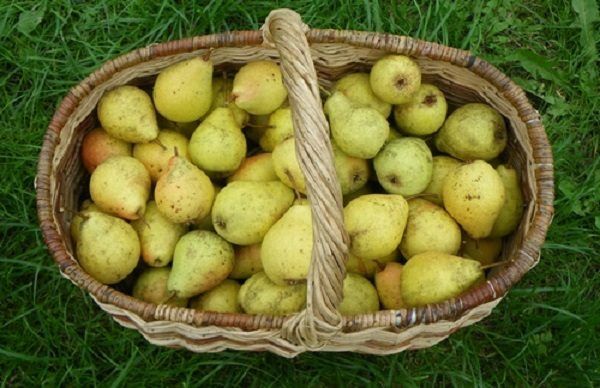
- The flesh of a ripe pear is yellow-white
-
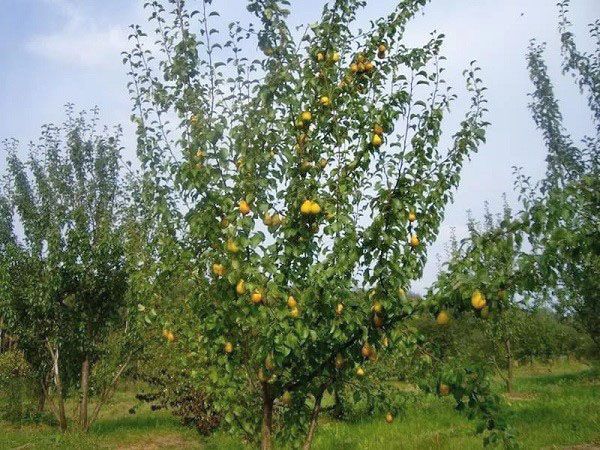
- Lada has self-fertility properties.
Harvesting, storage and use of crops
Ripe pears are picked from the tree with the stalk attached; they do not fall off after ripening. Store the harvest at a temperature of +1 to +4°C. Whole, undamaged pears are placed in wooden or plastic boxes or baskets lined with paper. A full basket requires careful transportation to prevent bruising. The shelf life is no more than 2.5 months.
To preserve fruit for a long time, they are dried in the sun or in special cabinets. Ripe pears are eaten fresh or used to make jam, compotes, yogurt fillings, or canned whole or in slices.
Drought and winter hardiness of the tree
Lada's distinctive feature is its frost resistance. During testing, trees of this variety withstood frosts down to -36°C. Drought weather negatively impacts the pear tree; excess heat and light cause the leaves to dry out. Therefore, in the absence of rain, proper watering is essential. Excessive moisture can cause root diseases.
Advantages and disadvantages of the variety
- early ripening of fruits;
- high taste qualities of ripe pears;
- early onset of the fruiting period;
- high yield;
- frost resistance;
- resistance to scab.
- lack of drought tolerance;
- short shelf life of fresh fruits;
- damage to pears during transportation;
- thickening of the crown with annual shoots.
Recommendations for planting and growing Lada pear
Selecting a location and preparing the site
The Lada pear should be planted in the south or southeast of the garden plot. The variety doesn't like drafts or cold winds, so the location should be calm but not shaded. If the garden is located in a lowland, artificial drainage channels or raised areas will be needed. The groundwater table should be at least 2 meters deep.
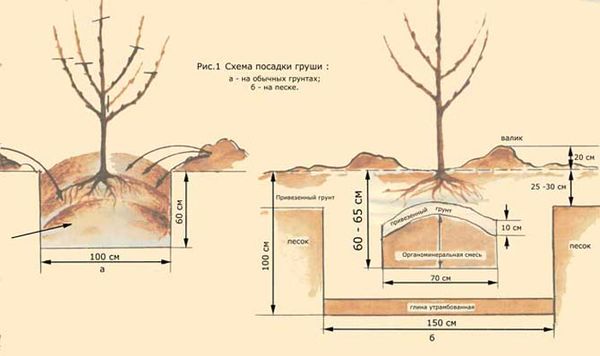
Pear trees require black soil and loam with a neutral pH. Clay soils are unsuitable. If planting is planned for the fall, prepare the soil in August. Add 7 kg of compost, 50 g of superphosphate, and 25 g of potassium salt per square meter, then dig with a bayonet shovel. Before planting in the spring, prepare the planting hole in the fall: a hole 80 cm deep and 130 cm wide. Prepare a mixture of soil, 200 g of azophoska, 10 kg of manure, 600 g of ash, and 700 g of dolomite and fill the hole.
Selecting seedlings and planting rules
Planting stock is purchased in the fall, when a good selection is available, and stored in a basement or crawlspace at a cool, but above-zero temperature until spring. It is recommended to choose two-year-old seedlings from specialist stores and nurseries. The planting stock should have intact bark, no root damage, and 7-8 developed branches. These will form the skeleton of a mature tree.
Trees are spaced 4-5 meters apart. A hole is dug in the prepared hole and the seedling is placed into it, ensuring the root collar is 6 cm above the soil surface. Some gardeners recommend pounding 10 eggs into the soil before planting to provide additional nutrition to the tree. The roots are then covered with soil, spreading them out first. A mound is created around the tree to prevent the root collar from sinking deeper when the soil settles.
Watering and fertilizing
Watering is done several times per season, depending on the weather. Sprinkler irrigation is the preferred method. Fertilizing is not necessary during the first year after planting. From the second year onward, root feeding is performed annually, and foliar feeding depends on the tree's condition.
Features of pruning
Pruning is done in March. At this time, dead branches are easy to identify. The first pruning is done immediately after planting. For this, select four strong branches, spaced evenly, and trim them back by 25% of their length. Subsequent annual pruning involves removing diseased and dead branches, excess shoots, and undergrowth. Garden varnish is applied to cuts larger than 15 mm.
Preparing for winter
To prevent cold from causing harm, the following measures are taken:
- trees under 4 years old are insulated by wrapping them in paper;
- the trunks of mature trees are wrapped in a special garden covering or insulated with snow;
- in the fall, the trunk and large branches are covered with a layer of lime;
- the lower part of the trunk is protected from rodents with a net;
- mulch the hole.
Diseases and pests and methods of control
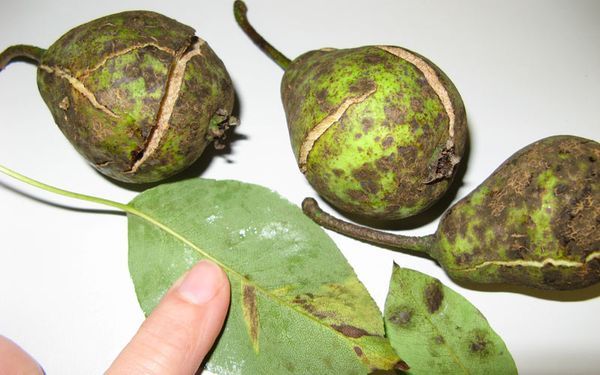
Lada has a strong immune system. To prevent scab, fire blight, fruit rot, and powdery mildew, treat the tree and soil with a urea solution (700 g per 10 liters of water). Pests are controlled with specialized antiparasitic agents.
Reviews from gardeners
"We got our first harvest from a seven-year-old tree. I think it's because there weren't any pollinating trees nearby."
“The harvest did not exceed 2-3 buckets until we planted Skorospelka next to it.”
The Lada pear tolerates winter cold well, but its fruit is not suitable for long-term storage or long-distance transportation. For maximum yield, pollinators are needed.