
Rules for propagating pear trees by cuttings
Content
The best varieties for cuttings
There is one rule: the smaller the pear fruit, the better it will propagate by cuttings – its shoots take root faster and take root more easily.
According to gardeners, the most successful varieties to propagate by cuttings are: Naryadnaya Efimova, Moskvichka, Osennyaya Yakovleva, Lada, and Pamyat Zhegalova.
How to prepare cuttings
Let's look at how to grow a pear from a cutting.
In the central part of the country, it's recommended to harvest pear cuttings in July (in the second half). In northern regions, this should be done earlier—in late June or early July.
For pears to reproduce successfully, they must be healthy, young, but already bearing fruit.
The top of the seedlings intended for propagation should be green, while the bottom should have roughened wood covered with bark. All leaves should be open except for the top one.
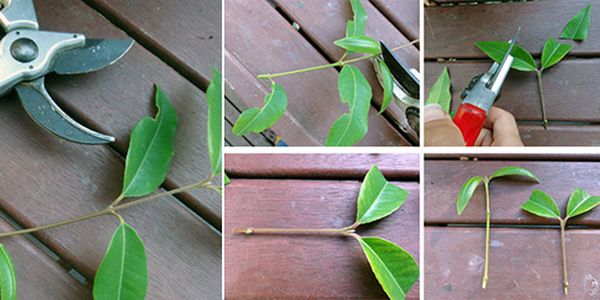
It's recommended to cut the sprouts early in the morning, as this is when they contain the most moisture. The cut is made with a sharp, well-disinfected pruning knife. The lower cut should be at a 45° angle toward the bud. The upper cut should be made horizontally above the bud. The branch should have two internodes (three if short) and three leaves. The lower one should be removed completely, and the upper two should be cut in half to reduce their moisture loss.
Place the cuttings in water with a rooting agent for 18 hours. Cover them with a plastic bag.
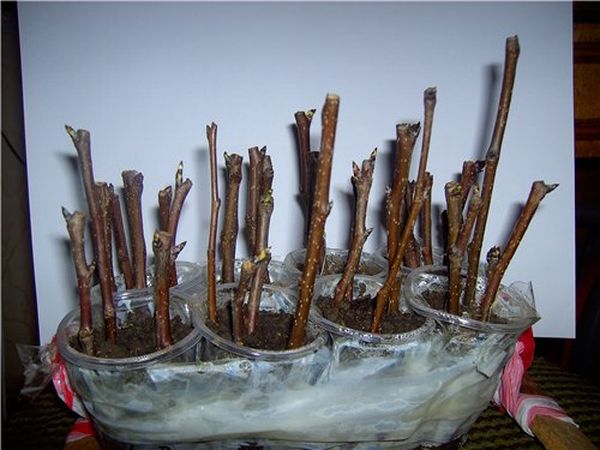
Gardeners sometimes ask: is it possible to grow a pear tree using air layering? Yes, this method is suitable. For this propagation method, select straight, healthy, actively growing branches. In the spring, cut them halfway down, 2-3 internodes below the apex. Treat the cut with a fungicide solution or crushed charcoal to disinfect, then apply a rooting agent. Next, cut a plastic cup in half and fill each half with damp garden soil and sand in a 2:1 ratio. Join the halves so that the cut on the branch is in the middle, and secure the cup with a bandage or electrical tape. Keep the soil in the cup moist, and roots will begin to emerge from the cut. In late summer, the branch can be separated with pruning shears and placed in a planting box for further cultivation.
Planting and rooting
The seedlings will need a box approximately 30 cm high. Add a 15 cm layer of nutrient-rich soil (black soil with organic fertilizer) to the bottom, followed by a 5 cm layer of calcined sand. The soil should be thoroughly moistened, preferably with the addition of a rooting agent.
Cuttings should be planted at a depth of 1.5 cm, no deeper, as this can cause rot. The box is then covered with plastic film to create a greenhouse-like environment. Be careful not to let the leaves touch each other, the sides of the box, or the plastic film!
When growing seedlings, provide ample but diffused light. Maintain high humidity with a spray bottle. A trickle of water is not recommended, as it can erode the soil layers. Ventilate the greenhouse for several hours once a week.
Check the leaves: if they begin to rot, remove them from the seedling immediately. Discard any rotting cuttings immediately to prevent them from infecting the rest.
The first roots will begin to form after a month. From this point on, the frequency and duration of ventilation are increased to harden off the propagated seedlings.
In the fall, the box containing the seedlings is buried in the garden at ground level without replanting. They are further insulated from above with sawdust, pine branches, or peat.
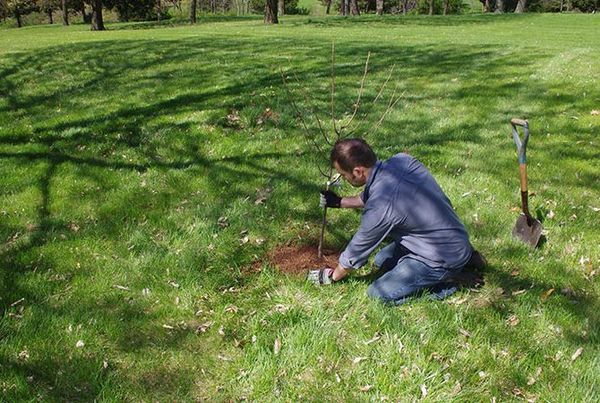
In the spring, the grown seedlings are transplanted into open ground using a special raised bed. A year later, the seedlings can be transplanted to their permanent location.
Another method for propagating by cuttings is to cut a green shoot at the base, insert it into a water-filled champagne bottle (be careful not to let the leaves fall into the water!), and seal the neck with wax or garden pitch. Bury the bottle so that the rim of the neck is 20 cm below ground level, and cut off the shoot, leaving three buds above ground level. Cover it with plastic wrap or half a plastic bottle. Periodically, air out and water the seedling (over time, it will begin to root in the open ground around the bottle). After 2-3 years, the plant can be transplanted to its permanent location.
Further care
If the seedlings were grown correctly, they will grow rapidly after transplantation, so they will need abundant watering and mineral fertilizing.
It's recommended to plant green manure (such as lupine) around the tree trunks. These will loosen the soil, and after mowing, their rotting roots will enrich the soil with nutrients.
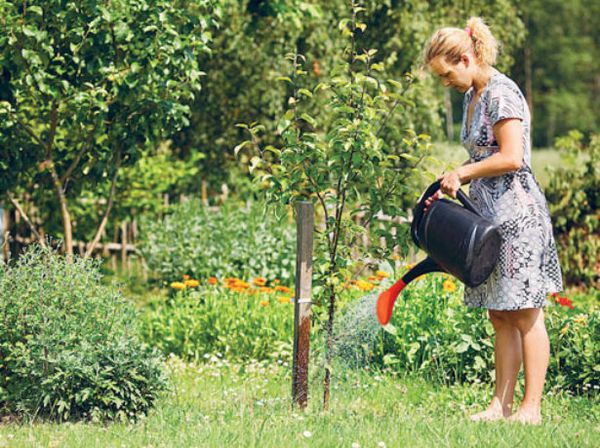
When watering pear trees, especially in the first few years, it's best to sprinkle them using a special garden sprinkler or a garden hose. If this isn't possible, water should be poured into 15-cm-deep grooves around the tree's trunk. After watering, these grooves are buried.
For the winter, the roots of young trees need to be insulated: cover the area around the trunk with sawdust, spruce branches, or simply sprinkle with snow. It is recommended to insulate the trunks with newspaper or straw. Sunflower leaves can also be used.
Video "Reproduction of fruit trees"
In this video, an expert will talk about how to propagate fruit trees.