
How to plant and grow a juicy Favoritka pear
Content
Description of the variety
The Favoritka owes its outstanding flavor to the Lesnaya Krasavitsa pear, which served as the basis for its selection. Trees of this variety are not exactly compact. They are tall or medium-sized, reaching 5–6 meters (depending on the rootstock).
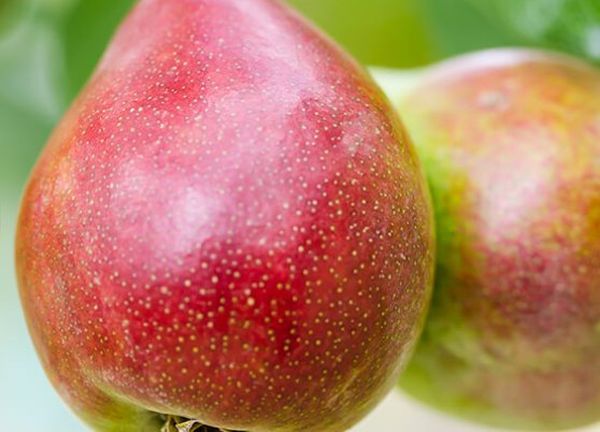
The robust trunk is adorned with a sparse, pyramidal crown, which is rounded when young and becomes more spreading as the tree ages. Large branches extend from the trunk at right angles, lending volume and a somewhat casual appearance to the crown. The bark is smooth, grayish-brown. The leaf blades are oval, slightly tapering at the base, and hairless.
The pear tree blooms profusely with large, double flowers, clustered in clusters of 6-7. The fruit ripens by mid-August, but it's best to pick them a week earlier, as ripe pears quickly fall off. Ripe pears don't have a long shelf life—no more than 15 days—but they retain their excellent marketable appearance and are suitable for transportation during this time.
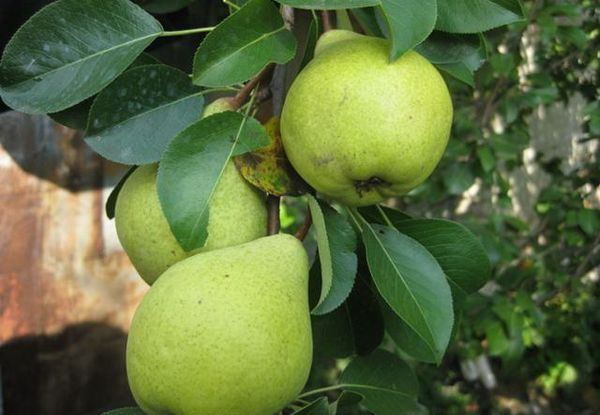
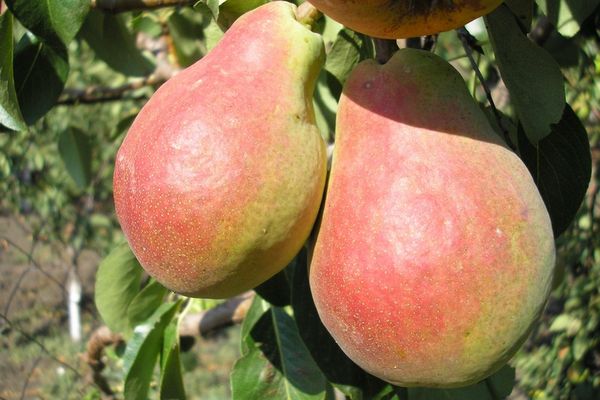
The main advantage for which the Favoritka pear is valued is the external appearance of the fruit and its excellent taste. Pears of this variety are large (up to 200 g), with very thin and smooth light yellow skin. On the sunny side, they may develop a bright carmine or washed-out pink blush (depending on the amount of sun). The skin surface is marked by numerous small dark spots, which is normal for this variety. The flesh is white or creamy, delicate in texture, and has a refreshing, sweet-tart flavor.
Favoritka trees are highly adaptable. They tolerate summer drought and severe frosts well, making them suitable for cultivation in various regions of the country. Resistance to scab is low, but proper agricultural practices (pruning, fungicide treatments) reduce the risk of infection. Furthermore, the variety is self-sterile. Suitable pollinators include Williams, Bere Giffard, or Lesnaya Krasavitsa.
Landing rules
Favoritka isn't picky about soil composition. The key is to keep the soil free of clay, saline, and waterlogged soil. It's also worth noting that its productivity increases in fertile, well-drained soil. This can be achieved by adding organic matter and mineral fertilizers before planting.
Regardless of whether trees are planted in spring or autumn, planting holes should be prepared in advance – 2–3 weeks.
If planting in the spring, preparation should begin in the fall. Standard hole dimensions for this variety are 1–1.2 m deep and 0.8 m in diameter. It's advisable to place a drainage layer at the bottom, followed by a layer of compost or humus (3–4 kg) mixed with soil.
For best survival, it's best to choose healthy seedlings that are at least two years old. When filling the seedling with soil, ensure the roots are freely positioned in the hole and the root collar is 3-4 cm above the surface. After planting, water the trees thoroughly (2-3 buckets of water per plant).
Care Features
Comprehensive care for the Favoritka pear includes the following processes:
- Watering - in the year of planting, the tree needs to be watered frequently, preventing the soil from drying out; thereafter, 3 times a year - so that the water penetrates to the entire depth of the root system;
- It is enough to apply fertilizers twice per season: at the beginning of the growing season (nitrogen complex) and after harvesting; in September-October (potassium, phosphorus);
- regular loosening or mulching of the tree trunk area;
- Crown pruning – formative in autumn, sanitary in spring.
Before fruiting, pear trees are very sensitive to cold and can freeze, so the area around the trunk should be covered with mulch and the tree itself should be covered with snow. Mature trees can survive the winter without cover.
Advantages and disadvantages
When evaluating the Favoritka summer pear variety, I would first like to note its strengths:
- excellent taste and attractive appearance of fruits;
- possibility of transportation, despite the short shelf life;
- resistance to any climatic and weather conditions;
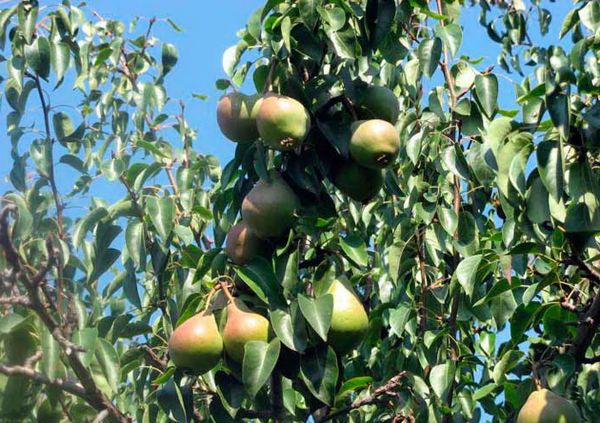
- good yield (up to 40 kg per tree).
Among the variety's shortcomings, gardeners note the late fruiting of trees (7-9 years of age), self-sterility, and low immunity to scab. One would also hope that such beautiful fruits could be stored longer.
Video: "Pear Tree Care"
In this video you will hear useful tips on how to care for a pear tree.